Wednesday, February 28, 2007
Natonality, the machinic and the spectacle. posted by lenin
Kasemir Malevich was by his own account the first "president of space". He said this in Summer 1917, before he became a 'Suprematist'. This statement isn't to do with outer space (that came later), nor is it a statement of egomaniacal insanity (not exclusively, at any rate). The topic of space obsessed Malevich, since what the world has been busily doing to space since the late nineteenth century was revolutionary, a profound and inconceivable break: what we can matter-of-factly refer to as technology was shattering traditional perceptual frameworks and inspiring frenzy. Whether it was the Lusitania or the Zeppelin or the first flight of an airplane, crowds in the six figures would be drawn to witness the spectacle - a spectacle commonly reported as leaving people spellbound with pleasure and excitement. When the Zeppelin was spotted flying over German workplaces, people would rush out to watch, and leave their bosses pleading with them to return. The sheer scale of these innovations and their gravity-defying activities were overwhelming traditional visual habits. I mean, to even see a thing like a ship properly, in its entirety, you would have to walk some considerable distance away from it. This revolutionising of the senses held not only for passive observers, but also for pilots who couldn't help but enthuse about the airborne way of seeing the world.
And, of course, the pilot had a different way of experiencing war - not a messy, bloody, earth-bound affair, but something noble and iconographic. Malevich dealt with all of these themes in 'Aviator' (above, click to enlarge), a 1914 painting in which the dimensions are literally shattered, proportions deliberately sent askew. The 'ace' in the aviator's hand refers to the 'flying ace', a title accrued by a pilot fighter who has shot down five or more enemy air craft. The change produced admiration and dread, a theme reflected in the advertising, in which the great ships would alternate between being "floating palaces" (which they certainly were for the pampered press corps) and "monsters", "colossuses".
Not only that - they were looming beings of great and obvious power, but also immensely fragile. Their triumphs and failures were romanticised (a cruise would literally be described as "a romance"), they were technological "miracles" but also mythopoeic monsters capable of tragic downfall as much as heroic mastery. Their creators were deified: it is said that Graf Zeppelin was more popular than the Kaiser ever was, despite the fact that his invention was a patent failure.
Indeed, it was precisely when it failed that it generated the most urgent support with donations flooding in from ordinary Germans who wished to see it succeed. Other exercises, such as the RMS Lusitania and the RMS Mauretania were conscious efforts at international military competition, especially at doing down the German chap. Indeed, if the change of scale and power produced apprehensions about the control of the technology, one way to overcome this was to embed it in a spurious 'community', an imagined community in fact - technology of such scale as, say, the Zeppelin, was not something that one could have a merely invidual relationship with. It 'belonged' to the community precisely through the media spectacle - remember, the spectacle is a social relation mediated through images. All sorts of political and social meanings could be overlaid to the happenings of these 'titans' by news editors (peculiarly emphasised was the fact that the Zeppelin did not emerge from Prussia, which is where the Kaiser was from, but from the far south-west). Further, it could be defined against other nations, as part of a great race for mastery of the skies.
The extraordinary invention of cinema left people "vibrating with emotions", their mood altered as if - so it was said - by the magician's hand, as if by sorcery in fact. As if the technology alone was insufficient to explain the powerful charm that cinema exerted. Such was the reputed power of the cinema that one headline in the British press read: "Talkie Cure for Deafness". It told the story of a 73-year old woman whose lifelong deafness came to an abrupt end while watching the sound film Singing Fool. On the one hand it was credited with "lifelike fidelity", its mimetic properties celebrated, so that the cinema acquired a more compelling reality than a cold and windy street mere yards away. On the other, it was feared and resented for creating stupefaction, for being a deception, a trick of persistence-of-vision that played on the physiological limits of human perception, for overwhelming viewers, for imposing impressions that preceded cool assessment, and for threatening to unleash latent irrationalism by bringing to life fragments of the unconscious. The cinema was not unique in producing suggestions of supernatural or miraculous power, as we've seen. Indeed, if its effects didn't seem to be obviously deducible from the technology involved, so the construction of the great ships seemed mysterious: shipyards were packed with a tangle of beams and scaffolding, a maze of girders, and soon there emerged something extraordinarily, well, "lifelike".
The advertisers caught on to the power of the spectacle: knowing full well that few took the rhetoric about 'modern wonders' strictly at face value, they used the spectacle's forms to gain the attention, capture the imagination and override rational detachment and scepticism. The political multivalency of the technology worked to their favour, and there was no need to point to any great narrative. In fact, the mark of the spectacle was its valorisation of moronic sensation, its championing of the facile sense of amazement and wonder. In the tradition of PT Barnum, bafflement was the whole point, and a tremendous source of revenue. And, of course, it was precisely where the cinema and the other new technologies interfaced, when the great ships like the Titanic were themselves represented in the powerful idiom of celluloid, that the spectacle reached its most lauded heights, with each technology imparting the other with impact. E A Dupont's 1929 film 'Atlantic' was recognised as a technological masterpiece in itself at the same time as it represented a technological masterpiece. The sense of an unprecedented innovative period in human history, with its obvious political and social connotations, had long since been reduced to its barest component of awe (the better that it could be commodified).I think I heard a sharp intake of breathe when some of you read the word "machinic" in the title. Relax. I only wanted to mention that the very notion of the "machinic" is not strictly to do with technology. It was partially generated by Deleuze and Guattari from Bergson's critical encounter with turn-of-the-century science and its inability - as he saw it - to escape from determinism and a linear view of causation. Crudely, how is genuine innovation possible if all present possibilities are already contained within the past? How is it possible to have a radical rupture? The "machinic" is an attempt to solve this problem. I don't feel like trying to explain in detail how that is, but this explains it very clearly, and it's written by a proper philosopher. I raise it, tentatively, because these heterogenous elements - inter-imperialist rivalry, the development of new transit and military technologies, the development of a mass culture, the development of photography, the socialist challenge - was a highly efficient cultural machine, and arguably produced a novel nationalist idiom. The community is no longer imagined through the printed word and a presumed uniformity of experience. Nationhood is achieved through the spectacle, through the compelling image of 'modern wonders', whose political polyvalency both assures the widespread acceptance of technology as thoroughly imbricated with progress even after World War I and perpetuates the notion of a national community in which all endeavours are to the same end, all part of a Promethean struggle for the triumph of the human spirit. It is arguably much more powerful and persuasive than appeals to eccentric notions of Heimat or Albion.
The strappado and the serum. posted by lenin
The Enlightened absolutists of Europe abolished torture in the 18th Century: Leopold, Frederick II, Gustavus III, Louis XVI, Joseph II. Regimes founded on dynastic, patrimonial power, but influenced by Enlightenment ideas about how to run a state, outlawed their tool kits and sometimes even got rid of the death penalty while they were at it. America's unEnlightened polyarchy has legalised torture, long a clandestine practise of its intelligence agencies, is enamoured of the death penalty and mass incarceration, and has even revived that medieval tool of pain, the strappado, (what Israelis call a 'Palestinian hanging').Systematically, they are now said to be driving hundreds, perhaps thousands of prisoners insane with the use of chemicals, sensory deprivation and sensory overload. Is it news? After all, the US has systematically tortured its prisoners for some time now. Well, let's say this is more systematic, and is being promulgated by new doctrines embodied in the 'war on terror'. What does the Padilla case reveal, or what can it reveal? Naomi Klein reports that it is now going to come to court:
Arrested in May 2002 at Chicago’s O’Hare airport, Padilla, a Brooklyn-born former gang member, was classified as an “enemy combatant” and taken to a navy prison in Charleston, South Carolina. He was kept in a cell 9ft by 7ft, with no natural light, no clock and no calendar. Whenever Padilla left the cell, he was shackled and suited in heavy goggles and headphones. Padilla was kept under these conditions for 1,307 days. He was forbidden contact with anyone but his interrogators, who punctured the extreme sensory deprivation with sensory overload, blasting him with harsh lights and pounding sounds. Padilla also says he was injected with a “truth serum,” a substance his lawyers believe was LSD or PCP.
According to his lawyers and two mental health specialists who examined him, Padilla has been so shattered that he lacks the ability to assist in his own defence. He is convinced that his lawyers are “part of a continuing interrogation program” and sees his captors as protectors. In order to prove that “the extended torture visited upon Mr Padilla has left him damaged,” his lawyers want to tell the court what happened during those years in the navy brig. The prosecution strenuously objects, maintaining that “Padilla is competent” and that his treatment is irrelevant.
The US district judge Marcia Cooke disagrees. “It’s not like Mr Padilla was living in a box. He was at a place. Things happened to him at that place.” The judge has ordered several prison employees to testify on Padilla’s mental state at the hearings, which began yesterday. They will be asked how a man who is alleged to have engaged in elaborate anti-government plots now acts, in the words of brig staff, “like a piece of furniture.”
Stephen Soldz produces a reply to the Stein article from a psychologist working in the field of drugs and addiction, indicating that the lawyers are barking up the wrong tree entirely: "It would sort of be like a NUCLEAR WEAPON hitting a city and saying, we know it must be an enormous amount of DYNAMITE that they used." Truth serums of the old fashioned kind (LSD, for instance) are "child's play" where the government is concerned, and they have all sorts of hormones that they can play with, which are much more effective. Soldz also notes that since much of the case in the upcoming trial will depend on Padilla's mental state, the government has found itself an authentic catch 22: "Rodolfo Buigas, the psychologist of the Federal Detention Center in downtown Miami, testified 'that the affidavit Mr. Padilla signed alleging mistreatment at the brig was evidence of his mental competence.'"
Well, torture is a global industry, a source of surplus extraction as well as the extraction of confessions. Disciplining bodies for capital, it is also a phenomenal source of profit in itself. America is one of the biggest exporters, as one would expect: it may not personally use the thumb-screw, but it does like its electro-shock belts to keep prisoners from getting out of line, and it does invest a huge amount in the various ways of inflicting psychological and physical pain. And, the British government has a stake in the trade, which is why it prevented a serious fraud office investigation into British Aerospace, whose products include tools for the efficient obliteration of human beings, or their rapid capitulation under massive pain. The government also has its own history of torture, which was routinely used against Irish internees. It would be amazing if they don't use it today, although there is the possibility of outsourcing, which is what the illegal torture flights and the legal international removal pacts are about. An interesting case of this is Abu Qatada who has now been deported. It is easy to be impressed by the fact that Qatada is someone with a profoundly unpleasant ideology, but that misses the point: he doesn't deserve to be tortured for it, and now that the precedent has been established, the case will be used to deport others to situations where they can be tortured without disturbing our sanctimonious, pristine culture of 'human rights'.
Monday, February 26, 2007
Genocide, Bosnia and the ICTY posted by lenin
After all that, this. According to the Associated Press report, the International Court of Justice finds that no one in Serbia, or any official organ of the state, could be shown to have had the deliberate intention to "destroy in whole or in part" the Bosnian Muslim population. "The judges found that Serbia, although it supported the Bosnian Serbs, fell short of having effective control over the Bosnian army and the paramilitary units that carried out the massacre". Further, "Unusual for such an important case, most judges were in accord, voting overwhelmingly on the various points of the decision."This assessment results from a case put by the Bosnian government, and it conclusively debunks the legal case that the massacres carried out by the Bosnian Serb army were part of a campaign of genocide. There is no question that the Bosnian Serb army committed atrocities, as did the Bosnian Croat army and the Bosnian Muslim army; further, Serbian and Croatian forces carried out the most killings and atrocities, reflecting their relative strength in the civil war that they were fighting (a civil war that need not have happened, had the United States government not encouraged its client Alia Izetbegovic to withdraw from an already negotiated settlement). However, there is no basis for the claim that the Serbian government ordered, encouraged or participated in a genocide against Bosnian Muslims. Why does this matter? Well, truth matters. It does matter if the repeated claims of an expansionist Serbian state recreating fascism, genocide and concentration camps on European soil were a pack of lies. It does matter if Western states and media organisations retailed a fairy tale, with Izetbegovic given a size-nine halo, Tudman largely acquitted (until he conveniently snuffed it) and Milosevic equipped with horns and trident. It does matter if those apologists for Western state aggression, Glucksmann, Ignatieff, Hitchens et al, regurgitated propaganda with the ludicrous result that when Yugoslavia was bombed Western liberals were actually able to derive some libidinal satisfaction from it, guilt-free. It does matter if our language is degraded so that the word genocide can be promiscuously bruited by those who, by their own implicit definitions, could find themselves charged with genocide practically every week.
It also sheds some light on the procedures of another court. As Ed Herman has correctly pointed out:
Milosevic was not indicted along with Mladic and Karadzic in 1995 for the ethnic cleansing in Bosnia in prior years, so the belated attempt in The Hague in 2002 to make him responsible for those killings suggests that UN war crimes tribunal chief prosecutor, Carla Del Ponte did this because she saw that the killings in Kosovo fell far short of anything she could pass off as "genocide".
The ICTY, which is to be distinguished from both the ICC and the International Court of Justice, has been pursuing a process of indictments of senior state and army personnel, including most notoriously the trial of Milosevic. It has refused to take up the issue of war crimes committed by the United States in Yugoslavia, because it owes its existence to the United States. It was and remains an auxiliary of American power, and this verdict lends some weight to Herman's suggestion.
You may say, reasonably, that the ICTY's own verdicts and conclusions also make the point well enough. You may fairly add that the ICJ doesn't challenge the ICTY's definition of the Srebrenica massacre as 'genocide' - indeed, affirms it - but merely says that this was the responsibility of the Bosnian Serb army under General Krstic, who himself is presumed to have been acting under orders from Ratko Mladic. That is true, and strange: the massacre of thousands of men of military age is an atrocity, but under no reasonable definition is it genocide. Although if we were to expand the definition of genocide in that fashion, we would end up including several recent massacres by the United States government in the category of genocide: in fact, the massacre at Mazar i-Sharif would also be genocide. The sole purpose of using the word here is to instrumentalise its normative force, to affirm the basic narrative, and to avoid the reality that a civil war driven by competing nationalist states pursuit of influence in the post-federal polity, and manipulated by imperialist states, killed 100,000 people in Bosnia, with the dead including 55,261 civilians, of which 38,000 were Muslims and Croats, and 16,700 Serbs. As Ed Herman has written elsewhere, the narrative of a Srebrenica genocide has been politically useful in various ways: first, it obscured the process of massacres and ethnic cleansing being carried out by Croat forces at the time, when Croatia was being supported by Western powers; second, it provided an excellent cover story for the 1995 bombing of Serb positions and subsequent carve-up, with its disastrous consequences; third, it has provided a compelling excuse for prolonged intervention into the former Yugoslavia long after the massacre, with the West's political and military control effectively persisting in both Bosnia and Kosovo to this day. They are, you are supposed to gather, holding back the next genocide.
Because there was not genocide, but massacres on all sides, as it were, because none of the state leaderships was angelic, does not mean we should be satisfied with the repellent explanation offered by some that nationalist/tribal hatreds dunnit. That culturalist explanation is every bit as facile as Hitchens' understanding of the conflict, which was that it was between those who loved cosmopolitanism and religious freedom, and those who supported segregation and religious intolerance and so on. The story initially is one of state failure, of ruthless IMF-driven neoliberalism that produces wave after wave of political crisis and struggle, of savage cutbacks and extraordinary levels of unemployment, and of recrudescent nationalism among the intelligentsia that is increasingly instrumentalised by the various states in the federal republic. Secondly, it is one of conflict over the power that each state would have in the future. For Croatia and Slovenia, the two richest states, the promise of Europe was alluring compared to remaining in a failing state with massive problems of production and cohesion. On the other hand, they weren't too solicitous with constitutional law on matters of secession, and Croatia in particular had begun to repress its Serb minority in ways that gave them ample reason to worry about their illegal secession (part of the illegality of Croatia's secession was that it ignored the wishes of the Serb minority, in violation of constitutional law). Izetbegovic began planning for a war as early as February 1991, and had formed paramilitaries and started to seek assistance from Muslim supporters several months before declaring independence and long before the founding of the Republic of the Serbian People of Bosnia and Herzegovina.
Thirdly, the story is one of imperialist intervention. Western powers saw the crisis and attempted to turn the situation to their advantage. Germany was swift to recognise Croatia an Slovenia when they decided to break away. The United States and the EU recognised Bosnia and Herzogovina as an independent state in 1992, despite the fact that only 39% of voters had registered support for secession, and despite the obvious opposition of Bosnian Serbs. This last resulted in Bosnian Serbs declaring their own independent republic, thus prompting Izetbegovic's declaration of war. The Yugoslav national army intervened in a half-hearted, brief effort to prevent Slovenian secession, but made a more successful and sustained bid to capture large areas of Croatia, including those areas with dense Serb populations. Croatia, for its part, sought not only to recapture lost territory but to annexe a sizeable portion of Bosnia too. In 1995, Croatia launched an ethnic cleansing drive in Krajina called Operation Storm, driving out not only the Serb forces but the pesky Serb population whose complaints of suffering oppression at the hands of a Nazi sympathiser and his army had caused some problems. Two months previously, Bosnian Serb forces committed the notorious massacre at Srebrenica. Several smaller massacres were also being carried out by Serb, Croat and Muslim forces, as is well-known and partially attested to by the mortality figures. And the US, amid a flurry of self-righteous propaganda, launched bombing raids on Serbian positions until it achieved acquiescence and cemented partition on terms amenable to itself, with a Western-imposed polity ruling in Bosnia, pro-Western regimes in Croatia and Slovenia, and the FRY substantially reduced in size. With the glorious intervention into Kosovo, whose noble impress includes ethnic cleansing, child sex slavery, corrupt occupation and immiseration, a second military base in the Balkans was established, using the KLA as a political foil. In 2000, David Benjamin, a member of the US National Security Council under Clinton, took Bush to task over his early criticisms of "nation-building" in Kosovo:
Mr Bush showed a misunderstanding of a major strategic achievement of the Clinton administration ... In particular [he] missed the intrinsic connections between enlargement and the conflict in the Balkans ... NATO enlargement advanced US interests in dealing with one of the country's foremost strategic challenges: coping with a post-communist Russia whose trajectory remains in question. (Quoted in Vassilis K. Fouskas, Zones of Conflict: US Foreign Policy in the Balkans and the Greater Middle East, Pluto Press, 2003, p 49).
NATO enlargement, hedging in post-communist Russia, advancing US strategic interests. For such prizes, they helped bring devastation to Yugoslavia. For such rewards, they spent years promoting a heavily politicised 'tribunal' to produce a background noise of "genocide" on European soil. And it is to preserve the utility of this tactic that anyone, like Chomsky or Herman, who happens to take truth seriously, is ritually denounced for "downplaying" atrocities, or even supporting genocide.
Terrorism, Glorification Thereof. posted by lenin
So, anyway, while some people have been entertaining themselves with the fantasy that British imperialism supports the Kurds, there was an interesting episode involving the publication of Abdullah Ocalan's book Prison Writings: The Roots of Civilisation, which has been well-received by a number of academics. Now, it so happens that the PKK have been feeling the heat of British laws long before evildoers interrupted Bush's pedagogy, but last week something rather interesting happened. The Peace in Kurdistan campaign had been due to host a meeting to launch Ocalan's book, which is a history of the Near East from anciency until the present, written during the years he has spent in prison since being kidnapped by Turkish intelligence in February 1999, approximately a month before Turkish planes were bombing Yugoslavia. The launch of the book was to take place in the House of Commons, however, there had been repeated indications in the Turkish press that Ankara wanted the book suppressed, and it transpired that the Foreign Office had the organisers kicked out - on the grounds that debating the book amounted to "glorification of terrorism". In a way, the organisers were fortunate that this was all that happened, since in Turkey two people have been sentenced to prison terms this week for "glorifying" Abdullah Ocalan.Now, the British state has used its 'anti-terror' laws, in which the PKK is listed as a proscribed organisation, to clamp down on supporters of the Kurds in the past, and to block Kurdish television. Its foreign policy disposition is to support Turkish state crimes with arms, diplomacy and domestic targeting of Kurdish supporters. That happens to be a logical part of the European collective security system set up under US tutelage, in which the Turkish paramilitaries who took part in butchering and torturing the Kurds in their tens of thousands were an integral part of NATO's secret stay-behind armies. The Foreign Office's move raises the spectre of the law being used against this book - since if to debate it is to glorify terrorism, what is the position when it comes to placing the book on prominent shop shelves? Or reading it on the train? The hammering irony is that this has taken place one week after David Lammy launched Labour Friends of Turkey with the aim of assisting Turkey's accession to the EU. The Turkish government appears to have plenty of friends. The British ambassador to Turkey insists that to refuse Turkey admission would be a "gift to the terrorists", while only today the EC has apparently decided that Ocalan cannot be re-tried. At the same time, a wave of arrests of PKK supporters and activists has been conducted across Europe recently, coordinated by the United States and Turkey with the assistance of EU states, because the EU considers the PKK a terrorist organisation.
You can read the press release from Peace in Kurdistan at the bottom of this post. One other thing - if I urge you to purchase the book in question and conduct an open public reading in the no-protest zone, does that make me a glorifier of terrorism? Merely checking.
Who are the real criminals? posted by ejh
This thought was probably prompted rather more by the appalling standards of driving in my part of the world - and perhaps the recent letter-bomb campaign - than any immediate political events.But wherever it came from, it occurred to me that the apologists for Israel, and in particular those who take the line "why do you always pick on Israel when there's worse régimes in the world", are rather like those drivers who having driven at excessive speed, dangerously close to other vehicles, endangering the lives of everybody on the road, are finally flagged down by the police.
At which point, rather than accept the fact of their reckless behaviour and the consequences it entails, they wind down the window as the officer approaches and say:
"Shouldn't you be out catching real criminals?"
The Redirection posted by bat020
The latest Seymour Hersh piece in the New Yorker covers the "redirection" of US foreign policy towards cultivating the Saudi dictatorship against Iran - and details US plans to bomb Iran at 24 hours notice. There's also a wealth of detail about what the US is up to in Lebanon and Syria, plus an interview with Hassan Nasrallah. As ever, it's a must read.Sunday, February 25, 2007
Guess who supports terrorism? posted by lenin
About a quarter of all Americans:Those who think that Muslim countries and pro-terrorist attitudes go hand-in-hand might be shocked by new polling research: Americans are more approving of terrorist attacks against civilians than any major Muslim country except for Nigeria.
The survey, conducted in December 2006 by the University of Maryland's prestigious Program on International Public Attitudes, shows that only 46 percent of Americans think that "bombing and other attacks intentionally aimed at civilians" are "never justified," while 24 percent believe these attacks are "often or sometimes justified."
Contrast those numbers with 2006 polling results from the world's most-populous Muslim countries - Indonesia, Pakistan, Bangladesh, and Nigeria. Terror Free Tomorrow, the organization I lead, found that 74 percent of respondents in Indonesia agreed that terrorist attacks are "never justified"; in Pakistan, that figure was 86 percent; in Bangladesh, 81 percent.
Saturday, February 24, 2007
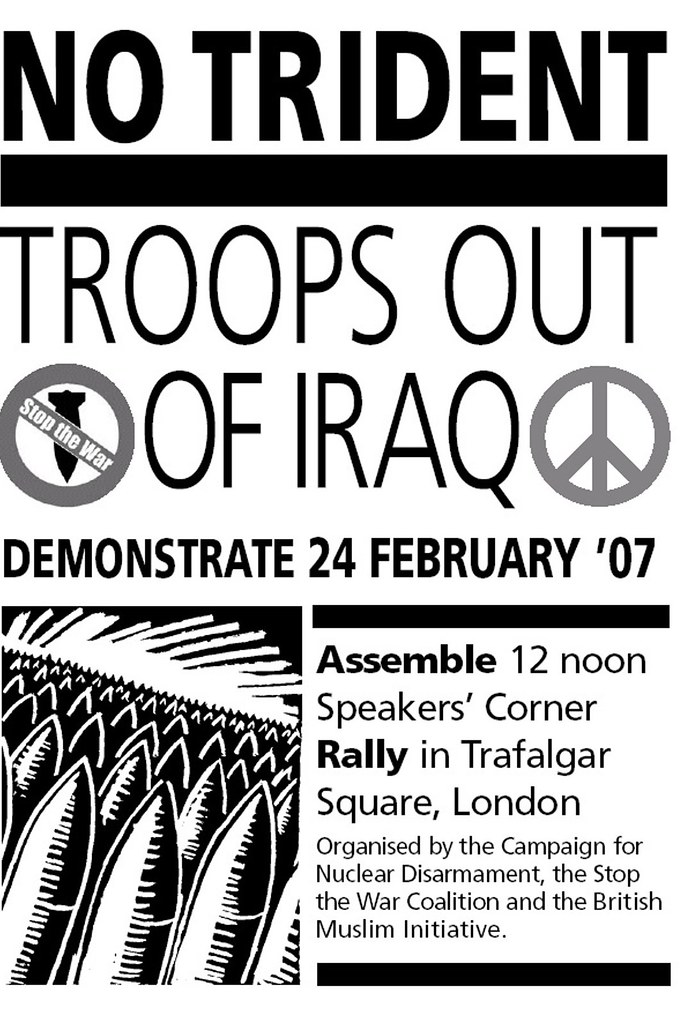
Troops Out, No Trident: report from London demonstration. posted by lenin
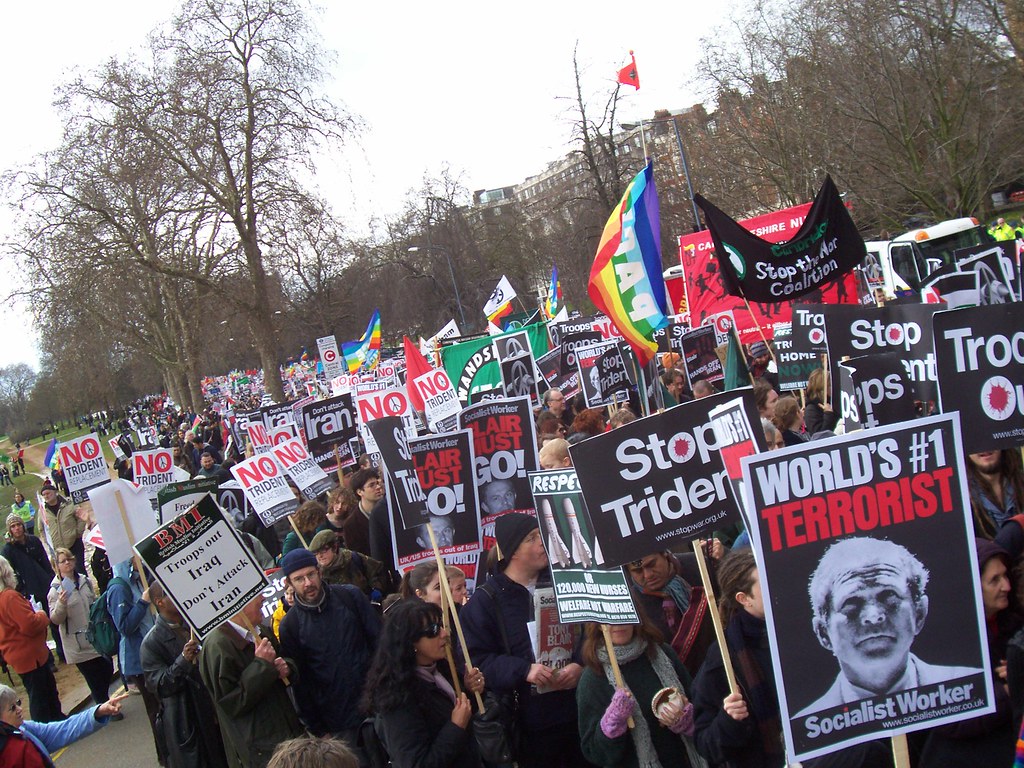
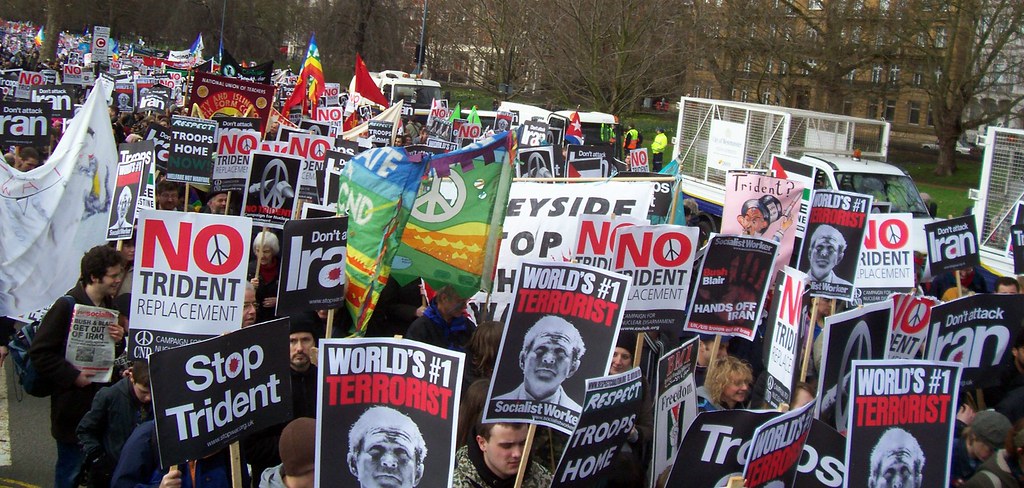
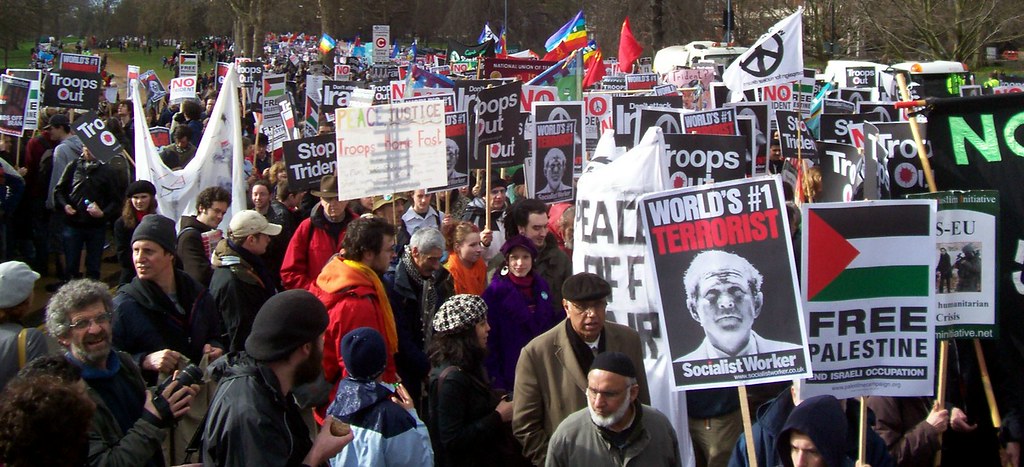
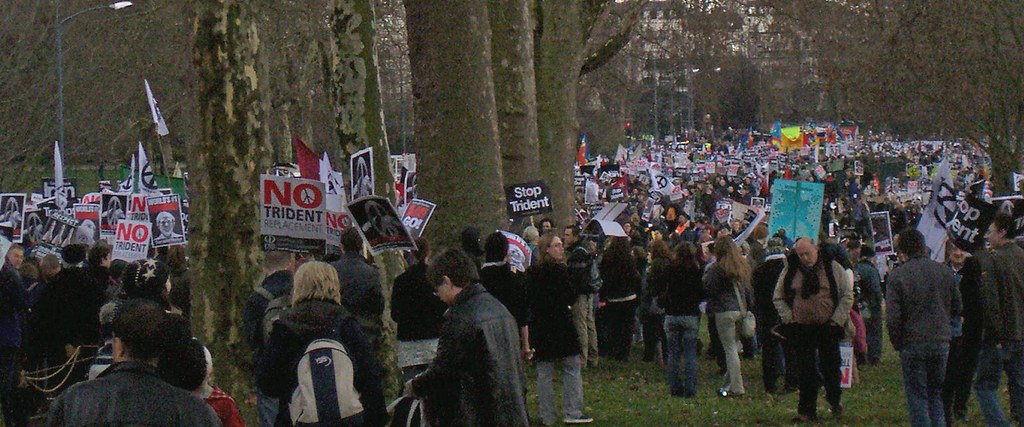
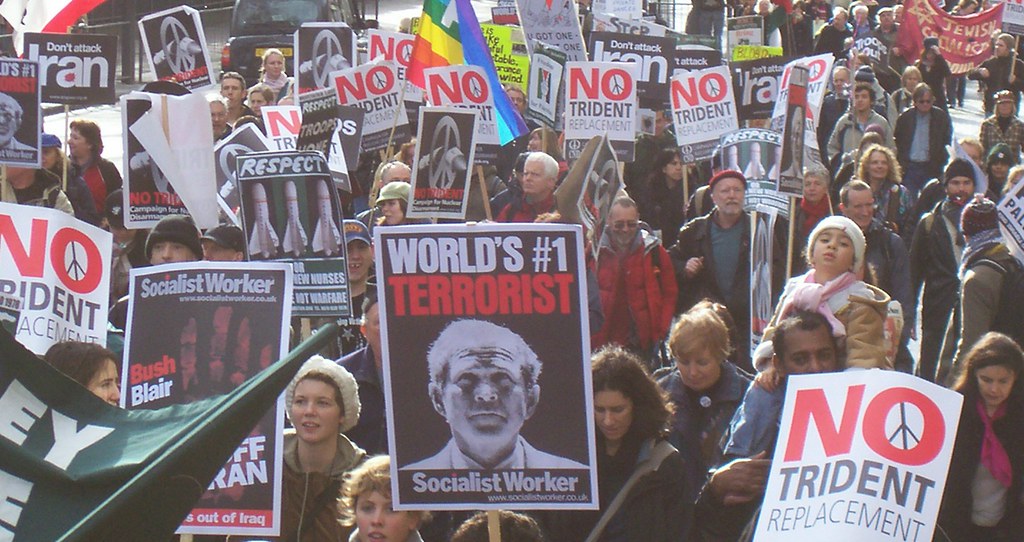
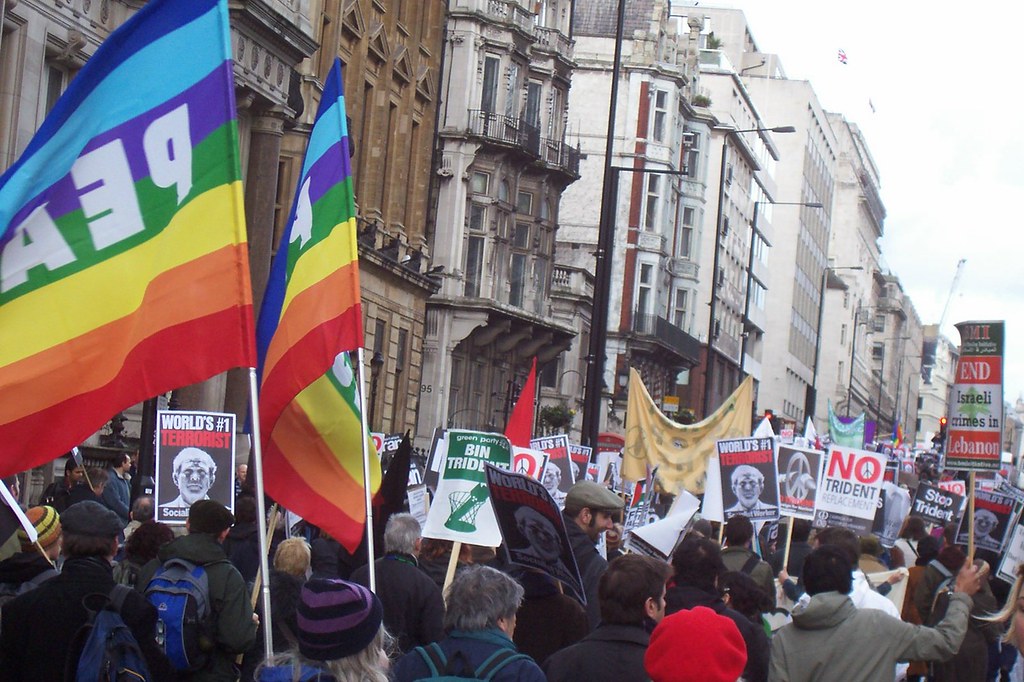
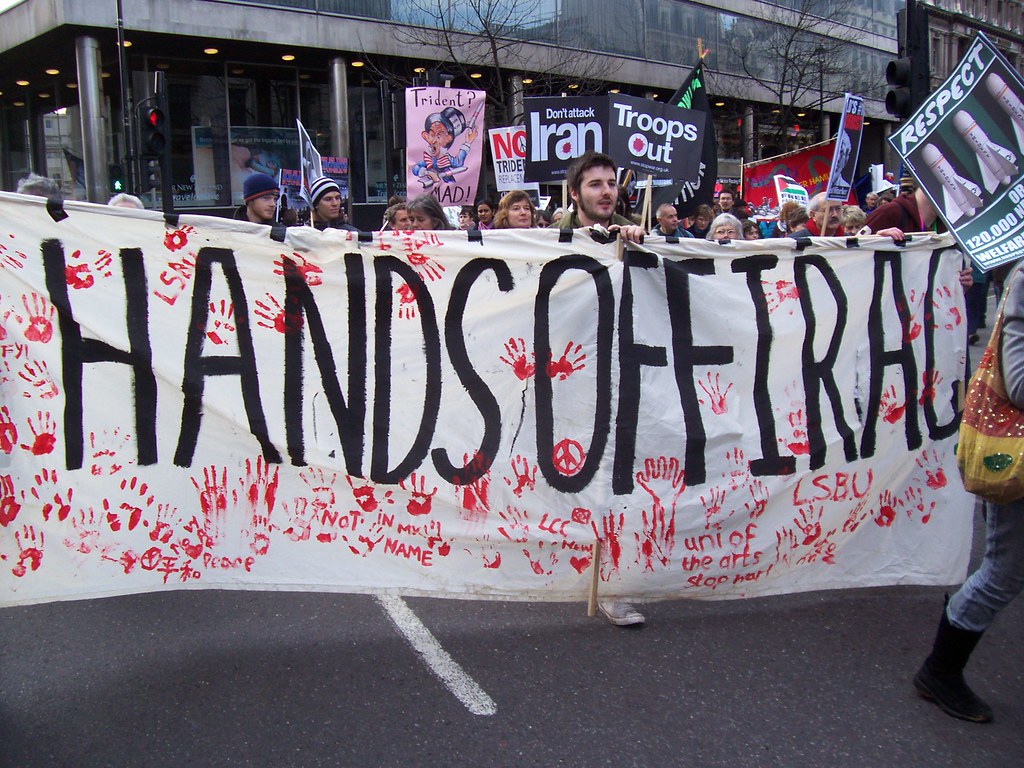
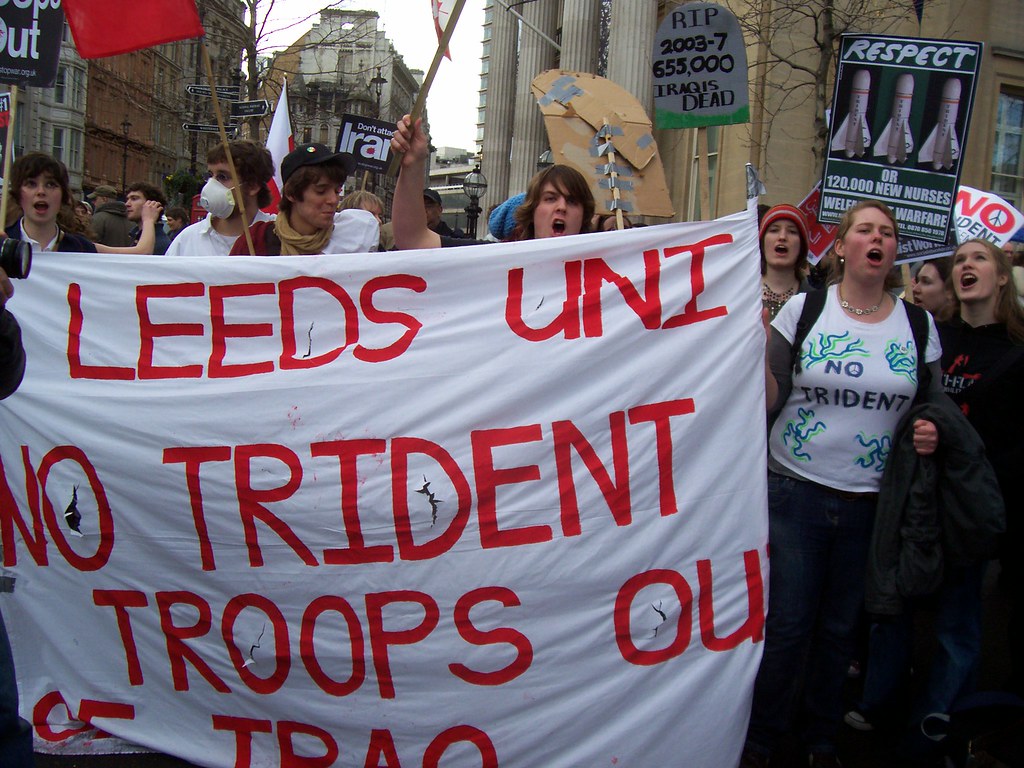
Ya hala Tomb-readers. I'm updating this report as fast as I can upload material. First indications is that was about 100,000-strong, which is probably one of the larger anti-nuclear demonstrations that we've had in recent years. I didn't hear any figures for the Glasgow demo, but I'm told it was enormous: unsurprisingly, since Scotland is where the British ruling class likes to keep its nukes. It goes without saaying that most of the media are blacking out the demo, and the BBC gives it only a few inches in a local section (misquoting the figures too). Bizarrely, they actually devote more space to the demonstration in Glasgow which they say was much smaller. It's quite interesting: clearly, the story of the boy who gave David Cameron the one-gun salute being arrested for possessing cannabis is much more important, as is the startling revelation that Hazel Blears wants to be the deputy Prime Minister. Here are some pictures of the demo as it began. My footage has been uploaded to Youtube, but they are taking their time approving some of it, so I will post as it becomes available.
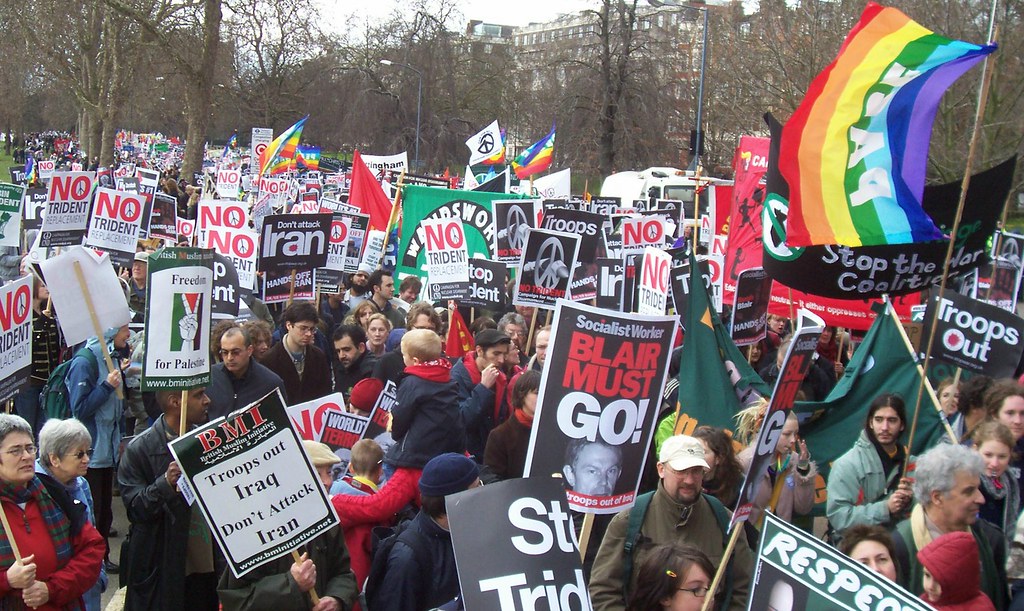
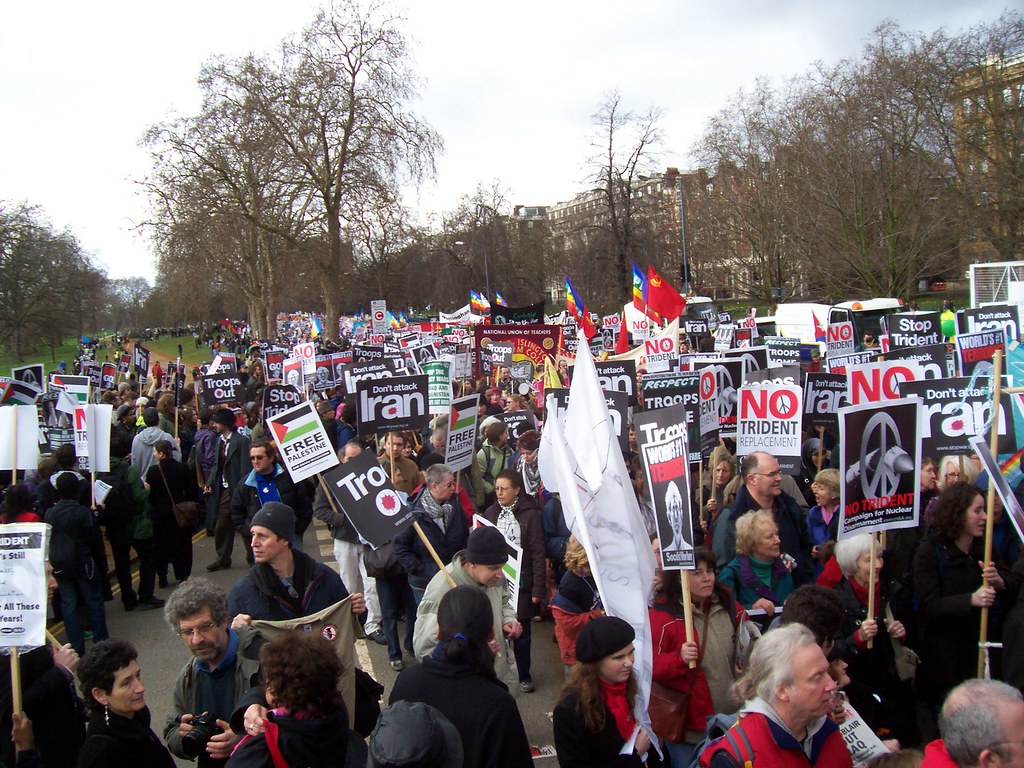
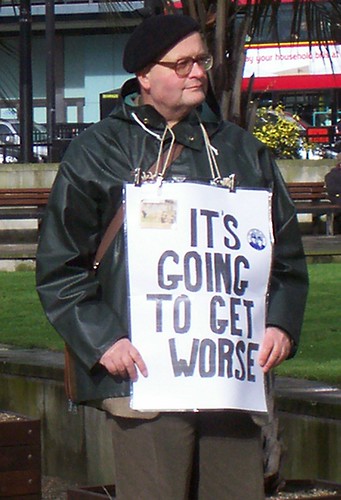
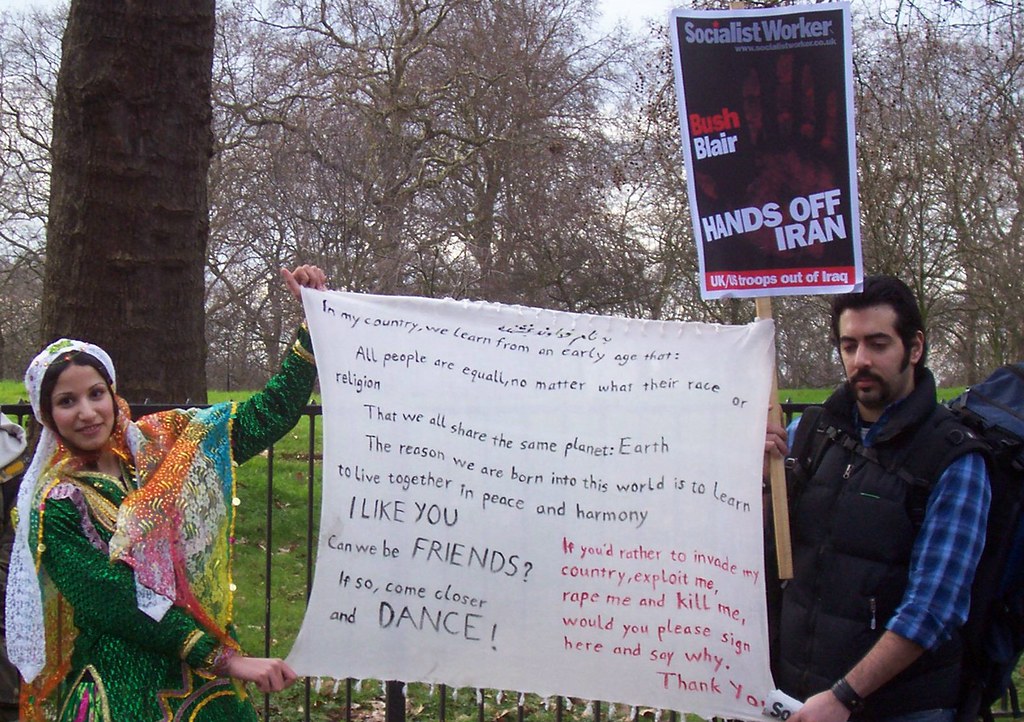
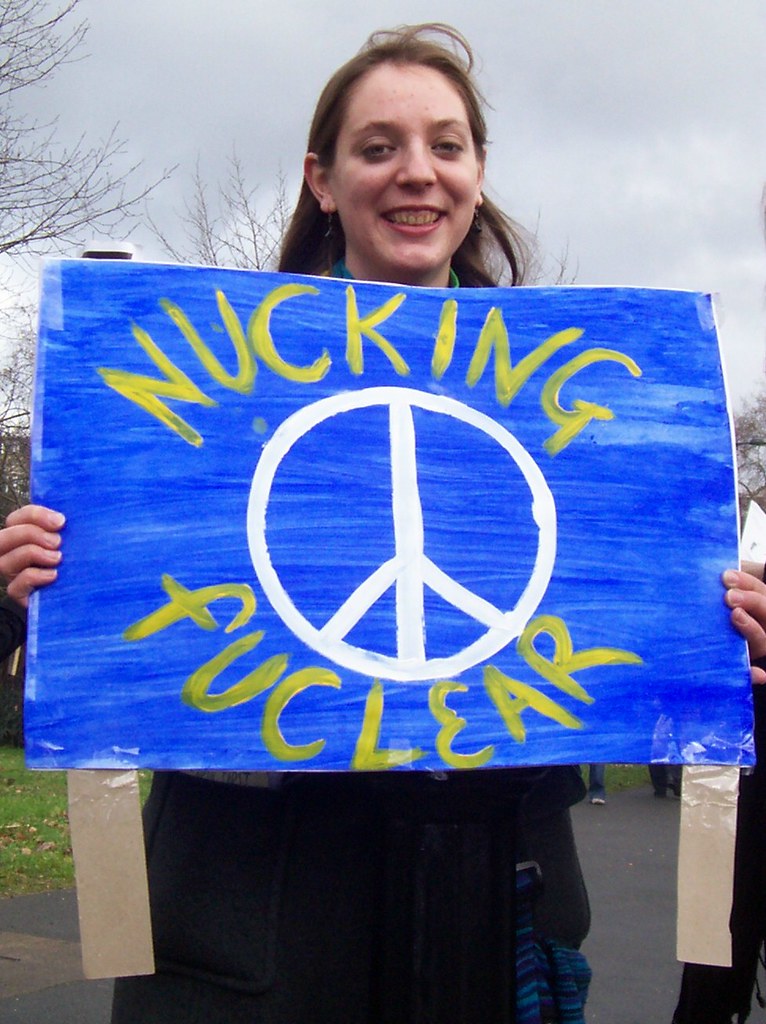
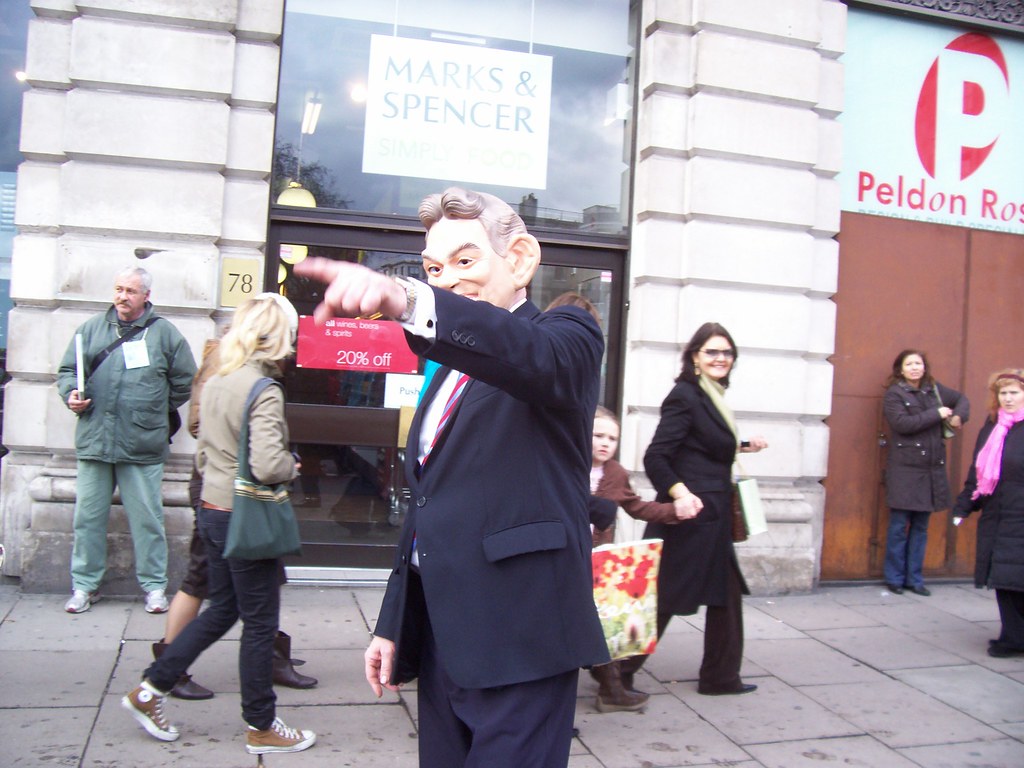
It's not easy capturing the crowd scenes with my camera, but it's a bit more difficult when certain people, who shall remain nameless because I don't know their names, insist on drawing attention to themselves. Like this purveyor of apocalyptic gloom. Then there was the man at the far back of the demonstration who kept shouting "Anti-Blair whistles! Only a pound!" How the fuck can you have an anti-Blair whistle? He then went on to chant, while rattling his blowholes: "Troops out, Blair out, Don't attack Iraq". Not Iran, Iraq. Which seems to miss the point that we already did attack Iraq. Then there was this call for international solidarity and equality from a pair of Iranian demonstrators. And a Spoonerist. Actually, for some reason, I quite like 'nucking fuclear', perhaps because it's an anagram for 'fucking unclear'. There was also a very young child with a t-shirt that read: "Unfuck the World". It looked like one of those produced by Globalise Resistance. Finally, there was a man in a mask.
Well, hear we are proceeding up Picadilly:
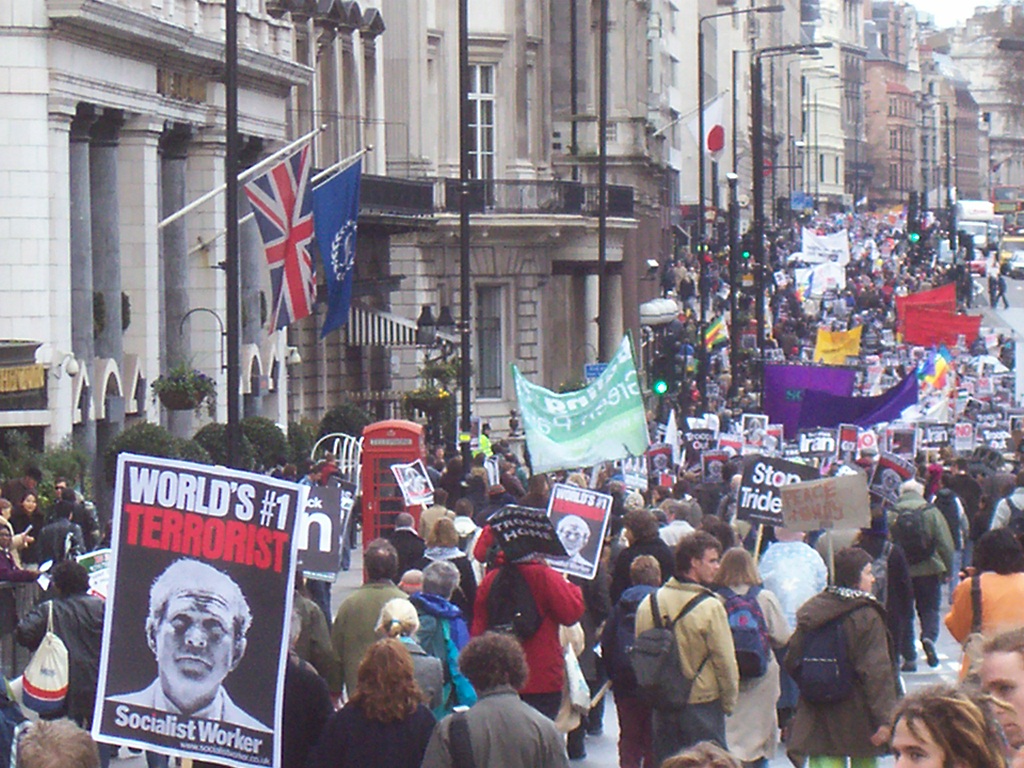
Here are some CND people. I have quite a lot of time for them, but they do have this alarming penchant for breaking into song at a moment's notice. A speaker from the Aldermaston Womens' Group approached the mic and immediately gave us a few bars of 'Five Minutes to Midnight'. What we really need, as I think someone said long ago, are more men of violence:
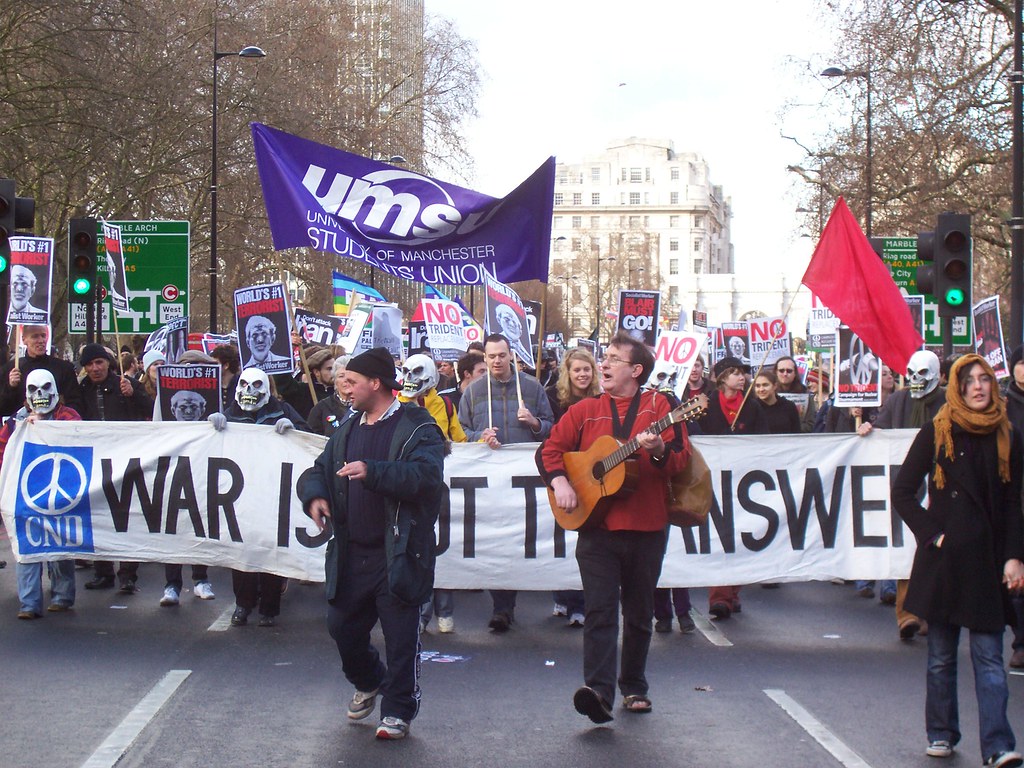
Some more for you:
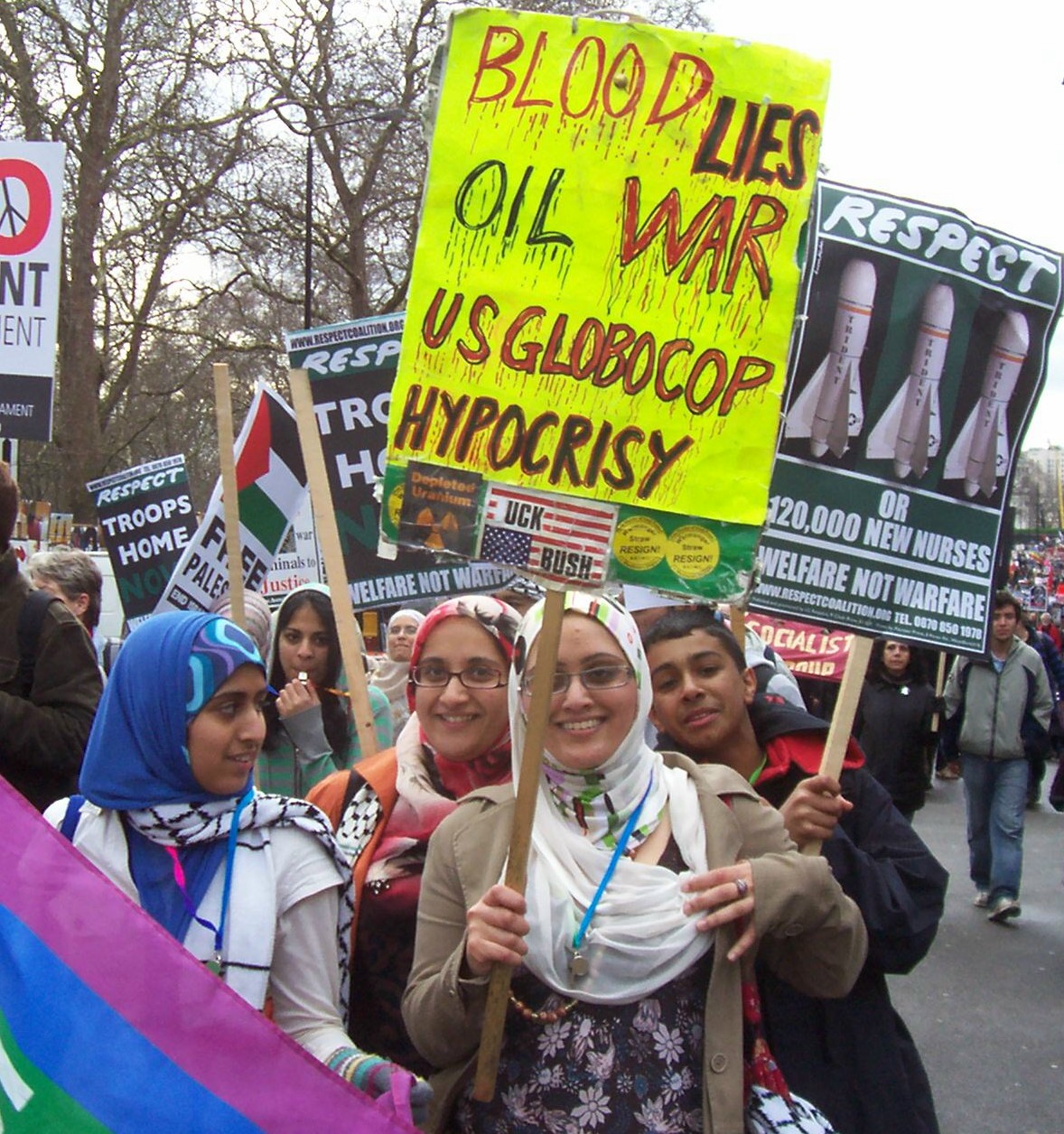
I recorded many of the speeches, which were brilliant. I regret that I did not capture any of Galloway's, although it was a vintage performance. He got a particularly rousing close by saying that if there was an attack on Iran, there wouldn't be protests in the streets of London: there'd be riots! People exploded into applause. Lindsey German, some of whose speech I did record, got a brilliant reception when she called for strikes and protests and occupations in the event of an attack on Iran. That's the way to do it. I missed Craig Murray's speech, so I hope one of the professionals filmed that. Livingstone's speech was actually quite good, and he a got a decent cheer for his recent deal with Chavez, and Augusto Montiel of the Venezulan National Assembly was warmly welcome when he arrived at the mic in his red shirt and said: "A BIG. WARM. EMBRACE. TO LONDON!! FROM HUGO CHAVEZ! FROM VENEZUELA! FROM ALL OF LATIN AMERICA!". The speeches are still being approved by Youtube, but in the meantime, you can see some of the demo footage here, here, and here. These next guys were a lot of fun. When this part of the demo fell a bit behind, the guy on the loudspeaker announced in a mock-melodramatic cry that "we are being isolated in this demonstration in exactly the same way that Palestinians are being isolated in the world!"
Socialist Worker's report is here. Good report and pictures from the Glasgow demo by the Prophet of Rage. David Simonetti has Mark Thomas and George Galloway, and some good photos here
Update: Well, as Youtube are still bungling my video uploads, I've uploaded a few to Google Video. Here's a tour of the demo as it was lining up from near the back to near the front:
Here's Livingstone's speech:
Here's Lindsey German:
Here's Augusto Montiel:
Atomic hypocrisy. posted by lenin
This story comes from Con Coughlin, so it must automatically be read cautiously. Nevertheless, I think it's interesting that Israel is trying to prepare the world for this possibility. Also interesting is the kind of relationship with the verities that Coughlin and most of his fellow reporters have. Coughlin, without the slightest bat of an eyelid, says:As Iran continues to defy UN demands to stop producing material which could be used to build a nuclear bomb, Israel's military establishment is moving on to a war footing, with preparations now well under way for the Jewish state to launch air strikes against Teheran if diplomatic efforts fail to resolve the crisis.
The pace of military planning in Israel has accelerated markedly since the start of this year after Mossad, the Israeli intelligence service, provided a stark intelligence assessment that Iran, given the current rate of progress being made on its uranium enrichment programme, could have enough fissile material for a nuclear warhead by 2009.
It's simply taken for granted that the UN's role is to provide the US and its allies and subordinates with the means to discipline its rivals. If the fact that these "demands" are raised through the UN mattered, there are so many obviously related topics that one could mention, one of which is to ask what attitude members of the UN - even the power elite in the UNSC - would take to an attack on Iran by Israel. Others are too obvious to mention. Further, there is no question for Coughlin and people like him that nuclear Israel is entitled to bomb neighbouring states because Mossad says that they might be have enough fissile material to produce a bomb by 2009, or they are "producing material which could be used to build a nuclear bomb". No one with an ounce of sense would take Mossad's claims, however "stark", seriously. However, Coughlin attributes the latter claim to the UN, and as it happens the UN has not made this assertion. It is simple enough to know what the UN says, because its specialised atomic energy body, the IAEA has had inspectors crawling over Iran and is in a position to make quite specific indications about the state of Iran's energy programme. The first point is that the IAEA has repeatedly stressed that the material that Iran currently produces, after many failures, is not currently producing material that could be used to produce a nuclear weapon. They are producing uranium enriched to 3.6% U-235, which as the IAEA has pointed out, is not exactly weapons-grade. Even if they began to enrich it further, they would need cascades of 3,000 centrifuges working day and night to even get sufficient materials ready. They presently have 164. There have been efforts to persuade the UN to say something different. US intelligence agencies have fed reports to the United Nations, but these have been swiftly discounted as groundless. The head of the IAEA has repeatedly indicated that there is no "imminent threat".
There happens to be an easy way to "resolve the crisis". The Iranian president happens to be have hit upon an entirely rational solution: those powers threatening Iran must also suspend their nuclear programmes. Applying the same standards to the United Kingdom as apply to Iran would yield an interesting policy option: we could cease the Prime Minister's decision to renew Trident, a vast nuclear weapons system with a current range of 4,600 miles. These are to be attached to submarines which obviously means that we would have a mobile nuclear capacity, capable of threatening practically anywhere in the world.
Something that is often missed about this is that the weapons are leased from the US: the UK purchases access to, but does not own, a pool of nuclear missiles produced by the American defense company Lockheed Martin. This has been the position since the 1958 Mutual Defense Agreement, and every aspect of UK nuclear weapons production is coordinated within that subordinate relationship. The UK has cooperation programmes with all main US nuclear research laboratories, and its model of nuclear deterrence is based on NATO membership, whose targetting strategy is based on US deterrence doctrine. The UK purchases many of the components for its weapons system 'off the shelf' from the United States, because it does not have the capacity to produce them itself. In accordance with this 'special relationship' strategy, the UK has carefully avoided stipulating a 'no first use' policy. Indeed, the UK government's entire purpose in pursuing nuclear weapons is to possess a credible threat that it can deliver a first strike, as the Defense Select Committee Inquiry reveals. This would involve "the launch of one or a limited number of missiles against an adversary as a means of conveying a political message, warning or demonstration of resolve". This conception contains the outrageous assumption that Britain is entitled to engage in a nuclear attack on another country not even in supposed self-defense, but as a warning shot to anyone who gets out of line.
The decision to renew reflects the current US posture of undermining the Treaty-based system of arms control, since it is in direct violation of the NPT of which the UK is a signatory. The British government has drastically limited the amount of information released by the Ministry of Defense since the election of New Labour in 1997, so there is much that we can't know. However, even a cursory study of openly declared US doctrine (and the American political system is much more open than the UK's in terms of information) tells you that the current nuclear posture of the US (and therefore of its subordinates) is to remove the strict barrier between nuclear weapons and conventional weapons. The US wishes to be able to visit various limited kinds of nuclear destruction on other states, with greater flexibility. It so happens that this is precisely what the Trident upgrade allows.
The decision to pursue an upgraded and more flexible nuclear arsenal when it is manifestly the case that there is not a serious countervailing nuclear pressure (as there arguably was during the Cold War) is an epic act of aggression, but one taken for granted by the intrepid reporters who tell us about the threat from Iran. If it isn't designed to force other states to try to pursue nuclear weapons, it certainly has that dimension. The current policy of the American capitalist class and its spear-carriers is normalising the prospect of a nuclear conflagration, and therefore raising the threat of the destruction of those populations that they consider superfluous. In fact, it raises the threat of full planetary destruction to a level that anyone with an atom of sense would be unwilling to tolerate. And that is one reason why the British government places such a premium on secrecy and lies, and why they develop such excellent relationships with columnists like Nick Cohen and reporters like Con Coughlin. I will see you at the demonstration in about half an hour.
Friday, February 23, 2007
Nick Cohen is being driven to Toryism by the Livingstone-Chavez axis. posted by lenin
The liberal who lost his way and joined the circus is outraged that Livingstone has cut a deal for cheap oil with Hugo Chavez, and may vote Tory if Livingstone doesn't stand down and make way for a neoconservative Labour candidate. Why? Oh, because Denis MacShane of the Henry Jackson Society says so. Because Chavez is accused of suppressing press freedom by his opponents (who control most of the media and routinely denounce Chavez, often in racialised terms). Because he cuts deals with autocrats and flatters them (hardly the only state leader to do that). Because Chavez has asked for and received powers of decree (not the first Venezuelan leader to receive those) and remove term limits (which means he could go on to win more elections). Because - aha! - Chavez once tried to mount a coup, so he probably wants to be dicator. Because Livingstone has previously "embraced" the "misogynist, homophobic, racist and dictatorial leaders of the Islamist far Right". (Much might be said against Yusuf al-Qaradawi, but I am unaware that he has dictatorial powers.)Aside from the usual irrationality and hysteria, I note a particularly common gesture here: Cohen is shifting to the right, which is a logical result of his position on Iraq (and earlier on Kosovo), but he insists against all evidence that it's our fault. The Left is forcing him to the right, much against his will, and if he ends up having to bury the shades of his past, we are to blame. Some cheek that man has on him.
"On supporting the Iraqi Resistance" posted by lenin
In which the Heathlander takes a well aimed shot at the convenient myths surrounding the Iraqi resistance.Herrenvolk posted by lenin
Here's an interesting comparison:Prof Dugard said although Israel and apartheid South Africa were different regimes, "Israel's laws and practices in the OPT [occupied Palestinian territories] certainly resemble aspects of apartheid." His comments are in an advance version of a report on the UN Human Rights Council's website ahead of its session next month.
After describing the situation for Palestinians in the West Bank, with closed zones, demolitions and preference given to settlers on roads, with building rights and by the army, he said: "Can it seriously be denied that the purpose of such action is to establish and maintain domination by one racial group (Jews) over another racial group (Palestinians) and systematically oppressing them? Israel denies that this is its intention or purpose. But such an intention or purpose may be inferred from the actions described in this report."
Father figure. posted by lenin

"The deprivation of stimuli induces regression by depriving the subject's mind of contact with an outer world and thus forcing it in upon itself. At the same time, the calculated provision of stimuli during interrogation tends to make the regressed subject view the interrogator as a father-figure."
Thursday, February 22, 2007
Harmless Childhood Fun posted by lenin
Chabert suggests in the comments box to the post below that the Muslim figures are redolent of Warner Brothers cartoons and American mas art, among other things. If anyone has seen Spike Lee's Bamboozled, you know it finishes with a montage of film and cartoon depictions of black people as inept, comical, and fundamentally as bestial. All of it giftwrapped in a posture of innocence, light-heartedness, wholesome comedy, childish fun etc.Here are a couple of clips:
I also found some material from Disney, Warner Brothers and various advertisers. These are highly sophisticated racist caricatures, in which the cartoonists demonstrate an easy familiarity with the ways in which racism can be used for physical humour. If you simply itemise what the caricaturists choose to amplify and exaggerate for comic effect, there is a remarkable consistency in all of it: the snaggled, protrusive, outsized teeth; snarling mouths; evil or mad eyes; dripping tongues; bulbous or hooked noses; exaggerated lips etc. In the case of Arabs, one might add unkempt bushes or stubbles, which contains an implication about hygeine, and the scimitar whose connotations are obvious. The movement and posture, moreover, is either baffled or predatory, but never dignified or human. I put some of this together into a video:
The Running of the Muslim. posted by lenin

Islamophobia Watch brings news of the climax to a recent carnival in Germany:
Some two million people took to the streets of Germany's Rhine region for the climax of the carnival season Monday but Muslim representatives were angered by floats featuring bearded men in turbans and explosives belts.
IW links to this Deutsche Welle article describing what happened:
The carnival floats in parades through the region's cities traditionally take an irreverent look at world events, but the Central Council of Muslims in Germany condemned one float in Düsseldorf which featured fiberglass models of two bearded men wearing turbans and explosives belts and brandishing guns.
The word "Cliche" was printed on one of the men, while the other bore the word "Reality."
"Irreverent". Oh yes, clearly le mot juste. Here is another "irreverent" depiction. Actually, let's get the pedigree right - here are some "irreverent" depictions:


New Orleans posted by lenin
Wednesday, February 21, 2007
Prodi forced out over Afghanistan. posted by lenin
Well, well... Prodi has resigned. After the ridiculous display made last year by the Italian communists in supporting troops to Afghanistan, the Rifondazione Comunista has inflicted a defeat on Prodi's government, that is the government that they decided to collude in. (I told them not to participate in the government but, for reasons he has yet to satisfactorily explain, Fausto Bertinotti doesn't read my blog).The defeat has been inflicted over both an expanded US base in Italy and the continuation of troops in Afghanistan. The expansion of the base was an agreement made between Bush and the departed Berlusconi. Not only the communists, but also the Greens and much of the Democratic Left that supports Prodi have been outraged by the attempt to persist with this policy. Prodi has repeatedly used confidence votes to get his way in the past, and this time it has flown back in his face.
There was a huge rally against the base last Saturday, and all the Berlusconi media were printing claims that some protesters were planning a terrorist attack against opposition leader Silvio himself. It's very strange: Berlusconi has compared himself to Christ in the past, and is clearly nailing himself to the cross for this, but why do so many people take him seriously? Now, because Prodi insisted on following Berlusconi's policy at the risk of collapsing the government, there is the prospect of fresh elections. The left coalition won by a tight margin last time, so there is a serious risk that in such an election Berlusconi would be re-elected. The war and the base are genuinely unpopular policies, and the campaigns are likely to have mobilised the left in a way that the timid rhetoric of last year's election could not, and it is hard to see how Berlusconi can capitalise on dissatisfaction with a policy that he supports. Berlusconi boasts that the polls give him and his coalition an eight to fifteen per cent lead. But these are the unreliable and self-serving polls conducted by Forza Italia that Berlusconi's newspapers print.
Nevertheless, Prodi has adopted the right-wing economic agenda of the Berlusconi coalition, merely avoiding the corrupt frills. He has even spoken of introducing "shock therapy" into the economy, invoking the disastrous neoliberal experiments in post-Stalinist Russia or Eastern Europe. Now, if that's the agenda, then why do Italians need an idiot like Prodi to do it? The whole point was that his government was supposed to be different. It is hard to see how it has been so: and that could cost his coalition dearly.
A letter to Comment is Free. posted by lenin
So anyway, Georgina (hello, by the way), I was talking things over with the vassalage the other day and someone said to me, they said, "But lenin, why has The Guardian never offered you a Comment is Free column? After all, you're at least as notorious as David T and a damn sight more fuckable than Oliver Kamm." Instantly impressed by the logic of this, I inquired further. "Well, lenin - if that is your real name - the way I see it, the purpose of Comment is Free is to stimulate a sort of artificial background noise of ferocious debate and democratic participation and discussion. In this way, they attract audiences for advertisers and give them a sense of ersatz involvement. Now, you've got a penchant for irritating liberals, and we all know that you're practically handcuffed to your personal computer. LT and CiF would be no mere marriage of convenience. It was meant to be."Well naturally, Georgina, I had this upstart shot. Nevertheless, it's food for thought, no? Do not, please, evacuate your bowels immediately, but look! Look at all the no-name wonders you've got in that catacomb of commentary! Look - Brian Bivati? Who the fuck is that? Andrew Anthony? The fucking food critic? What's his excuse? "I know a fish finger when I see one, and that's why the Islamofascists must not be allowed to destroy Western civilisation"? Get real, Georgina, this is the twenty-first century. What you really need is someone called lenin on your site. (Why the small l, you ask? I'm an anti-capitalist, of course.) I'll cut you a deal: I'll supply The Guardian with free labour if you turn off Nick Cohen's booze drip and give me one minute in the dark with the bastard who designed the 'Berliner'. Who the fuck thought of that? Ich bin ein fuhrious, Georgina.
Oh, sure, G, I know I'm not famous like Oliver Tickell and Byron Taylor. I know that I shall never have the pulling power of Open Thread, whoever he is. However, I know you'll agree with me when I say, 'shut it and do exactly as I say'. I attach a copy of my first dangerously edgy and contrarian article about why the Left is wrong about the environment, the war on Iraq, nuclear weapons, Israel, Islam, trade unions and so on, for special reasons that I disclose only glancingly in a tantalising finisher, which reads: "It would be refreshing if the Left would get its act together and be realistic. Saddam Hussein clearly does have weapons of mass destruction - otherwise why is he hiding them? He clearly is linked with Al Qaeda - unless you prefer to believe bin Laden's story that they are only distant enemies. The war isn't about oil - but it should be, because only by extracting the rich, gooey contents of the earth and sending it all up in dispersed clouds into the atmosphere can we reduce heating costs for impoverished pensioners in Burnley. Not that I would expect the left to care about impoverished pensioners in Burnley unless they all suddenly became Islamofascists and deciced to blow themselves up while queuing at the Post Office. And speaking of the white working class, why doesn't the left support free speech for Nazis? I had Nick Griffin orate from my back garden yesterday, and do you know why? Free speech, you totalitarian bastards!" That should ruffle the cat among the pigeon's feathers.
I await your enthusiastic reply, G. Safe.
Tuesday, February 20, 2007
Blair to pull out troops. posted by lenin
All previous reports of withdrawals of UK troops from Iraq have been surreptitious leaks. This one is to be official. 1,500 troops returning within weeks. That leaves 5,500 in Basra.Well, it's a start, and I'm certain it isn't because the situation has suddenly taken a calm turn. What has actually happened is that the British have been unable or unwilling to force control over southern Iraq, or to try and do so with the ruthless measures used by the Bush administration, and have been forced to hand over control to Iraqis in province after province. The Bush administration do not and perhaps cannot do things that way, for obvious reasons. This is the beginning of the end, a partial victory, and we must absolutely pile on the pressure this Saturday to hammer it home: Troops Out.
The Financial Times has more info, and says that in fact the initial withdrawal is 1,600, but that still reduces it to 5,500 because there are 7,100 troops presently in the British occupied territories. The FT comments that:
For Mr Blair, in his final months as prime minister, Wednesday’s announcement is highly symbolic. After being dogged by the debacle in Iraq for nearly four years, today’s statement allows him to leave office conveying the impression – albeit a limited one – that the UK intervention has had some success.
If that's his thinking, he's in for a shock. Absolutely no one believes there has been a success of any kind or qualification. Blair is said to be ready to insist that Washington is not opposed to his move, but this comes as the US ruling class is increasingly divided over the escalation policy.
Since the Prime Minister is already going to be saying that the British occupation of southern Iraq has been a tremendous success, and this is why they can hand control of Basra over to Iraqi security, I think I should mention the firefight between British soldiers and local resistance fighters in Basra today. Of course, our superior management of the natives has resulted in southern, largely Shiite, Iraqis turning to support the resistance in overwhelming numbers, first in the Maysan province, then across the board. This particular PM isn't above claiming that Harry can take the place of all the withdrawn soldiers, mind you.
Defend Council Housing posted by lenin
Today, a new report for the government will make recommendations about the future of council housing. From reports this morning, it looks as if the report will be a serious blow to the campaign to Defend Council Housing. I didn't catch the details, but in a BBC interview this morning, DHC campaigner Carol Swords was bitterly angry about it, explaining: "Twenty years ago, I was desperate, I needed a home and I got one. What about the person who's desperate tomorrow?" The Mirror's report is unequivocal: 3 million council tenants face boot. They suggest that Ruth Kelly is about to get rid of the right to remain in one's council house for life. I don't know if this is true or not, but it is certainly the case that the government is eager to push privatisation and market housing. It has long been their policy to abolish council housing, and it is expected that Ruth Kelly will raise the spectre of means-testing, so that what they hope is a diminished stock of council housing is reserved for the very poor. It is strange - on the one hand, Kelly's supporters and defenders insist that council housing is a ghetto-ised system, and people need to be freed from it. On the other, the government seems intent on making it more ghetto-ised. Meanwhile, those who aren't sufficiently poor will have to rent or buy on the market, and that'll cost you. It will cost the Treasury too, since they are obliged to subsidise homes for key workers in order that they can subsist. They are also looking at ways to remove rent controls and introduce other market measures into the council housing system.And no wonder the charity Shelter is worried about housing security: as most experts in the field will tell you, the primary causes of homelessness are a nexus of low wages, benefit shortfalls and the unleashed housing market (indeed, if memory doesn't completely fail me, I believe that precisely such a case was put in a book by two Shelter workers in the mid-1990s). Introducing further insecurity, privatisation and higher rents is bound to exacerate the problem. While the number of rough sleepers has according to official statistics diminished sharply in the last ten years, the number of households recognised as homeless has increased to well over 100,000, and it is estimated that there are 380,000 'hidden' homeless households in the UK at any one time. See Crisis for statistics. Naturally, this is the sort of homelessness that goes through the roof during an economic downturn, when the bastards start reposessing in the hundreds of thousands. It is the pool of people at the bottom of this 'housing ladder' who are most vulnerable that the government wants to expand.
To coincide with today's report, DHC has produced a booklet [PDF], which makes the case for expanded council housing. The report notes that several select committees and the Audit Commission have examined the government's policy of stock transfer and found it bad value for money. It notes that although the government is transferring billions of pounds received from rent to what it claims is 'historic debt', there several billions unaccounted for. What is more, the government is pushing up council rents to match those of the 'social landlord' sector, and introducing separate service charges, all to make transfer more attractive. Not only does this have a devastating effect on tenants on low income, it actually costs the Treasury through increased housing benefits payouts. So, while making off with billions, the government is also going out of its way to subsidise a policy that is costly to millions of council house tenants. And they have the nerve to do so in the name of efficiency: they say that to fund council housing by direct investment would cost £12 billion, adding that this would result in higher interest rates and inflation - and, Ruth Kelly says, raising the spectre of 1979, "get back to the days when we were playing with the stability of the economy". This is a government that wants to spend an additional £70 billion in defense. The Public Accounts Select Committee has already pointed out that stock transfers are more expensive than direct investment, while there have been no official costings to back up this £12 billion figure. Further, if they insist on raising rents, the least they could do is ring-fence the increased income from them for reinvestment in council housing, but they refuse to do so. With matchless venality, this government has bribed, bullied and blackmailed to force through this neoliberal agenda. They have refused to grant repairs and improvements to those tenants who didn't want their homes transferred to Arms Length Management Organisations. They have victimised council workers who oppose their policies. They have been caught engaged in smear tactics against their opponents, deliberate misinformation campaigns where they know they are losing public support.
It's important to bear in mind that in most cases where ballots have been held on stock transfers and privatisation, the public have overwhelmingly opposed it. Labour conferences have opposed it, and the trade unions are opposed to it. 260 MPs have signed an early day motion supporting the DHC campaign and its demands. The government is being defeated left, right and centre, and they're desperate to push ahead with this policy at the expense of local democracy and in the face of all opposition. The only people loudly supporting the government's policy are the Tories and their despicable Shadow Housing Minister, Michael Gove. (Yes, the neoconservative Times columnist). The policy that DHC advocates, which has the backing of MPs, councillors, tenants and trade unionists, is called the 'Fourth Option', and it is staggeringly simple. The government should provide direct investment to fund council housing for the rising number of people who cannot afford to get on the housing ladder and for those who find it impossible to get on it. This could be paid for by ring-fencing all receipts from council housing rent for reinvestment, writing off debt and funding any gap between the resources available to carry out necessary improvements, and those necessary to do so. If the government is prepared to write-off debts on the few occasions when people opt for privatisation or 'social landlords', they should be prepared to do so when tenants prefer public provision. If they want to charge more rent, it should go back into the tenants housing. There shouldn't be any other purpose to charging rent for public housing except improvement and necessary upkeep: it is ours, after all, we own it and all the rents that are paid. This option for funding doesn't even involve significant public expenditure as Ruth Kelly claims, but it would have the effect of allowing for an expansion of socially affordable housing and therefore help reduce rents in the private sector. Who stands to lose from rolling back the tide of this absurd housing market apart from landlords and investors? Why shouldn't there be an expansion of decent, affordable housing with rent tightly controlled and receipts ring-fenced for investment? Why shouldn't there be secure housing universally available?
Anyway, if you don't fancy seeing your wallet grow thinner while the rich grow fatter, I suggest you e-mail your MP and ask if they are supporting Early Day Motion 136. If not, why not? Is your elected public servant really going to let the government get away with transferring more public assets and cash to the rich? There is also a public meeting in the House of Commons tonight.
Monday, February 19, 2007
US Plans to Attack Iran Revealed. posted by lenin
It has been an open secret for some time. Intelligence officials, political figures and anonymous spokespeople have briefed and disclosed left, right and centre already. We have the power to strike soon, they have said, and it looks as if we will. The BBC "has learned" that there are contingency plans in place for precisely that: and they don't include merely a few targeted sites, but the entire military infrastructure. Now, American officials tell the BBC that they don't want war, desperately wish for UN sanctions to work, hope that they don't have to...A good question at this point is who the hell are the permanent members of the security council to censure and sanction the Iranians for enriching uranium? Right now, there is no evidence of anything other than a civilian energy programme being promulgated by what The Sun prefers to call Sunni Iran, but we are right now in the middle of trying to prevent the Prime Minister from investing billions of pounds in a nuclear weapon system that can not only target a few regional foes, but actually wipe out anywhere in the world, rather quickly. The United States has not been above threatening the use of nuclear weapons against Iran. The ultimate, though anticlimactic, irony will be when we discover that the US is in fact sponsoring Sunni insurgents in Iran. It isn't as if they haven't raised the civil war option, is it?
As it stands, Iran has not threatened or invaded another country for a quarter of a millenium (notwithstanding the fabrications about wiping Israel off the map). The idea that this country is a threat to anyone, or that - god save us - its citizens are crying out for liberation, American style, is utterly utterly absurd. It could not be more important to take over London's streets this Saturday.
Meanwhile, David Osler, referring to a debate among socialists about what stance to take on US aggression (I don't believe there is much of a 'debate', in fact), is talking about Third Camps. Further, he tentatively declares his support for the restoration of the Shah as a constitutional monarch (because, like the original Third Campist, he thinks it would open up a breathing space for the left). I only raise it because I expect to hear this brand of nonsense more often. It reflects nothing about the situation in Iran, where the so-called Third Camp are practically non-existent (and I bet you won't find many eager to restore the bloody Shah either), and everything about the political drift of a certain class of former revolutionaries.
World rejects 'clash of civilisations'. posted by lenin
New global opinion polls reflect an interesting set of divisions. Far more interesting than the BBC's middle ground, as it happens. In terms of the sources of conflict between 'Islam and the West', most people in most countries believe it is about power and interests, not culture or religion. Insofar as there are conflicts of culture, these are assigned to 'intolerant minorities' (presumably the same minorities who subscribe to the clash of civilisations thesis). Obviously, the terms of the poll are misleading: whose power and interests are they talking about? Why start by positing a conflict between 'Islam and the West'? Is Bandar Bush in conflict with George Walker Saud? Are these 'intolerant minorities' aligned with power, and where? For example, does the President of the United States belong to an intolerant minority? And what would tolerance mean? The Brzezinski Plan? Kissinger Lite? Etcetera.A couple of points of interest. In some countries, such as Poland and India, there are fewer people who are convinced that this 'conflict between Islam and the West' is about 'power and interests' than in other countries. That said, even fewer believe it is about fundamental cultural conflicts. Muslims (55%) are somewhat more certain than Christians (51%) that the problem mostly derives from political conflict. There are reasons for this that automatically suggest themselves. But here's the thing that stands out to me: in only one country is it believed by most (51%) that a 'violent conflict' between 'Islam and the West' is 'inevitable', and it is Indonesia. Yes, I know, I know: Indonesia is thickly populated with Them. All the pseudo-internationalists remember Bali (but only as far back as 2002). However, Political Islam is far from a mainstream current in Indonesia, and the main Islamist party, the PKS, lost support when its agenda shifted from issues of corruption and democracy to issues of piety (from 10.1% of the votes to 2.7%). Further, most of those questioned there do not put the conflict down to one of 'values', but to 'power and interests'.
I simply raise this because it points to what kind of 'power and interests' we might be talking about. The interviews in Indonesia were conducted in urban clusters (it would be difficult to get in touch with the poor rural communities, and I don't think West Papua or Aceh fell under the survey's remit). On of those clusters was in Surabaya. Another was Bandung. Of course, the main sample was in Jakarta. Respectively, the scene of the heroic routing of Dutch forces (backed by 6,000 British-India troops); the scene of the 1955 Asia-Africa Conference where postcolonial states met to position themselves in the Cold War, which ultimately led to the Non-Aligned Movement; and the centre of the biggest, most intense counterrevolutionary massacre of the 20th Century that inaugurated decades of dictatorship and created the Indonesian warfare-national security state that even today is committing atrocities to keep the sweatshops open for free enterprise. Suharto is gone, but the state has not ceased to be repressive, and the hyper-exploitative arrangements based on the obliteration of organised labour and independent political parties have not gone away. Western governments continue to supply the government with hawk aircrafts, torture equipment, tanks and anti-crowd weapons; Western capital continues to work labour to the bone. (I suppose an example must be the polling organisation used to collect the information, Deka. I don't know if they pay more than the highest minimum wage of $878 a year, or 710,000 rupiah, but market research companies aren't the highest paying outfits in the world even under the best conditions.) In other words, I'm saying that if 51% of Indonesian people feel this way, it probably has to do with persisting and prolonged iniquities that they have suffered, ranging from massacre to torture to slave labour.
Do you see what they mean by 'power and interests'?
A "perfect Petri dish of capitalism." posted by lenin
Mike Davis, writing on the November elections, says this about former House leader Tom DeLay:One of the most savoury moments of the November vote was the election of Nick Lampson to Tom DeLay’s old seat in the 22nd District of Texas. Lampson—a school teacher who was formerly the Democratic congressman from Galveston—had been one of the principal victims of DeLay’s infamous 2003 redistricting of Texas: an unprecedented mid-decade gerrymander that was made possible by the massive and illegally laundered corporate donations that the House Majority Leader had deployed to elect a Republican majority in the Texas Legislature the year before. Thanks to the courage of a local grand jury and Travis County da Ronnie Earle, DeLay was indicted for perjury in September 2005, and soon afterward, under federal investigation for his close ties to corrupt lobbyist Jack Abramoff, he was forced to resign his majority leadership, then his congressional seat.
DeLay, of course, was the Robespierre of the 1994 ‘Republican Revolution’, perhaps the most ruthless crusader for one-party government in us history. As one of the co-founders of the so-called ‘K Street Project’, along with Rick Santorum and Grover Norquist, he was notorious for coercing huge campaign contributions from corporate lobbyists (as well as promises to hire only Republicans) in exchange for allowing them to directly write gop legislation. As Majority Leader (or ‘Hammer’ as he was known to Republicans as well as Democrats), he imposed unprecedented ideological discipline on the gop (even defying a White House attempt to give a small tax break to low-income families) while slashing at every vestige of bipartisanship and collegial civility. In partnership with the infamous Abramoff, he was also the advocate of the sleaziest causes in the Capitol, ranging from support for indentured labour in the sweatshop paradise of the Northern Marianas (a US territory without the protection of us labour laws) to under-the-table favours for a giant Russian corporation that in turn kicked back money to DeLay-related causes.
"Indentured labour", you say? Yes, DeLay famously declared that the government of the Northern Marianas was "a shining light for what is happening in the Republican Party, and you represent everything that is good about what we're trying to do in America in leading the world in the free-market system". He added that it was a "perfect Petri dish of capitalism". There, the boss can force you to have an abortion, because giving birth interrupts the labour process. You are effectively indentured since, although you are hired on a one-year contract, you have to pay a recruitment fee to the people who put you in contact with the company, and food and housing expenses to the company itself. They don't pay you enough per day, and there aren't enough work days in the year, to be able to pay it back in a year. And you're lucky if they bother to pay you at all. Their t-shirts say 'Made in the USA', and if GOP and financial lobbyists who work through people like DeLay had their way, there wouldn't be a single law to prevent it in the mainland.
The annual hunger holocaust. posted by lenin
18,500 kids a day starve to death, that's roughly 6.6 million a year. 850 million children go to bed without food in their stomachs each night. Associated Press gives it five short paragraphs.Sunday, February 18, 2007
Racism and the uses of 'genocide'. posted by lenin
The UN warns of a Rwanda-style genocide in Chad. The claim comes from Matthew Conway, a UNHCR worker, who happens to be a regular writer on this topic for the almost defunct Labour-left paper, The Tribune. But let me sample the BBC's report:Eastern Chad and Darfur have a similar ethnic make-up, with nomadic Arab groups and black African farmers both seeking access to land and scarce water points.
Our reporter [Orla Guerlin] says the violence in Chad follows the same pattern as in Darfur - mostly Arabs on camels and horseback attacking non-Arab villages.
Without an international protection force, there is no-one to stop the Janjaweed, she says.
A similar report from Stephanie Hancock for Reuters says:
Bandala is one of dozens of villages that have been attacked in a wave of inter-ethnic violence pitting Arabs and black Africans that has displaced 120,000 civilians in eastern Chad. At least 70 of the villages attacked have also been torched.
This terminology, as I pointed out elsewhere is pernicious twaddle. As far as Darfur is concerned: "Both groups are African, both are black, both are Muslims and both are Darfurians." As Alex De Waal pointed out, depicting the conflict in this way was also tactically useful for the Khartoum government: "While insisting that the conflict is tribal and local, it turns the moral loading of the term 'Arab' to its advantage, by appealing to fellow members of the Arab League that Darfur represents another attempt by the west (and in particular the U.S.) to demonize the Arab world." Far more importantly, this focus on marauding Arab militias, racialises a multifaceted struggle that is political and economic in origins.
For instance, what could be happening in Chad aside from the Janjawid militias alleged by Idriss Deby to be supported in their attacks by Khartmoum? Well, there are two rebellions going on, one against the Chad government, and the other against the government of the Central African Republic: both staes were former French colonies, and both regimes are currently supported by French troops. (Remember this when Jacques Chirac begs Sudan to accept an 'international force' in Western Darfur). While the claims the rebels make against the regimes they oppose are often legitimate, they are not necessarily any more charming themselves. General Francois Bozize is a dictator, and Idriss Deby is corrupt (and has a bloody history), but in both cases, their armed opponents represent rival power factions. In Chad, the opposition parties boycotted the recent election when Deby decided to amend the constitution to allow himself to stand for a third time, and attempted a coup some weeks before the latest election which saw Deby confirmed as leader.
Then of course, there is oil. I said, oil. That's right, oil. The Chad-Cameroon pipeline deal, financed and supported by the World Bank with Exxon and Chevron the main partners, has been central to the insurrection in Chad. The oil ought to enrich Chadians, who are among the poorest people in the world, but two factors are thus far stopping this. On the one hand, Deby reneged on an agreement to use 80% of the revenues for development programmes, so that he could pour money into his own pockets and purchase arms. On the other hand, the agreement itself is horrendous, preventing both Chad and Cameroon governments from passing social and environmental regulatory laws should they impede upon the profits of the key operators in the project, namely the oil companies. Deby's opponents have attempted to capitalise on his corruption, accusing him of stealing Chad's money. They might, in this fashion, succeed in winning over some popular support.
As in Darfur, the conflicts in Chad and the CAR do not resolve into simple ethnic boundaries: rebels in Chad and the CAR are both Arab and non-Arab, Muslim and non-Muslim. In the case of the Chadian rebels, they include ethnic Mimi and Wadai. They are both attacking Arabs and non-Arabs. By the same token, much of Deby's support has come from Chadian Arab groups, with whom he launched his successful coup against the Habre government. Chad's rebels have happily accepted an alliance with Khartoum's militias who themselves are trained and penetrated by Sudanese government paramilitaries. In the same way, Sudanese rebel groups have accepted help from Chad, who have allowed them to operate in the east of the country. The recent agreement by the governments of the CAR, Chad and Sudan to stop supporting rebel movements in one another's territories can be taken as a collective admission of guilt on that front. As Amnesty International suggests: "Both the Sudan and Chad governments are taking advantage of conflict between different ethnic Chadian communities over access to land, water, livestock and other resources by arming them and using them to attack targeted civilian groups."
The suggestion of an impending Rwandan-style genocide is at this moment a colossal overstatement. As it stands, the three governments have reached agreement (this was negotiated by France) and the rebels in Chad have signed a peace deal with their government. They have accepted a 'beefed up' African Union presence. It is unlikely that this will automatically dissipate the violence if it does so at all, but the indication that genocide is imminent is nonetheless curious. No one but Matthew Conway has made the claim (even though it has been widely attributed to "the UN"), and there is no clear basis for such a comparison: Rwanda's genocide did unfold in the context of a civil war in which Western powers backed different sides, but it was a premeditated, conscious act of annihilation which was prepared for with noxious propaganda and carried out with ruthless efficiency in the space of a hundred days. What is happening in Chad is an attempt by disgruntled elements to sieze power by the most ruthless means possible, and this is interlocking with military rivalries between it and the Sudanese government. If there is a slaughter remotely comparable in scale and intensity, it is the killing of up to four million people in the DRC by various forces including those despatched by Rwanda's Paul Kagame, but why insist on similitude? And why the media insistence on this simplistic racist narrative of 'Arabs' attacking 'Africans'?
In a continent that is being torn apart by Western armies and mercenaries, client dictatorships, and feuds between rival power centres, all over the immense material resources of oil, platinum, cobalt, coltan, diamonds etc, why is it necessary to distill conflict into some cultural essence, as a pathological abberation rather than an outgrowth of the system? How will they explain the violence in the Nigerian oil delta, I wonder? There, oppositional militias are emerging against Olusẹgun Ọbasanjọ's Shell-backed dictatorial control over the region. Mysteriously, the President received almost 100% of the votes in the delta region at the last election - and now some of the gangs that he used to suppress the political opposition, steal ballot boxes and rig the election, are moving against him because he did not honour his promises to them. Meanwhile, much of the opposition to the regime is coming from Muslims in the north of the country: will this be depicted as a Bin Ladenist incursion, in the same way that we are now being told that the Islamic Courts movement in Somalia is an Al Qaeda conspiracy? Is this ultimately what the 'Clash of Civilisations' thesis is for?
Saturday, February 17, 2007
Regnant Mayhem: Mike Davis on the car bomb. posted by lenin

Over the last week, car bombs have struck in Canada, Algeria, Iran and Iraq. That's a very short-range sample. How about since 2000? We'd have to add Indonesia, Tunisia, Chechnya, Russia, Colombia, Pakistan, Israel, Peru, Saudi Arabia, India, Kenya, Afghanistan, Sri Lanka, Kosovo, Thailand, and Turkey. If we went back to 1990, we'd have to include the United Kingdom, the United States of America, Argentina, Spain, Italy, the north of Ireland, Dagestan and Tanzania. There is not a continent aside from Antarctica on which the car bomb hasn't struck in the last thirty years. Indeed, as Mike Davis discusses in his new book Buda's Wagon: A Brief History of the Car Bomb, it is a technology that has been everywhere since its first deployment by the anarchist Mario Buda in Wall Street in 1920, and is still going places. I say 'car bomb', although as often it involves trucks, vans or in the first instance, a wagon. Davis clarifies that he uses the term as short-hand for what the Pentagon refers to as a "Vehicle Borne Improvised Explosive Device". One could therefore include the attacks on the World Trade Centre in the same category: a car bomb "with wings" as Davis puts it.
Mobile, covert and deadly, this mode of destruction was pioneered by insurgent movements, but has also been globalised by state-intelligence networks in Vietnam (where the technique was first used by the CIA), Algeria (where it was used by the OAS with some assistance from the CIA), Ireland (where strong evidence suggests that MI5 planned and conducted a deadly series of bombings in Dublin in 1972), Afghanistan (where the CIA's assets used it against the Soviet invaders), Lebanon (where the CIA paid local assets to try and knock of Hezbollah's leaders) and Iraq (where the CIA's assets, the Iraqi National Accord, blew up schoolbuses in the 1990s). Shin Bet were also involved in car bombings in Lebanon in 1982, as were Syrian intelligence, who bombed the Iraqi embassy in retaliation for Hussein's support for the Syrian branch of the Muslim Brothers. Insurgent groups using the weapon include the Zionist Stern Gang, the Palestinian resistance to the Zionists (in which blue-eyed British deserters participated), the Viet Minh, Sendero Luminoso (Shining Path), the IRA, Hezbollah, ETA (Basque separatists), various Iraqi resistance groups and the LTTE (Sri Lankan Tamil Tigers). Criminals using it include the Sicilian Cosa Nostra and Colombian drug lord Pablo Escobar. These three groups overlap in various ways: what is sometimes called "black globalization" can involve both insurgent outfits and intelligence units deriving funding from massive criminal activity (clearly, the opium business whether in the Golden Triangle or Afghanistan fits this bill beautifully), while at the same time insurgencies are often either sponsored or heavily infiltrated by intelligence departments.
The use of the car bomb increased dramatically in the 1990s and it is no secret that there is hardly a week in Iraq without a sequence of such deadly attacks. It is the latter that I shall come to discuss in a bit of detail in a minute, since Davis hits on some analysis that is of immediate, compelling significance. But what is the point of a book about car bombs, and what does the trend mean? Davis acknowledges that narrating the development of a technology, even one as horrifying as this, "risks self-absorption and exaggeration". He reminds us, however, of Marx's insight that the meaning of technology resides partially in how it is embedded in specific social forms. Steam power meant little to the Alexandrian Greeks when slave labour was so abundant - similarly, he notes, the car bomb had been invented long before it became widely used. The real rise of this tactic came about primarily as a result of its use in Beirut and Kabul by the CIA and ISI, and it has proliferated "in the thousand fissures of ethnic and religious enmity that globalization has paradoxically revealed. It also flourishes in the badlands of extreme inequality, on the edges of poor cities, and even in the embittered recesses of the American heartland". The advantages of this weapon impress themselves upon the urban guerilla warrior: they are the "poor man's air force", because they are "stealth weapons of surprising power and destructive efficiency"; because they are "'loud' in every sense", carrying an impactful message alongside the operational function; because they are cheap, inasmuch as it costs only a few thousand dollars to inflict billions of dollars of damage in the cases of both the attack on the FBI headquarters in Oklahoma and the 1993 WTC attack; they are easy to organise and information on how to do so is simple to obtain; being indiscriminate, they are ideal for the purpose of creating a strategy of tension and demoralising whole societies; they are very anonymous, leaving little forensic evidence; finally, most importantly, they enfranchise marginal forces with neither significant constituencies nor mass legitimacy, and add "claws" to resistance groups with genuine support.
Aside from its origins in conflicts emerging from the current phase of global capitalism, there is its effect on the social landscape: Davis describes the proliferation of 'rings of steel' around state buildings, financial areas and privileged residential zones, while warring parties probe soft targets for areas of vulnerability (which, if they are persistent enough, they are bound to find). That is, the Green Zone, whose predecessors can be found in Belfast city centre and in the City of London, will be globalized alongside a vast Red Zone embracing most of humanity. In Davis' last book, Planet of Slums, we were introduced to the devastating facts about the cities of the future in which most demographic growth is to take place in urban corridors connecting megalopolises of the global south, in which there is urbanisation without growth, in which the greatest employment growth is to take place in the casual sector. This is a certain recipe for conflict, and the global ruling class will secrete itself in high-tech villas behind separation walls, with hired retainers guarding the peripheries and surreal serenity within. To reduce the threat of car bombs, it would be necessary to 'decommission minds', to reform the society in ways that tended toward the pacification of conflict. There is, notes Davis, no sign of such changes coming soon - quite the contrary.There is no romanticism in this book: Davis remarks that the car bomb is a weapon whose use is "guaranteed to leave its perpetrators awash in the blood of innocents", a "categorical censure" that applies "even more forcefully to the mass terror against civilian populations routinely inflicted by the air forces and armies of so-called 'democracies'". He repeatedly describes the devastating effects of these devices on their human victims. Their efficacy in accomplishing some military goals is without question, and those who use it are not simply irrational, but it inherently tends toward the brutalisation of civilians, toward immense tactical cruelty, as the targets become 'softer'. Genuine liberation struggles have been discredited and undermined by the use of car bombs, he argues.
And this is where we come to Iraq, for there is no doubt that the resistance is entitled to resist and is entitled to do so with force. Yet while most of the resistance attacks have been characterised by roadside attacks on military convoys, mortars, rockets and gunfire exchanges, the bloodiest ones have been car bombs. These have been directed largely by "foreign fighters", the transnational takfiri elements such as the supporters of the late Zarqawi, and their relationship with the goals of the domestic resistance is complex. The earliest wave of such attacks seriously undermined several props of the occupation such as the United Nations, the presence of several foreign armies and staff. They also drove the occupiers into their heavily fortified Green Zone in the first place and seriously undermined the attempts to build up a client state, by attacking police and army recruitment stations. The military logic of such attacks is transparent, even if the cost in civilian lives has been enormous.
However, there has been a wave of car bombing attacks dedicated to civil war: usually by sectarian Sunni groups against Shia targets. The logic behind these is directly political: as far as the takfiris are concerned, a unified Sunni-Shiite rebellion would probably be a nationalist and secular one, and they would lose out. This was, Loretta Naopoleoni has reported, Zarqawi's repeated stress. By targeting the Shi'ites in their homes, burning them alive in the streets, atomising them in their mosques, they proved that the occupiers couldn't protect the Shi'ites, who turned to militias for protection. The results have proven that the strategy is effective: every time a car bomb went off in Sadr City, for example, a series of attacks was launched on neighbouring Sunni areas. More Sunni bodies appeared with the markings of Black & Decker cordless torture and riddled with bullets. In this respect, the strategy of the takfiris is not at all unhelpful to the occupiers, whose own sectarian strategy is both politically and militarily similar: using the Badr Brigades and the SPCs, they terrorise Sunni areas, stimulating sectarian responses that forestall the development of a national united front and prevent the occupiers from being expelled. What is more, the current drive against the "Shia militias" (which include only the supporters of the anti-occupation Muqtada al-Sadr) is set to disarm areas like Sadr City, remove their roadblocks and make them more vulnerable. Several attackers were able to strike, as Davis notes, thanks to US troops dismantling Mahdi Army controls.
The car bomb's horrendous career in Iraq is setting a disastrous precedent: the recent escalation of its use by anti-occupation fighters in Afghanistan indicates, according to Davis, that the transnational Islamist movements have decided to create "one, two, three, many Iraqs!" And it works: there are no magic bullets coming soon. If someone wants to rip apart soft targets in any capital city in the world, they can do so. As long as blizzards of imperialist violence and repression create the recruits for the movements using this tactic, and as long as people can be persuaded to have their arm handcuffed to a steering wheel and their foot taped to an acceleration pedal as they speed toward their immolation, we have not seen the half of it. As long as intelligence agencies are free to destabilise societies and combat insurgencies in secrecy, the car bomb will continue to tear up our global red zone with increasing frequency.
Friday, February 16, 2007
Apostle of Liberty. posted by lenin
"Peoples do not judge in the same way as courts of law; they do not hand down sentences, they throw thunderbolts; they do not condemn kings, they drop them back into the void; and this justice is worth as much as that of the courts. If it is for their salvation that they take arms against their oppressors, how can they be made to adopt a way of punishing them that would pose a new danger to themselves?"
Guns, families and the war on children posted by lenin

It is as official as the United Nations: Britain fucks over its children on a regular basis. The UNICEF report [PDF] dealing with the condition of children in advanced capitalist countries finds that the UK is way down the list on education, health, poverty, and well-being. UNICEF prefers to state that this is because of a "dog eat dog society", which is vague enough to satisfy everyone. Not wishing to please everyone, I note that it is those societies which have most embraced the nostrums of neoliberalism that are the most vicious toward their children, while it tends to be social democratic northern European countries who fare best. The UK is number 21, below the US at number 20. Both of these societies are in different ways deeply competitive ones in which the institutions not only of the labour movement but of civil society in general have been repeatedly and systematically run down in the interests of capital. A correlation, merely? Hardly.
The purpose of neoliberal measures was to fundamentally break with modestly redistributive arrangements, curb the power of labour, restore profitability to industry and facilitate a massive long-term transfer of wealth to the richest. In the UK, this was much less successful than Thatcher would have liked, much less than was expected of her by the ruling class: nevertheless, it produced some dramatic results. Professor John Hills of the London School of Economics was interviewed in 2005 about his book Inequality and the State, and I quote him here:
If you look at the whole period from 1979 to the end of the 1990s, you can put it in quite a dramatic way.
Of the total increase in national income, 40 percent of it went to the top tenth, 16 percent of it went to the top 1 percent, 13 percent to the top 0.5 percent. £5 out of every £100 went to the top one thousandth of the population.
There is no mysterious process here. Wage rises were suppressed because labour's bargaining power was curbed. Where wage growth was achieved, it was often transferred to the rich through increased rents due to the unleashing of the housing market, or through increased indebtedness and long-term interest repayments to creditors. Furthermore, working hours and the intensity of work increased, so that one produced more for less remuneration. What is more, successive governments pursued a policy of maintaining a sizeable reserve army of labour, the further to curb bargaining power. One can try, as New Labour has, to remedy the worst aspects of the poverty thus generated through various targeted measures (even while making repeated, gratuitous attacks on various welfare recipients), but so long as the current neoliberal arrangements are in place, massive and growing inequality is the default condition of the society. Underpinning these policies, of course, was an individualist ideology which might aptly be termed as "dog eat dog". For a few this meant aggravated opulence and hedonism, while for those at the bottom of society it translated into a survivalist dispensation: individual enterprise, legal or otherwise, was a way out when other forms of social mobility were being restricted and forms of social solidarity being undermined and beaten at every turn.It has always been the case that those who suffer most from poverty and poor amenities are children. Not that I'm Oliver fucking Twist or anything, but I suppose I know a little bit about it. I grew up in some of these lifeless, concrete council estates, the windy little shitholes with bare scraps of bush and shrubbery to brighten up the pebbledash housefronts, potholed roads with broken glass scattered, bricked up garages, piss-infested mattresses and nothing going on but the rent. For young men who didn't want to go and work in the barber shop, or a supermarket, or on one of the industrial estates, there were the usual ways out of petty crime, burglary and drug-dealing (I suppose much of this must have been run by the paramilitary groups). For those who lacked money and meaning to be getting on with, there might be the very occasional opportunity for collective combat with the police, violent civil disobedience, or sectarian intrigue. But usually it was car thieving, petty vandalism and so on. Alternatively, one can escape with the ingestion of drugs that have been prohibited by the state, perhaps paid for by emptying mother's purse or nicking things from school. And if you are a young girl, you might find yourself subsidising such a serious habit by being prostituted. In other words, with the erosion of opportunities and forms of social solidarity, and given the prevailing "dog eat dog" conditions, illicit economies appear that are every bit as callous and brutal as the legal ones that drive hundreds of thousands of people into homelessness every time the housings market crashes, for instance.
When I saw this story, therefore, it made me unusually angry. It is about the Tory leader's reaction to the recent shootings in South London. I don't, as a rule, care what David Cameron says about anything, but he does stand a chance of becoming Prime Minister one day, and his greasy shibboleths could become policy in some perverted form. And it is the usual 'family values' drivel, this time with the noxious mytheme of 'deadbeat Dads' thrown in. He praises marriage, and wants to get tougher on men who have split up with their former spouses/partners and don't pay up. He talks about "gang culture", while Alan Duncan will later claim that parts of Britain are becoming "de-civilised". I don't suppose I'm alone in noting racist connotations introduced here. "Gang culture" is something that is usually applied by mainstream politicians to Britain's black or Asian communities, in the same way that "terrorism" is applied to Muslims and not BNP members. And of course the trope of de-civilisation shades so easily into bestialisation, which is not exactly unfamiliar. Moreover, "gang culture" isn't really a concept. It doesn't actually refer to anything other than a vague aura that accrues to those whom Tory voters would love to see banged up. But of course, it isn't only racist: it is also dripping with contempt for young people, the hoodie-wearers whom the Tories claim are running out of control, unwilling to be disciplined by their elders, in desperate need of a hard kick up the arse from the state which has already made them victims. The comments of Dr Larry Jones, who is organising the Black and Minority Ethnic Education Conference, were not as obnoxious, but they were totally and utterly vacuous. Young people don't communicate their emotions well, he said. "What is the most likely cause of uncontrollable emotional outburst? Insecurity. Wrong company. Choice of music and entertainment. Depression. Drug addict." The solution, therefore? Tell children that "you can be who you want to be, understand yourself." Somehow, the idea that two men broke into the house of Billy Cox and shot him in his bedroom did so out of a feeling of emotional insecurity or from listening to rap or simply falling into the wrong crowd doesn't convince.This kind of evasive, insidious bilge is a dead giveaway, of course. I think most young people would recognise instantly that David Cameron and his creepy confederates don't give a toss about what's happening to their communities and their schools.
Thursday, February 15, 2007
Urgent: Iraqi puppet government to execute four women. posted by lenin
While the American government ostentatiously displays the occasional concern for women's rights, the deteriorating prospects for Iraqi women under the occupation have not escaped scrutiny. IRIN, the news agency of the UN Office for the Coordination of Humanitarian Affairs, has repeatedly raised ever starker details of the plight of Iraqi women. Now there are urgent reports coming from Iraq that three Iraqi women, Wassan Talib (31), Zainab Fadhil (25) and Liqa Omar Muhammad (26), are to be executed by the regime without having received a fair trial.For well over a year, the pro-US government has been carrying out public executions to complement the terror campaign it is conducting alongside US forces. The women are called 'terrorists' because they are alleged to have been 'complicit' in the killing of police officers loyal to the US. Walid Hayali, lawyer and member of The Iraqi Lawyers Union, said the Court issued a ruling against the three women under item 156, without allowing them to engage counsel from a lawyer.
Urgent messages are being sent to antiwar groups all over the world to stop this. According to the Brussels Tribunal, there are thousands of women prisoners in Iraq held as 'security detainees'. "According to Mohamed Khorshid, head of Human rights orgs in Iraq in his statement to Asharq Al Awsat newspaper on 6th April 2006, there are over 2000 women classified as 'security detainees' under the supervision of both the occupation and the Iraqi puppet regime, in various prisons, camps and detention centres."
The Iraqi Human Rights minister, Wijdan Mikhail Salim, has said that there are over 1000 women security detainees. She "denied her own statement within a day after a public outcry."
"It is," the statement continues, "a horrible proof that the illegal executions of Saddam Hussein and other Baath leaders were not 'isolated' or 'exceptional' incidents, but that they laid the groundwork for employment by the Iraqi ruling clique of 'judicially sanctioned' executions as a legitimate 'measure' against those who oppose their puppet regime and the illegal US occupation."
The statement urges people to protest: "We believe it is vitally important to protest and take action, to compel the Iraqi authorities to revoke this sentence. Do appeal to relevant institutions and ask them to intervene to stop this".
According to Walid Hayali of The Iraqi Lawyers Union, the Court issued a ruling against the three women under item 156, without allowing them to engage counsel from a lawyer. He and his organisation are pleading "with the whole world" to "stop the execution of the three women and to condemn the Court's ruling". He adds that Liqa Omar Muhammad gave birth to her daughter in prison a few months ago and is still nursing the child, and Wassan Talib has a three-year-old daughter. The three women are now in "Kazimiah prison" in the Kazimiyah region, and they are scheduled to be executed on 3 March 2007. As there was no lawyer permitted, there could be no appeal.
Amnesty International states that there is an additional woman condemned to be hanged for "the murder of her uncle, his wife and three of their children in the al-Khudra district of Baghdad". Amnesty state that she has accused her fiance of the crime, and confirm that he too was arrested, but are not aware of the charges.
Send your protest letters to Iraq's Justice minister: Hashim al Shilbi: head-minister@iraqi-justice.org
Two million, your honour. posted by lenin
This story is a pack of lies. Could another patented Galloway court case be in the offing?On bad leftists and nice liberals. posted by lenin
Danny Postel is one of Anthony Barnett's employees at Open Democracy, a friend of Doug Ireland, and author of a book entitled Reading Legitimation Crisis in Tehran. He has interviewed Ramin Jahanbegloo before he was imprisoned by the Iranian government for four months last year and campaigned for his release. These days, he is a supporter of a new Iranian Revolution. Fine by me.What is a little bit irritating is that liberals like him feel entitled to blather and blather incoherently about the failure of the Left to be more like him, as he does in this interview conducted by a sympathetic Scott McLemee. Oh, it's the usual. The Left doesn't support the Iranian dissidents, displays "unseemly reticence", is only interested in opposing regimes supported by US imperialism. "Due to intellectual laziness, a preference for moral simplicity, existential bad faith, or some combination thereof, lots of leftists have opted out of even expressing moral support, let alone standing in active solidarity with, Iranian dissidents, often on the specious grounds that the latter are on the CIA’s payroll or are cozy with the neocons." Further, if some on the Iranian left have migrated to the neocons, it is because the European Left and American Left have abandoned them. Therefore, "Antiwar activists and progressive intellectuals in the west should know, and be prepared to say extemporaneously in public debate, what the likes of Shirin Ebadi, Akbar Ganji, Emadeddin Baghi, Abdollah Momeni, and Ramin Jahanbegloo think — most pressingly, what they think of a US military attack on Iran, but also what they think about the human rights situation in Iran, the nature of the Islamic Republic, and what members of global civil society can do to support them."
As usual, there is an element of biography in the charges, such as when Postel relates that while he opposed the Stalinist regime in Russia and Eastern Europe, somehow "the prospect of standing in solidarity with those resisting it from inside just didn’t stir me ... Realizing that I got it wrong on that front is partly why Iran is important to me. Though I don’t discuss it much in the book, the parallels between Eastern Europe and Iran are manifold — many of the philosophers and political thinkers who inspired Eastern European dissidents loom large for Iranian dissidents today (Arendt, Popper, Berlin)." (Some of those dissidents could at various times have claimed the Left Opposition as a legitimate predecessor, but Postel does not appear to be that interested in the Modzelewskis, Kurons and Michniks in their radical years). Having spent so much time supporting dissidents in Central America, Danny Boy at long last hears the pipes of liberty calling in the East: alas, too late for 1989 and all that, but certainly in time for what he imagines is going to be a similarly earth-shaking event in Iran.
I fail to see why anyone else should be impressed by Postel's report against himself, but apparently it has something to do with the ubiquitous failure of the Left and Leftists in general to form alliances with Iranian intellectuals and to publicise their cause and have big meetings advertising their slogans. There is a snide, moralising, red-baiting tone that pervades the whole thing. As Sean Andrews points out on LBO Talk, this is not an anomaly. It is not, as it happens, hard to find American or European left intellectuals and groups prepared to support Iranian dissidents. Some of us have long cooperated with Iranian dissidents and argued against allowing the movement from below to be manipulated or coopted by imperialists. Postel knows that among those supporting Jahanbegloo's release from prison were people like Chomsky, Zinn, Wallerstein, Laclau, Mouffe, Zizek, Juan Cole etc etc. It is by no means unreasonable to suggest that the organised left, such as it is, could be of some service and could do itself some good by associating more with currents in the Iranian opposition. However, to successfully pitch such an argument, it is rather important not to begin from a position of supercilious hostility to the Left. One could, for instance, equally upbraid the American and European left for not having forged significant links with opposition to the Mubarak regime. How many left intellectuals have forged links with the Moro insurgents in the Philippines? Or Kashmiri groups? Or indeed those resisting the tyranny in a state directly contiguous with Iran? Actually, how good has the US left been at opposing Bush? Really? How far have they got? I'm not being nasty, but if one is not sufficiently empowered, for whatever reasons, to stop Bush from bombing, torturing, assassinating, running death squads and international kidnapping rings, then what the hell has one to offer the Iranian dissidents? Similarly, if the issue is a strategic one (and not this preposterous fairy tale about the left's alleged moral failings, the sort that Cohen started to go on about when he was being flattered by the PUK), then one has to be in a position to point to an agency in Iran that is capable of doing something with that support, which means broadening the perspective beyond the intellectuals. Some of us still look to the organised working class, but this is entirely absent from Postel's purview.
Anyway, having raised some of this, I was forwarded a gently condescending reply from Postel indicating once more that the Left is inadequately involved in the campaign that he champions, and that the liberal websites don't talk about it enough, and that at any rate, the only ones who really know anything about the Iranian dissident intelligentsia usually turn out to be liberals or at least non-Marxists: thus proving the failure of the left, or some parts of it, on the question of Iran. And so on. All of these denunciations of the left, all of this rhetorical energy expended on proving that the left is bankrupt, irrelevant, all of the shrill moralising - it is hard to take seriously the idea that it is fundamentally about supporting Iranian dissidents. We have, after all, been here several times before. Kanan Makiya got a rapturous reception from American commentators and European liberals when he started to denounce the left for being insufficiently appreciative of the legacy of Mill and Locke, declared the left's stock analytical apparatus moribund, denounced the alleged 'silence' of Arab intellectuals in the Middle East and so on. For this, he was branded a "Vaclav Havel" of the Arab world by the absurd George Packer, whose book The Assassins Gate is a prolonged apologia for and love-letter to Makiya and American pro-war liberals. Postel is not a warmonger, but he is positioning himself as one of those tiresome liberal finger-wagging idiots, his pet cause merely providing ample opportunity for him to pursue this course.
There are too many of these creatures around, these characters who have recently developed an attachment to liberal rights-based discourse, as if it was some kind of advance on the historical materialist problematisation of that discourse. As if, in fact, the entire body of socialist critique has been somehow discredited, revealed as a narrow and dogmatic deviation from the venerable tradition of liberalism, and that on account of one's own imperfect radical past! Makiya does this all the time: he cites his own apparently banal and vulgar conception of revolutionary socialist attitudes from his Trotskyist years (in which America and Israel are the source of all evil and the Palestinians are hallowed saints), and contrasts this with a heroic idealisation of liberalism. Cohen's the same: his own boring political past is constantly invoked as a condemnation of his contemporaries. The same with Marko Hoare, condescending to and upbraiding his former radical self. The ex-communists used to do much the same in the Fifties, and the antitotalitarians of the Seventies could be scathing about their former selves, even while hubristically and narcissistically fortifying their present comportment.
Wednesday, February 14, 2007
Egyptian Revolt. posted by lenin
Glad to see Hossam El-Hamalawy, in this week's Socialist Worker, which covers the protests and strike waves in Egypt that are challening US puppet Hosni Mubarak's rule. Hossam has been reporting many recent victories for workers on his blog, often with women on the front line, despite intimidation by state thugs. In this article he writes:Now this movement is challenging the state-backed unions, and raising political demands about democracy, corruption and repression.
Often the strikes are short, winning victories after occupations, hunger strikes and confrontations with the hated state security forces.
No sooner is one strike settled than another breaks out.
This is Egypt’s winter of discontent. In the words of one strike leader it is the beginning of the “revolution of the hungry”.
Read the rest here, and check out this excellent picture of protesting workers, taken by Nasser Nourie initially featured on 3arabawy:

The early days of humanitarian interventionism. posted by lenin
I was reading a bunch of essays by liberals and Fabians about the colonies from the early-to-mid 20th Century. It shouldn't be a terrific surprise that these are characterised by criticism of imperialism, but the curious thing is how the definition of imperialism is casually tailored to allow continued colonial or quasi-colonial forms of domination."Our colonies," declared the liberal intellectuals in 1900, are blessed with "a policy of non-interference". Further, they are the treasure of the world thanks to the "studied avoidance of aggression" and "toleration and generous amity between conflicting creeds and diverse races". All of this underpinned by "liberal principles and liberal ideas". These essays go on to assail certain aggressive policies, dull racism and all the rest of it. That is, the "liberal believes that the greatness of the British Empire imposes a special obligation to act with self-control and moderation." The intellectuals in question were serious public intellectuals at the time. Gilbert Murray, Francis W. Hirst and John L. Hammond were all aligned to the Liberal Party, all prolific writers. Murray worked as a diplomat, Hammond for the Manchester Guardian, and Hirst for The Economist. This was the mainstream 'critique' of imperialism at the time: domination and exploitation, in moderation. Throughout the essays, Imperialism is formally and explicitly opposed to Liberalism, even as the latter proposes to continue to rule the colonies and extract from them on the basis of Free Trade.
Skip ahead forty-five years and the cause of anti-imperialism is one now inflected with the writings of Hobson and Lenin. Even the Fabians admit their influence and rigor, and with an incoming Labour government are committed to framing "positive" policies aimed at "showing how the primitive and colonial peoples can be integrated within the organised life of mankind". The prominent left-wing writer H N Brailsford wrote those words, and was one of the more committed anti-colonial writers of the time, an early supporter of the ILP and a pacifist of kinds. He references both Condorcet and Lenin, in the first instance to show that colonies contain progress, in the latter to show that they are exploitative and are based in the modern case on the need to export capital. He proposed a Fabian solution to empire, the gradual education of the natives so that they may become accustomed to self-government. Similar stances were taken by the other essayists including Arthur Creech Jones MP, who went on to serve as Attlee's colonial secretary. (He worried that if the "backward races" were left in ignorance and squalor, then they would "menace" the rest of the world.)
By 1959, a new set of Fabian colonial essays had come out. Rather less optimistic this time, a bit more explaining offered as to why Labour's colonial policy had not been quite as envisaged. Rita Hinden, a South African writer who composed elegant and vitriolic pieces for the Labour right's Socialist Commentary, was also secretary of the Fabians' Colonial Bureau. She attended conferences of the Congress for Cultural Freedom along with Tony Crosland, Hugh Gaitskell and Daniel Bell, and would go on to become a supporter of the Vietnam War. She had been expectant of a gradualist drift away from colonies in 1945, based on the introduction of socialist forms of governance into the colonies and the reconstitution of the empire as a commonwealth. This time she proposed a different outlook.
She quoted from the Labour Party's programme in 1919 entitled Labour and the New Social Order: "If we repudiate, on the one hand, the Imperialism that seeks to dominate other races, to impose our own will on other parts of the British Empire, so we disclaim equally any conception of a selfish and insular 'non-interventionism' unregarding our special obligations to our fellow citizens overseas: of the corporate duties of one nation to another; of the moral claims upon us of the non-adult races; and if our own indebtedness to the world of which we are a part." Emphasis added, naturally. Hinden comments: "Anti-imperialism? Yes. But non-interventionism? No. We must intervene, but somehow it must be for the other man's good. We must be trustees, not imperialists." This was a persistent theme of the time: humanitarian interventionism meant acting against one's own national interests. This was Strachey's attitude in The End of Empire, also published in 1959 after his stint in office (and a long drift to the right). He wrote that "it is necessary that the developed countries should deliberately intervene against their own interests, or at least against their apparent interests." To be fair to Strachey, however, he is referring to the transfer of capital to assist development, not to continued rule. I merely note the theme, which has always been used to pluck on the heartstrings of the sentimental Labour Left (perhaps people remember Glenys Kinnock explaining in 1999 that the Kosovo war was legitimate because, after all, there was no oil there). Hinden went on to note that the 'socialist' government of the Labour Party had not been especially repressive of the colonies (Lenin and Hobson are derided as 'false prophets' in this regard), but notes that the more is done for the "colonial peoples, the further they advanced in wealth and welfare and knowledge, the less satisfied they have been to remain in tutelage, however benevolent."
However, the response of socialists to this straining at the shackles should not be simple anti-imperialism, for there was the problem of "the plural societies", those colonies "particularly in East and Central Africa" where "different races live side by side and refuse to mix, let alone coalesce into nationhood ... Hardly any of the local population of whatever race, who can see further than the end of their noses, really wants the imperial power to recede while all those passions are on the boil. Someone is needed to keep te ring and to help forge a nation out of what is still no more than a collection of warring and suspicious 'tribes'". This presents socialists with a "dilemma". Dare we, she asked, withdraw from Kenya or the Central African Federation "and so open the door to repetition of the South African sotry with its white minority domination?" It would be hard not to notice that those societies were already under white minority domination, but far more curious is the reference to Kenya which continually appears. At this point, as we now know thanks in part to the popularising history of David Anderson and Carolyn Elkins, Kenya was being brutally suppressed by the British government with the use of concentration camps and mass executions. Inasmuch as there was sectarian or ethnic tension in Kenya, it was courtesy of a British divide and rule policy.
Hinden goes on to worry about the consequences of straightforward anti-imperialism. What if we get a repeat of "the Middle East crisis in 1956"? There you had, she writes, Britain as the main imperial power being pressured by both the socialists and the nations of the Middle East to withdraw. There you had trusteeship and in short order the empire "was in fact ended" (as if by a gift here, and not by nationalist revolutions in Egypt, Iraq, Aden etc). And what was Britain's reward? "Petty princelings ruled in corruption; oil companies intrigued and bribed; Big Power politics played off one small state against another, encouraged their puppet regimes, seduced them with armaments. Was this so much better than the old imperialism? In some ways it might even have been worse ... Imperialism, for all its defects, was a form of world order. Pax Britannica maintained some kind of peace and international security over large parts of the world. As country after counrty now throws off the imperial shackles, are they each to pursue their own self-assertive nationalisms unhindered? Are they each to be in a position to break international agreements, to hold the world to ransom if geography or raw material assets favour them, to oppress their own minorities (or majorities) if they so wish, to arm and threaten their neighbours?" Notice that this spiel is prompted by the 1956 crisis in which Nasser has the nerve to nationalise the Suez Canal! Strachey, in his book, was also wary of the Arabs who he claimed had an unquenchable thirst to "exterminate the Israelis", one which no British government of any stripe should permit.
Hinden et al are at this point advocating a new form of international order, and they look to institutions like the United Nations to complement the commonwealth. Surreptitiously, of course, there is a shift to America. Against the Bevanites and fellow-travellers, the Fabians began to assert Atlanticist dispensations, which is fitting. Anyone who consults Newsinger's book on the British empire, The Blood Never Dried, can see how important it was to the ruling class to adapt a state moulded around its imperial commitments to a new kind of warfare state, hanging onto the coat-tails of the Americans as the only power that could defend America's interests. They can alos see how radical the 1945 Labour government was in this respect, the speed with which they moved to align British policy with that of the Americans, the undemocratic way in which Britain was inserted into Nato and the nuclear club.
Humanitarian interventionism has always been utterly blind to the realities of empire, sentimentally attached to its power, racially arrogant, and reactionary in its attitude to the oppressed. Something to bear in mind.
Tuesday, February 13, 2007
Nazi pleads guilty posted by bat020
This just in:Ex BNP man 'feared UK civil war'
A former British National Party (BNP) candidate admitted possessing explosive chemicals in anticipation of a civil war in Britain, a court heard.
Robert Cottage, 49, from Lancashire, pleaded guilty to possession of explosives at the start of his trial at Manchester Crown Court. The 49-year-old, from Colne, denies conspiracy to cause an explosion. A second man, David Jackson, 62, of Nelson, Lancashire, denies both charges under the Explosive Substances Act.
Alistair Webster QC, defending, said Mr Cottage, of Talbot Street, was a former BNP candidate and had been the subject of threats. He explained that his client believed the "political and financial condition of the country" would lead to civil war within the coming years.
Mr Cottage accepted the possession charge on the basis that the explosives were designed to deter attacks on his property, Mr Webster said. The trial continues.
Lebanon: that civil war again. posted by lenin
Bombs blow up buses travelling through the fascist Gemayel's "ancestral home". The reports from the Lebanese state-run news agencies say that the buses were travelling on a highway through the area, carrying people to work. It is hard to comment on the motives or agents behind this, since it isn't self-evident from the early reports who was on the bus and where they were going. That hasn't stopped the former marxist writer and Christian parliamentarian Samir Franjieh from saying that it is "at foiling the second anniversary of the assassination of martyr Hariri". If it is an attempt at intimidation, it is extremely clumsy. It would also be pointless, since the opposition are the overwhelming bulk of the population and are perfectly placed to overcome the Siniorites.I note this slimy sentence from the BBC's report: "Lebanon's political crisis arose when since six pro-Syrian ministers resigned in November, primarily over the endorsement by the cabinet of a UN tribunal to try suspects in the Hariri bombing." Hezbollah have ties with Syria, Amal is pro-Syrian - but the Free Patriotic Movement? The reason for the resignations, as reported by the BBC at the time I might add, is that the government refused to form even a partially representative national unity government. The seats in Lebanon's parliament are distributed by confession in proportions that everyone knows are based on outdated census data. We're talking about a census taken in 1932. By far the biggest population group in Lebanon at this point is Shi'ite, and on that basis, in a confessionally-based representative system would produce an entirely different coalition government. The more pressing issue last November was of course that the government as then constituted had proven itself utterly incapable of defending the country, and Siniora is held to have collaborated with the Israelis.
Nevertheless, we will undoubtedly hear as we already have from the American government that it is part of a Syrian plot to overthrow the government of Lebanon. There are certainly elements of a simmering sectarian war going on, one involving Washington, Tel Aviv and Damascus, but it is a curious kind of sectarianism that cuts across sects. It is a curious "pro-Syrian" opposition that includes Michel Aoun.
On a side-note, I caught this utter drivel from Michael Totten, an American pro-war liberal, interviewing the sectarian warlord Walid Jumblatt. Jumblatt's party, the PSP, is a member of the Socialist International, and this prompts Totten to assure his bovine readers that Jumblatt's ideas aren't marxist. As if marxism is ubiquitous in an international that includes the British Labour Party, the French PS, PASOK, the SDLP and the Patriotic Union of Kurdistan. What a fool.
Monday, February 12, 2007
The coming attack on Iran. posted by lenin
I don't see how it is deniable any more. The US is planning an attack on Iran. The military build-up has already enabled them to attack by Spring. The cassus belli is being assiduously prepared. Yesterday on BBC News 24, a strip of bold white text appeared on a red background: 'IRAN IN IRAQ'. Today, we get a glimpse of what all the fuss is about. The US is saying that it has 'proof', much of it hidden in a classified 200-page military report, that Iran is arming the Iraqi insurgency. They presented a table full of shells which they said bore Iranian serial codes and which had been found in Iraq. These are even less impressive than the grainy photographs supplied by Colin Powell to the United Nations. Leaving aside the dirty cheek involved in America decrying another country's involvement in violence in Iraq, everyone knows that there is a huge black market in weapons in Iraq, and that many of them are likely to have been produced in Iran. That's how black markets work. It's extremely likely, by the way, that many of the car bomb attacks use cars produced in America. What does this prove? Further, these shells were gathered in 2004: what kept them so long in displaying this information?It's a really cheesy, obvious fraud, but whatever the scepticism of parts of the American ruling class and the European ones, the Bush administration has so far proven adept at giving the appearance of solidity to pure wind. Even if no one buys it, they won't have wasted this much money and effort on practise runs and military build-up for nothing. Bush knows he's going, and a last-minute hit and run operation in Iran would presumably suit him fine.
24 is torture. posted by lenin
When this show came out in late 2001, you heard about it. Friends and colleagues were watching. It was supposed to be a super-tense post-ironic action show, like Hollywood for television. Since then its ratings have soared, rising year on year among the advertising friendly 18-49 year olds. There is little attempt to deny that it is an absurd conspiracy thriller that shoves "America's story" down your throat. The ultra-reactionary Heritage Foundation staged an event called "24 and America's image in fighting terrorism: Fact, Fiction or Does It Matter?", featuring the producers, several cast members, Rush Limbaugh, Clarence Thomas, Laura Ingraham and Michael Chertoff, in which it was revealed that Cheney and Rumsfeld were big fans of the show. One of the stars of the show planted a kiss on Rush Limbaugh's morose piehole.At the beginning of last year, Zizek hit the right note about the show: The depraved heroes of 24 are the Himmlers of Hollywood. It graphically dramatised the mythical 'ticking clock' scenario used by advocates of torture, humanising its practitioners The show also panders to Islamophobic hysteria: there is always a terrorist plot looming and it is almost always those damned Muslims. Following the Abu Ghraib revelations, the show decided to air episodes that would - let me try some suitable euphemisms - illustrate the sensitive issues involved in extreme interrogation. In the show, the fictional CTU (a brutal, amoral version of the Impossible Mission Force) has allowed or ordered Bauer to shoot a suspect in the leg while interrogating him, electrocute a businessman with a lamp cord, use a stun gun on a suspected colleague and put the son of the Secretary of Defense through high-tech sensory disorientation (the hero couldn't bring himself to pump a load of chemicals into the kid that would make his nerve endings feel like they were on fire, the soft bastard). There have been suffocatings, knife attacks, beatings, druggings, and the result has almost always been that critical secrets are divulged at the last minute. And of course, as the executive producer of the show said: "It goes with the 24 conceit that we need information and don't have days to break this person. Sometimes we don't even have hours". Exactly.
Well, this year, the New Yorker has had a chat with the show's creator, Joel Surnow. A Hollywood liberal he is not (there are probably very few actual Hollywood liberals). Sitting in an office with a glass-cased US flag that has supposedly flown over the Green Zone in Baghdad, he takes pride in the "patriotic" show, is glad that the Bush administration loves it so much, is friends with Rush Limbaugh, insists that torture would be the right thing to do if - say - a nuke was pointed at the US, hates welfare, adores military strength, and is generally the most pompous reactionary dimwit that you could conceive of. Not dimwitted enough not to know what he's doing, mind you. Not dimwitted enough not to be loaded. But I do think there's something exceptionally slow and lethargic about a person who works in television, supports Bush and is friends with Rush Limbaugh. That's a sort of triple-crown howler. His co-creator Howard Gordon says: "Most terrorism experts will tell you that the ‘ticking time bomb’ situation never occurs in real life, or very rarely. But on our show it happens every week." They have drawn on copies of the C.I.A.'s 1963 KUBARK interrogation manual for their torture scenes, but Gordon says he usually innovates the scenes himself. How imaginative, and what fun!
Last year, U.S. Army Brigadier General Patrick Finnegan, the dean of the United States Military Academy at West Point went to meet the producers and creators of 24. He pleaded with them to stop showing torture as effective: show that it backfires, if only once, please? He thought it was a bit much that Bauer kept his cool after committing barbarous acts, including the decapitation of a state’s witness with a hacksaw. Tony Lagouranis, a former Army interrogator in the war in Iraq, was also there. He told the show's producers that "People watch the shows, and then walk into the interrogation booths and do the same things they’ve just seen." He added that: "In Iraq, I never saw pain produce intelligence. I worked with someone who used waterboarding. I used severe hypothermia, dogs, and sleep deprivation. I saw suspects after soldiers had gone into their homes and broken their bones, or made them sit on a Humvee’s hot exhaust pipes until they got third-degree burns. Nothing happened."
Go ahead and read the whole article. The case against torture presented to the show's producers is that it is counterproductive, doesn't generate real evidence, and really has unpleasant dehumanising effects on the torturer. It is a breathtaking document of imperial ideology, of how mutilation, cruelty and murder of a kind that evoked fury and shock when carried out in a Zarqawi video nasty is sold to the American public as a necessary reaction. The constant recourse is 'what would you do if you had only five minutes to save someone you love? And don't you love your country? So what would you do?' That's the sell. Meanwhile, in the background, we have a senior member of the US military describing torture that he has witnessed or perpetrated, with no expectation of rebuke or court-martial, torture that ranges from sleep-deprivation, to freezing, to breaking bones to inflicting third degree burns. No nuclear weapon, no threat to America, merely an imperial power doing what they have always done, more and more openly, with increasing contempt for the constraints of humanitarian discourse, and self-righteously. Aviad Kleinberg suggests that the ultimate expression of self-righteous aggression was Golda Meir's suggestion that she would never forgive the Arabs for making Israel kill their children. I don't know. I'm sure there are other comparisons one could make, and Himmler doesn't seem that far off.
Of course, the attempt to turn torture into television fun hasn't only been an American phenomenon. Remember Channel 4's The Guantanamo Guidebook?
Sunday, February 11, 2007
The ex-communism of fools. posted by lenin
Try, comrades and friends, to get into the mind of someone who could write a passage like this:"Much is made, especially in recent days, of American militarism and belligerency: this is, the discourse of cowboy culture aside, a myth. No other major country has a record as cautious and restrained as the USA: it had to be dragged into World War in 1941, as it was dragged into Bosnia in 1995. The USA fought these wars in the 1990s – in Kuwait in 1991, Bosnia 1995, Kosovo 1999 – all in response to aggression against Muslim peoples."
These are not the words of a fool, at least not a complete fool. It only seems that way if you try to read the above as a serious argument, which it is not: it is a carefully constructed collage. It is a re-imagining of 20th Century history, clearly far from innovative but certainly meticulous in what it omits and includes. The most significant ommissions are of course the forty-five years between the end of WWII and the end of the Soviet Union, that period in which the author of this passage has nothing positive at all to say about US foreign policy and certainly perceives no restraint there. Others include the casual distortions that one was forced to make since 1990 if one wished to make the shift of loyalties from the Kremlin to the White House, and these needn't be rehearsed here.
The author of the above, published in 2002, is Fred Halliday, whose recent piece for Dissent sets feathers to the heels of his fantasy-life. With the expected didactic audacity and flair, he begins his piece by inviting us to 'leave aside' the "widespread, if usually unarticulated, sympathy for the attacks of September 11, 2001, justified on the grounds that 'the Americans deserved it'". If such sympathy was unarticulated, how does Halliday know it existed? How widespread was it, and where did it appear with the claim that 'the Americans deserved it'? But that devious aside aside, Halliday's thesis is the same one that he offered some months ago for Anthony Barnett's Open Democracy website. You can read the original article here, a riposte here and Halliday's reply here. I think the least that can be said about the latter is that Halliday is evasive: having launched a very aggressive polemic against the left (which included the greasy formulation in which the left sees "some combination of al-Qaida, the Muslim Brotherhood, Hizbollah, Hamas, and (not least) Iranian president Mahmoud Ahmadinejad as exemplifying a new form of international anti-imperialism") he is suddenly rather coy, avoiding the most telling criticisms while adressing others less than adequately and with more than a hint of smug piety.
His latest is an updated version of the Open Democracy piece. The same instances of shocking Left-Islamist complicity and overlap are cited: Chavez in Tehran; Livingstone meeting Qaradawi; left-wingers denying Israel's legitimacy; a Basque militant raising the flag of Hezbollah. And so on and on, proof of the "international united front" being formed. What to say about this? On the one hand, an overlap with anyone else's ideological programme is not necessarily more than that. Solidarity with the Lebanese resistance in circumstances demanding it is quite a different affair. Chavez looking for friendly business relations with states that are hostile to the one which has recently tried to have him overthrown is, again, a different matter. And a bourgeois politician meeting a Muslim leader for talks is something different again. None of this quite adds up to the filthy plot that Halliday evokes.
On the other hand, for those who think that the left can make tactical alliances with Islamists, Halliday proposes some 20th Century lessons. These have to do with the historic combat between "communism and socialism, on the one side, and Islamism and organized Islam, on the other." Central for Halliday, without question, is what happened to the Soviet occupation that sought to prop up the PDPA in Afghanistan. He has lamented the critical stance toward that occupation adopted by his former colleagues on many occasions. The other instances raised are presumably more than familiar to most of his former comrades: the Saudi monarch's hostility to the left and its organisation under American tutelage of the forces of reaction; the various uses made of the petit-bourgeois Muslim Brothers in Egypt; Israel's encouragement of Islamist opposition to Fatah; Khomeini's fatwa against Rushdie; the killing if Naguib Mahfouz; the anti-socialism of the NIF in Sudan; the persecution of the left in the early years of the Iranian Revolution. Thus, the world-historic opposition between the left and the forces of Political Islam as adumbrated by Fred Halliday.
The left, then, by allying with Islamists to whatever extent and in whatever form, is making a mistake. There are a few problems with this picture. The first is that Halliday appears to have forgotten a deeper and more unambiguous conflict between imperialism and the left, one that was embodied in Russian Revolution. The second, which compounds the first, is that Halliday's range of examples by no means exhausts the complex interaction between the left and Political Islam in the 20th Century. I'll come back to this in a moment. The third is that Halliday repeats several claims whose rebuke he is already well aware of. For instance, he once again cites Franco's recruitment of Moroccan mercenaries to fight the Spanish Republic, but not the hundreds of thousands of north African troops recruited by the Allies who were instrumental in defeating fascism. Nor does he mention that Franco was able to recruit in Morrocco only after the colonial subordination of that country during which the generalissimo learned the techniques of 'pacification' that he would bring to Spain. Nor does he acknowledge that it was the colonial policies of both French and Spanish forces against the Islamic liberation leader Abd el-Krim and his guerilla forces that ensured that Morrocco would become the source of fighters. Krim was caught by French forces led by Marshall Petain (anyone recognise that name?) and imprisoned. The Popular Front government in France did not care to release him or the colonies, and the Popular Front in Spain did not fight for his release, even though he pledged to fight against Franco. To put it another way, a great Muslim anti-imperialist fighter (whose successful tactics would inspire Ho Chi Minh and Che Guevara) had offered to be an anti-fascist as well. As a consequence, both Spain and France would be lost for years to fascist rule. The European social-democrats had stabbed themselves in the front.
Halliday's argument is also marred by the apologetic attitude to Stalinism which has always distinguished him, from his enthusiastic support for the pro-Russian parties in the Middle East to his covering for the PDPA in Afghanistan and the Derg's coup in Ethiopia. So, for example, he writes of "widespread religious and tribal opposition in Central Asia" that the Bolsheviks experienced in the 1920s and 1930s, and their attempt to "destroy the social bases of organized religion, above all by emancipating women" in response. Not for the first time, a theorist noted for his insistence on making distinctions here elides them even though he knows better. These are described by Dave Crouch here and of note is the difference between the early experimental attitude of the Bolsheviks when they sought to gain the trust of Muslims who had lost out to Russian imperialism, and the later repressive, centralising tendencies under Stalin (described in Moshe Lewin's The Soviet Century). It is true, for instance, that the First All-Russian Congress of Muslims agreed on political emancipation for women, but the idea that the puritanical abortion-banning Stalinist bureacracy that later emerged pursued female emancipation is utterly, utterly absurd. And it was under the hostile fire of the Stalinist regime (with its preposterous crusade against the veil), not under the conciliatory (and actually rather effective) policies of the Bolsheviks, that the revolts began.
We inevitably return to Afghanistan. Halliday writes: "Those who backed the Afghan Islamists in the 1980s seem to have been totally insouciant as to the later consequences of their actions. Yet the Afghan War was to the world of the twenty-first century what the Spanish Civil War was to the Second World War—the devil’s kitchen in which all the brews that later poisoned the globe were first prepared." Halliday elsewhere includes not only the CIA but Tariq Ali among those supporting the forces of 'reaction' in Afghanistan. He also explicates the ideological propinquities involved in supporting Soviet occupiers in Afghanistan and supporting American ones in Iraq, since in both cases the resistance is treated indiscriminately as a force of reaction. Some people, like Tariq Ali but also the SWP, had a different attitude to the Russian occupiers, the mujahadeen and later the Taliban. Making no concessions to Brzezinksi's puppets, Jonathan Neale rightly noted that the CIA-ISI opium warlords did not define, control or represent the indigenous resistance to the occupation. He also noted that the Russian occupiers were not even there to save the regime that issued from the 1978 revolt by a radical section of the state machine, but to impose a 'moderate' puppet regime on Afghanistan. The "devil's kitchen" in Afghanistan included not only American imperialism, but also Russian imperialism, a colonial policy cooked up by the decrepit inner circle of Brehznev's dying regime. This bitter inter-imperialist rivalry tore Afghanistan apart and saw over a million people killed. To have supported either power was as grotesque a mistake as it is to now support Washington in Baghdad, at the cost almost three quarters of a million Iraqis.
Yet it is his utter blindness to the possibilities of legitimate indigenous resistance that distinguishes Halliday, especially now in his explicit Warrenite phase. In their rebuttal of Halliday, Fouzi Slisli and Jacqueline Kaye refer to Halliday's outright refusal to grant anticolonial forces any legitimacy except that conferred on them by the ideological roots they find in Europe. Muslim freedom fighters are only legitimate to the extent that they are seen as pursuing a western-inspired project. Halliday sees "Muslims as raw material for the Soviets' modernisation project". It is no accident that Halliday's revisionism about the American empire followed so closely from his catastrophic disappointment over the collapse of the Russian empire. Have a look at the passage from 2002 again: whether in Yugoslavia, Iraq or Afghanistan, Muslims are so much raw material for what Halliday sees as America's modernising project. A Sivanandan has castigated the "racial arrogance" of Warren and much of the European left. "Where in colonial capitalism," he demanded to know, "was there even a suggestion of political democracy except at its end? When did the colonies ever enjoy 'the moral and cultural standards' of capitalism: 'equality, justice, generosity, independence of spirit and mind, the spirit of inquiry and adventure, opposition to cruelty, not to mention political democracy'?"
The slogan used to be Neither Washington Nor Moscow. Halliday's career suggests a different slogan: First Moscow, Then Washington.
The killer who wasn't dies. posted by lenin
He drank himself to death. There is no chance that those who perpetually leak suspect's details to the press, and those who plaster all over front-pages with sensationalist diatribes clearly implying guilt, will have a moment's remorse. The scum British press have driven plenty of people to their own deaths before and it has never stopped them yet.Saturday, February 10, 2007
Commodifying the slums of Haiti. posted by lenin
The BBC brings news that 700 UN troops have "flooded" into a "Haitian slum" (that's Cite Soleil, site of several massacres perpetrated by the scum in blue helmets), "sparking a major gun battle with suspected gang members." They entered a "stronghold of a gang leader known only as Evans", who is "blamed for kidnappings, killings and rapes in the areas under the control of his gang." The New York Times has a similar tale. UN troops mysteriously "arrived" in Haiti after the agent-less "ouster" of Aristide. This Evans character is evidently one bad bastard. He was even, get this, occupying a school, from where he could shoot upon 'peacekeepers' and demand money from motorists. In fact, from the NYT, we get some attempt at history: Haiti "has a long tradition of politics mixed with thuggery", what with Duvalier and the Ton Ton Macoutes (who, I wonder, supported those guys? Where are the Ton Ton Macoutes leaders today?). We hear from some Haitians, moreover, who are described as "debating" whether the UN's tactic is really the best way forward. Further, we actually get some more details of this one-named bandit, 'Evans'. He is superstitious and accuses cats of bringing him bad luck: and so he decided to "roast" all the cats in his neighbourhood. He runs his clique with "absolute" authority and is "linked" to murders and kidnappings and rapes.No more of that, thanks fot the diligent efforts of 'peacekeepers'. Minustah's commander insists that he will "cleanse" Haiti's slums of the gangs. Leave aside the fact that UN troops are rapists, murderers and thugs. Not only in Haiti, but practically everywhere they set foot. This mysterious, nebulous, ebondark Evans, who doesn't even have the decency to acquire the proper forename and surname, is the real villain. His gangs are the source of repression and violence in Haiti, not the anti-Lavalas genocidaires that have been brought into the government and exonerated by the occupiers, and not the UN troops.
We might call this production The Man With One Name. On to the next movie. Ah, Blood Diamond, in which a roguish Sith Iffrican arms dealer played by the gorgeous Leonardo Di Caprio becomes a good guy thanks to the affections of a white American reporter, and decides to help a humble African man retrieve his son, who has been kidnapped by - gasp - Marxist revolutionaries. With capital, and imperialism, safely evacuated from the picture, we can enjoy the misery of the diamond trade (and implicitly every other precious commodity trade, whether cobalt, coltan or platinum) as Warner Brothers home entertainment. Now you can have a glimpse of The Interpreter in which Nicole Kidman symbolises African suffering. And then there's Hotel Rwanda, in which you experience the genocide through the central performance of Don Cheadle, with references to Belgian colonialism and a despairing condemnation of the failure of the West to intervene. Ahem. And where's my copy of Black Hawk Down?
So, on this theme, here are a couple of cartoon-essays, by the Monkey Dust team, on culture and imperialism:
There are, of course, other ways to understand UN violence in Haiti.
Thursday, February 08, 2007
Air Iraq: how the Bush team plan to pulverise Iraqi cities under the rubric of the 'surge'. posted by lenin
I've written before about the air war on Iraq. I noted that the air war had begun secretly in 2002, (which means, since I'm on the topic, that the war on Iraq began long before the debacles at the UNSC). And I noted that it had continued on and off in secrecy since 2003, but especially intensely in 2005.Today, Tom Englehardt and (mainly) Nick Turse are once again left to notice what most of the media will not. That is the systematic and concentrated use of American air power against densely populated civilian areas. It isn't that the instances themselves aren't reported, since at least some of them are. It is that they are tacitly understood as off the cuff moments of suppression directed against evil-doers, rare and isolated events at that. Articles by various reporters on Englehardt's site have long documented that the contrary is true. What's more the 'surge' policy (I can't escape that word, that's how good the branding exercise was), can only involve a drastic escalation of tactic. Why? Because they have nothing else to throw at it. Everyone knows a shock boost of troops will do nothing but create a few thousand more corpses, a few of them American.
Now there are some reports suggesting that there is such a plan, and that the Air Force is preparing for a "heightened role". In light of this, Nick Turse has investigated the air war, probing military sources and so on - the way reports are supposed to do - and come up with some disturbing facts. Bombs, missiles, rockets, bullets, cannon rounds - he tries to account for everything, and gets further than any NYT schmuck ever has. At the end of those weapons, Iraqi bodies piling up by the thousands, barely reported, barely visible.
The escalation in the Iraq war comes as further aggression is threatened, this time against Iran. When it comes, I am certain it will be a brief, but destructive air war. The ironies are too numerous to enumerate. One is that it is an axis of aggressive states that accuse Iran of aggressive designs. Another is that it is an axis of nuclear states that cries foul about Iran's alleged plans for nuclear weapons. A third is that states which have explicitly pursued a sectarian strategy and in broad daylight, for those not too blind to see, sent death squads roaming across iraq, are now accusing Iran of the same. And when they threaten Iran, they will cite some UN resolution as if they held these things to be holy texts. UN resolution 2625, which prohibits even the threat of aggression, will not be so highly spoken of. Finally, various throw-away stories about the human cost of the regime in Iran will be purveyed and then dropped like sizzling carrion when the bombs have done their business. They may even, while strafing the cities with tonnes of explosives, have the nerve to lob a few food parcels out of the airplanes. Didn't someone say the age of irony was over?
Blair: this is not a police state. posted by lenin

It's hard not to laugh at the formal denial issued by Downing Street that Britain is a police state for Muslims. It's laughable that they felt it necessary to do this, and to make a big news item out of it. What do they want, an award? "We're not fascists, and stop saying we are." Is that going to be on the front of New Labour's next manifesto?
Of course it isn't quite a police state for Muslims. We aren't there yet, no matter how quickly some would like to propel us in that direction. As a point of comparison, Saudi Arabia is a police state for Muslims, and it's one our Prime Minister is rather fond of. However, this isn't entirely a normal democracy, is it? The withdrawal of habeus corpus, the imposition of detention without trial, the violent busts, the shootings, the torture flights, not to mention all the demonising hysteria - there has to be a phrase for this. Answers in the comments boxes, please? Is Britain: a) a democracy, b) a police state, c) fill in blank?
Occupiers move against Sadr. posted by lenin
They've kicked on the door of a Sadrist health minister and taken him down the nick, an obvious attempt to provoke a confrontation. Who knows if the Mahdi Army would have the military strength to face own the occupiers in open combat? There are a couple of things to note in respect of this: first, the US has evidently given up on the idea of trying to integrate the Sadrists into a US client-regime; second, this is the second time in recent days that they have undertaken an operation against opponents in the SCIRI. This fits into a more general strategy of encouraging sectarianism, long supported by neoconservatives.It comes at the beginning of a new clampdown, or as the BBC puts it: "US and Iraqi forces have announced a major offensive in the Baghdad area, aimed at ending spiralling violence by Sunni and Shia militants." There is no shortage of violence in Baghdad, and much of it is directed at the population of Sadr City in the form of car bombs. It could all be those takfiris, but I personally suspect some modern day Edward Lansdale has a hand in it. The fact that the US is using death squads known as 'Special Police Commandos' and that the current head of the US army in Iraq, Lt Gen Petraeus, was in charge of the SPC while they conducted their worst atrocities, add to the suspicion. This by no means implies that there is no sectarian violence between Shia and Sunni communities, but it does imply that the US is far from above using, encouraging and funding it. Neither are the British, for that matter.
At any rate, one can only expect that the rate of violence in Baghdad and elsewhere in Iraq is about to drastically increase. The US is facing an increasing rate of casualties, and seven helicopters have been downed in the last three weeks. But the recent massacre in Najaf suggests that the US has a brilliant way to deal with this: bomb their targets from a great height, then send in the cavalry to scoop up the dead and cart the survivors off to a torture camp.
Free speech for Jews. posted by lenin
Well it's about time. I'm not being facetious - this is an important and timely development. The founding statement from Independent Jewish Voices is far from an attack on Zionism but nor does it commit signatories to Zionism or to any specific solution to the occupation of Palestine. Its spare assertions about the rights of Palestinians and about the fact that the fight against antisemitism is undermined when criticism of Israel is branded antisemitic, if taken seriously and logically, entail a challenge to Jewish nationalism. Especially the rabid kind that manifests itself during war.One signatory to the declaration writes very simply that: "the more that the Israeli government claims to act on behalf of all Jews, the more I feel obliged to make my dissenting voice heard." The author of this piece refers to a Jewish tradition of supporting civil rights movements, and I don't think the point is to assert any particular chauvanism: it is rather to assert a counter-claim to Jewish identity. Many of those who have signed have already been involved in initiatives supporting Palestinians, but this initiative specifically seeks to combat the idea that when Israel goes to war it is, as Ehud Olmert claimed during the 33-day assault on Lebanon, "a war that is fought by all the Jews."
And look at what a bunch of apologists is attacking it. These people, of all people, are professing it a hoot and a laugh to suggest that there is any kind of authoritarian communalism within the Jewish community, any attempt to disinherit Jewish people of their right to dissent and demur. The people who wrote this nauseating crap, I mean. And look who is pleading caution.
Apologists for the Israeli government are already professing bewilderment: you guys already criticise us and attack us, they say. You have limitless, gluttonous free speech. Why, the London Review of Books and The Guardian are wide open to your arguments. In fact, if there's a Lobby, you guys are it. Some of you, ha ha, marched with the supporters of Hezbollah, who are calling for the destruction of Israel. This is an example of such argument.
Well, anyone who cares to know about it can find instances where the institutions supporting Israel have worked vigorously to denounce its critics, stop them from speaking, disrupt their activities and so forth. It is by no means simply a matter of some supporters of Israel saying mean things about Jaqueline Rose or Tony Judt. Israel makes a concerted effort to manufacture a Jewish consensus, and devotes hard currency to this, because the entire moral basis for its existence as a Jewish State is threatened by the perception that there are serious divisions as opposed to a few 'renegade Jews' as Elie Weisel might call them. What is more, the declaration makes clear that one of the principal problems is that organisations like the Board of Deputies claim to speak for British Jews, but do so in order to promote a pro-Israeli agenda. What serious person doesn't know that they organised a 'solidarity rally' with Israel when it was pounding Lebanon's housing estates into dust? Who doesn't know that the Chief Rabbi took the trouble to say, during this, that Israel had been too generous in withdrawing from most of southern Lebanon and from the Gaza Strip, since its reward was further war? You could only make such a claim in all seriousness and with no expectation of being derided in front of an audience that was absolutely convinced that: Israel was the legitimate bearer of Jewish interests; its actions were driven by the (perhaps overzealous) imperative of self-defense ('Never Again'); its opponents were driven by antisemitic demonology. There is no other way, with all the facts being as they are, that one could sustain such an idiotic position in the midst of a series of outrageous Israeli massacres. And there is certainly no way, without this communalist appeal, that large numbers of people would be motivated to organise boycotts, lobbies and flak, to pay any attention to GIYUS, AIPAC or similar organisations.
So, I repeat, this is an important and necessary move.
Wednesday, February 07, 2007
Time to stand up to the extremists posted by bat020
Today's news of a third letter bomb attack - this time sent to the DVLA - should be a wake up call for everyone in this country. For too long we have allowed an extremist minority of Radical Motorists to grow like a cancer in our midst.And the few brave souls who have stood up to the stifling politically correct "multivehicular" consensus and warned of the threat posed by Extremist Motorism have been shouted down with wild accusations of "Motorphobia" for their pains.
Let us be clear. The vast majority of British Motorists are law-abiding moderates. But they have allowed their community to be hijacked by a radical fringe with no respect for our common values.
These extremists have infiltrated so-called "driving schools" and taken over the most prominent Motorist organisations, such as the RAC and AA. And they have a hidden fanatic agenda of replacing our British rule of law with their Highway Code.
It's time for moderate mainstream Motorists to acknowledge the problem in their community and, errm, drive out the extremists. They need to be clear and unequivocal in their condemnation of the latest Motorist outrages. They should start cooperating with the transport police rather than complaining about how they're being "victimised".
And the government needs to take off the kid gloves and crack down hard on hate-filled extremists such as Jeremy Clarkson who hog the airwaves and give all Motorists a bad name.
Oh, and one more thing. How are we supposed to communicate properly if some of them insist on covering up their faces?

[with thanks to orm and the 40percent crew for 'inspiration']
The Poverty of Philosophy posted by lenin
Tuesday, February 06, 2007
The cost of killing. posted by lenin
It is well-reported that George Bush wants a staggering $623 billion for the Pentagon, and it is reported that he may seek more. It has perhaps been less noticed this side of the pond that much of this money is coming out of healthcare.While the military budget is outrageously inflated, and Homeland Security is to get more billions for 'border security and immigration control', Bush plans to slash Medicare by $66bn, and Medicaid by $12bn. Cuts are also expected to be imposed on the education budget. At the same time, he is trying to consolidate his radical restructuring of the tax system for the benefit of the richest 1%, but cutting almost two trillion dollars from tax over the next decade. The capitalist class will surely be delighted with its generous R&D tax credits, and its increased take-home pay, but its media outlets appear uneasy at the riskiness of these proposals. The Bloomberg wire service, for instance, describes the plans as "a menu of politically perilous cuts affecting the poor, the elderly, and the disabled."
Some of the Democrats may well be inclined to limit Bush's agenda and curtail his wilder excesses, for the sake of appearances if nothing else. However, the Democratic Senator who chairs the Finance Committee, Max Baucus, says he wants to find a way to keep Bush's tax cuts. Further, practically every commentary on the matter asserts that the Democrats will go along with most of the increase for the military if not all. A number of them have already clammed up when invited to endorse a resolution criticising Bush's escalation of the war in Iraq. Much depends, as ever, on how much pressure the Democrats feel under.
Covered Up: One Massacre in Iraq, and One Village Destroyed in Afghanistan. posted by lenin
Socialist Worker carries a report by Simon Assaf on the massacre at Najaf I wrote about last week. It contains a link to video footage of some of those rounded up by Iraqi security forces after what the puppet government had alleged was a firefight between soldiers at an army checkpoint and a 'messianic cult'. The arrested, of course, are clearly civilians, including many women and children, which gives further support to the investigations which have suggested a politically motivated massacre by the SCIRI.You might have heard today that in Afghanistan, a 'Taliban base' was 'cleared'. This base consisted, reportedly, of nothing more than 'compounds' in which 'Taliban fighters' lived. It has been reported in sources like Agence France Press with the soft sell of the British MoD (Mendacity or Death), in which readers are told that with the pesky Taliban out of the way, a new hydroelectric dam can be built. However, I am reliably informed that on Indian television stations, a different picture is emerging: it is reported that the 'Taliban base' that was 'cleared' by Royal Marines was in fact a village, and the residents have now been left homeless. The reports come with footage of the destroyed mud houses and smoke billowing into the air. It was surreptitiously reported some while ago that the resistance, especially in the Helmand province, is not exclusively or necessarily principally the Taliban. If there is popular local resistance to the occupiers, then the adoption of tactics that punish the civilian population is one characteristic response of occupying forces. If I find out more, I'll tell you more. Meanwhile, the IRIN news service reports that 8,000 people have already been driven out of their homes in Musa Qasala after Nato forces dropped two bombs on the village, destroying a passenger car. It is anticipated that Nato intends to launch further air strikes in operations against Taliban forces which have taken the village.
New divisions on the American right. posted by lenin
I had no idea it had come this far. An extremely right-wing hawk like Joe Scarborough, sits down with other hawks like Joe Klein (a 'liberal', pffft), Pat Buchanan and Michael Crowley from the pro-imperialist New Republic, and - every one of them except Buchanan a war supporter from the start - all diss Bush and his war, and his 'surge' policy. They're particularly irked that Bush's spokesman has slandered a Republican congressman who was critical of the war's execution. I only raise this as an anecdotal example, since it reflects in a mediated fashion the divisions in the American ruling class itself. The success of the Iraqi resistance in depriving the US of stable hegemony in the country, and driving its troops out of huge areas, has compounded and intensified the growing domestic revolt. And it has left much of the American political establishment thinking that it's no longer worth the effort. Watch:The Trial of Ehren Watada. posted by lenin
Lt Col Tim Collins of the Henry Jackson Society, has some thoughts on whether it is permissible to refuse to serve in a war one believes is illegal or unjust. His answer is predictably that it is not. Rioting in controversy, he avers that the army is not a holiday. Further, he cites military law, to which a good soldier must submit. Oh, certainly, international law is supposed to override military law in these circumstances, but Collins has a cunning answer up his sleeve precisely in answer to that argument: the illegality of the war is unproven. And if you don't like that, you resign your commission.Hence, Ehren Watada, a First Lieutenant in the US army who has refused to serve in Iraq, citing the Nuremberg Principles, and is due to be courtmartialed, is merely a big baby who thought he could pick his war destination as if it were a cruise. This already risible argument is undermined by the fact that Watada did, in fact, offer to resign his commission, and was refused. In fact, the very first thing that Watada did upon deciding that the war on Iraq was an illegal venture, was to submit a resignation request. Further, if there is an issue of illegality, and if this is the central part of the defense case, then what better airing could it have than in a court of law? Unfortunately, most of Watada's defense witnesses have been barred by the military judge Lt. Col. John Head. The defense cannot, he says, debate the legality of war in court, which is another way of saying that the defense cannot make its case, the supremely pertinent case.
There is no question that Watada is being made an example of. He is by no means the first to refuse to serve in Iraq. Sgt Kevin Benderman became an outspoken conscientious objector after a period in Iraq, and was detained and then dishonourably discharged. The trouble they had with Benderman is the same one that they have with Watada, which is that he made it known that he had such views.
The curious thing is that the military leadership who are intent on seeing him imprisoned do not even adhere to the principle that they espouse, namely that one obeys at all points, and without thought or discrimination. If they did, they would not have offered Watada a desk job in Iraq without direct combat involvement. The reality is that they can tolerate those who, for no particular reason of principle, wish to avoid combat duty. They cannot tolerate either the notion of conscientious objection, which is a right embedded in US military law, or the idea that one can refuse a war on grounds of a superceding law, or that one could refuse on any principle whatsoever. The very idea interrupts the system of mindless discipline enforced through basic training. What if the grunts and jarheads start getting fancy ideas like that? It undermines the state's automatic right to wage war on any grounds it sees fit, and that is the most fundamental right any state reserves for itself.
Monday, February 05, 2007
Palestine and strategies of resistance. posted by lenin
It's an interesting moment. Here we have had the biggest mass antiwar movement in history, the rise of a global anticapitalist movement, sweeping into the advanced capitalist countries from the global south. We have had some successes. But we keep finding out the limits of protest, to our immense frustration. I remember being criticised by anarchists during the anticapitalist protests who said that marching and selling papers was not going to change anything. But their strategy was to plant cannabis in Parliament Square and wait for someone to smash in the windows of McDonalds. So, given that the movements in Latin America are so much more advanced, people have taken to trying to learn from them. One tendency thinks that the Zapatistas have the answer, and that the Chavistas will end up diverting mass movements into inhibitory reformist strategies. Changing the world needn't, they say, involve taking power. In Bolivia, there was the question of whether violent confrontation with the state was the correct way to proceed, or whether to focus on building up institutions and strategies that circumvent state power and that seek to transcend the boundaries imposed by it.In this vein, Ben White wrote an interesting article for the Palestine Chronicle about violence as a strategy of resistance to the Israeli occupation, drawing on the work of John Holloway. I wrote to him about it, to criticise and nitpick. Prophylactically, I should point out that there is no question of prescribing policies for Palestinians or telling them what to do. But I think the issue resonates more broadly for us. I said: "you've interpreted the violence between Hamas and Fatah as a matter of 'internal' differences being 'resolved' (or not) by violence, without the appropriate focus on Fatah's role in accepting Israeli arms, attacking Hamas reps, and cuddling up to the oppressors. The focus on violence as a strategy therefore misses what seems to me to be most crucial, and comes across as somewhat abstract." Further: "It isn't even clear to me that the Palestinian movements have put violence on a 'pedestal' ... the pattern of suicide attacks and rockets suggests a temporally delimited tactic which has emerged in response to given situations."
Further: "My other worry is that the solutions offered as alternatives to violence suggest that the critique is moralistic as much as it is tactical. For instance, you refer to "the rich vein of civil disobedience, creative resistance, insubordination and refusal", perhaps of the kind that we witnessed during the first Intifada ... [but] at present it references none of the coordinates of the current dilemma for Palestinians." Moreover, "such tactics are routinely used by Palestinian groups and citizens as I know you must be very aware, so I can only gather that you think these means could be used more broadly and more effectively: the question is how, and under what circumstances can this come about?"
And: "It is important to recognise that the use of these tactics is already pregnant with violent possibility (as per the recent BTselem video of settlers attacking Palestinians fulfilling their legally acquired right to pick their own olives, a fairly modest form of resistance). The redeeming feature of non-violent tactics, therefore, is that they stand a better chance of success in the given circumstances. Are there ways in which those of us who are not in Palestine can elaborate concrete strategies, or at least adumbrate some, without dilating in 'carnival of resistance'-style generalities?"
He point out first of all that he was aware that Fatah had been "working hand-in-glove with Israeli and US politicians and intelligence, in order to smother genuine Palestinian resistance and protect a class of Palestinians that benefit economically from an Oslo/bantustan style arrangement. On my blog, for example, I linked back in December to an excellent piece by Chris Hedges that appropriately described events as more of a 'coup' than a so-called 'civil war'". However, he had set US and Zionist policies to one side in order to "concentrate solely on Palestinian resistance choices. Although in one sense that can seem strange (though I would hope in my case, not disingenous or sinister), it is because a colonised or resisting group that finds itself confined to act within parameters or a dynamic determined by the enemy has already lost some of its creative autonomy and self-determination. When I speak of a 'pedestal', I mean to say that violence has come to be seen as the only method of resistance." That is, it is either moqawama or passivity. "For many Palestinians, this latter choice is entirely undesirable, since it is viewed as the preserve of a few young men, and having been unproductive in leading their people to any serious breakthrough in the national struggle. What I am hoping to suggest, as are a good number of Palestinians, is that it is not simply a choice between signing up to the Al-Aqsa Martyr's Brigade, or sitting and watching your homeland colonised before your very eyes."
"I do believe that strategies of civil disobedience, refusal and creative nonviolence can be used more widely and effectively. It is of course tricky to propose specifics, since such schemes by their very nature are dependent on very precise 'on the ground' circumstances. But, for the sake of coming up with an example, a mass, unarmed advance by hundreds of thousands of Palestinians across the West Bank in an attempt to overwhelm and cross the checkpoints that emprison them in their cities - widely organised and publicised - would be a great opportunity to expose Israeli apartheid for what it is. Of course, such mass actions would be met with force - but the IDF uses force at will anyway. Far better to channel the violence of the coloniser into securing their own tactical defeat, by exposing the disparity between occupied and occupier."
Inasmuch as this highlights the problem with elite commando units acting as the resistance in ways that leave most of the population out, it's a very important point. It's the sort of argument one would have made against the IRA, for instance. It is entirely consistent, for example, with Trotsky's argument about terrorism. I suppose my dander was raised by the mention of Holloway, whom I have taken issue with before.
War drive. posted by lenin
Sunday, February 04, 2007
New Labour manufacturing its own 'left' challenge. posted by lenin
Keep your eye on the locquacious Jon Cruddas, who has been putting on a 'left' face in his bid for the deputy leadership, and is now calling for the Prime Minister to resign. He has recently been interviewed by the New Statesman, in which his support for the Iraq war is not even touched upon. Somehow, that topic slipped by the due of Martin Bright and John Kampfner (the NS is much worse for the departure of Peter Wilby, who was a bluff toff, but a million times more sophisticated and witty than Kampfner). In the interview, Cruddas gives the impression that he finds the entire economic edifice of Blairism flawed. He references a working class background, highlights a rare rebellion over tuition fees, says he will be regularise immigrant workers (so that employers can benefit), says something incomprehensible about primary health care (apparently it amounts to a direct challenge to Gordon Brown), pledges to keep independent trust schools (privatised brainwashing camps), and promises to build council houses. He says of his opponents in the race: "They're playing smoke and mirrors to find themselves. After ten years of doing the nodding-dog routine, they try to reinvent themselves as more radical." Which, his interlocuters cannily note, is exactly what he is doing.No one should mistake Cruddas for a leftie. In Dagenham, he is playing a very dangerous game with racial politics, claiming that low wages in his area result from an influx of migrant workers. Granted, he tells NS readers that he means to resolve this by regularising the migrants, but this is not his rhetoric in Dagenham, where he highlights 'real concerns' about migrant workers etc. Now anyone familiar with Dagenham politics knows that the real issue there is that employers have been allowed to sack large numbers of workers without any serious barriers. Ford is emblematic of this as a big firm laying off unionised workers, but they are far from alone. The solution is to get tough with big business, not with workers who happen to have been conceived in the wrong place.
Cruddas has been involved in some anti-fascist work, but this is a strategy of conserving the Labour Party's hegemony, and this is expressed in his plugging of the Stop The BNP campaign, which is Searchlight's Labour-supporting alternative to the much broader Unite Against Fascism. Indeed, this appears to be the whole basis of Cruddas' campaign, a fantasy of regenerating the Labour Party on the basis of very very moderate centre-left policies which he describes as 'radical'. Hence, the opportunistic concessions to racism.
Cruddas appears to be positioning himself to be the Peter Hain of the next government. He wants to be the one who opposes everything in private, and gives a nod and wink to activists, while vocally supporting it in public. He has always been a Blairite, and it is hard to detect where any principle of his has ever stood in the way of his career ascension. He has an intelligible and intelligent strategy for self-promotion, but I can't avoid the suspicion that he is a sanctioned 'controversy' candidate, a Brownite placeman, someone who hopes to create a lot of fuss, draw attention to himself, raise a bit of noise about restoring the Labour Party (which is probably a serious intention, but not one he can possibly realise) and then assume his position as a senior Brown ally. He has always been a backroom boy, his ascension to a New Labour candidacy in Dagenham was a done deal, and he appears to be experiencing no serious difficulties in his bid for favourable publicity. Only two people have spoken against his bid, to my knowledge: one is Ann Clwyd, who expects people to believe that her constituents are terribly angry about what's being done to poor Mr Blair; and the other is Liam Byrne, for whom the strategy of appealling to core voters and building up Labour Party branches is woefully outdated. Aside from that, he appears to have the connections and the endorsements to see him right. If I may put it another way, New Labour appears to be producing its own stalking horse to pose as the 'left' insurgency, to testify in effect that the party is not dying on its arse.
The Parish Commune. posted by lenin
The Segolene-supporting Le Monde carries a poll today claiming that in the ZUS (Zone Urbaine Sensible - the urban areas with the most difficult problems), where 5 million French people live, a high turnout is expected for the Presidential elections and the voters are looking to the left. 45% of youths polled say they are voting for a left-wing candidate while 19% will be voting for a right-wing candidate. Interestingly, beyond the votes for Royal and Sarkozy are: Olivier Besancenot (6 %), Arlette Laguiller (5 %), Marie-George Buffet (4 %), Francois Bayrou (3 %), Domenica Voynet, Philippe de Villiers and Jean-Marie Le Pen collecting 1 % each one.Segolene Royal would get a plurality, but it seems clear that she isn't inspiring a great deal of enthusiasm among these voters, to the extent that even Sarkozy is credited with a better understanding of their problems than she is. So, she has taken to trying to manufacture 'authentic' moments of grassroots, direct democracy, in which French youths tell her why people are alienated from mainstream politics. In fact, I was told by savonarola yesterday that the Royal campaign has been putting up stickers and graffiti in a bid to create a quasi-situationist viral-marketing buzz. Another scheme being contemplated, which is being taken care of by Bernard Kouchner, is the creation of a 'national civic service'. By this is meant a non-military version of national service, obligatory for all 18-25 year olds. This is the latest version of her previous, crackpot idea, which was to tackle the situation in the banlieues by imposing national service. What could this mean? Obviously it involves the exact same proposition that the draft does - that people are the property of the state - but what are they going to do with them? Is this some weird Fabian idea to deal with unemployment by nationalising the reserve army of labour? Put them to work cleaning up graffiti and doing community service, is that it? I suppose they'll have them doing menial work in homes for the elderly and engaging in Duke of Edinburgh Award-style pursuits. Young people of France, take my advice and shoot these fuckers.
Update: savonarola sends this, in which Segolene Royal is supposed to be inspired by the French theorist, Jacques Rancière. A Maoist in the early 1970s, Rancière later became a critic of marxism, which he criticised for distorting working class discourse. He has been utterly contemptuous of the PS, as can be seen in his reaction to the farcical 2002 elections in which voters were left with a choice between a crook and a fascist: "April 21, 2002 showed that the socialists have nothing more to contribute to the people than their adversaries ... Today, it is the whole system that has begun to break down". So Segolene, the Blairite PS leader, is "inspired" by Ranciere, is she?
Saturday, February 03, 2007
"Containment was working" posted by lenin
I don't want to belabour an old point or anything, but you are still liable to read in the liberal columns and opinion pieces from time to time that, with respect to Iraq, "containment was working". That is the extreme dissenting position as far as the US media is concerned, for instance, but it also pops up on the blogs and in Letters to the Editor. It's a sickly phrase. Working at what? Killing hundreds of thousands of children? Containing what? Saddam was a threat to America? Or anyone, besides the population of Iraq, who happened to be the chief victims of 'containment'?Let's remind ourselves of what 'containment' was. Recall how James Rubin described the policy if UN inspections and sanctions to John Pilger when he was the State Department's spokesman: "not sanctions per se, but to deny Saddam Hussein's regime the funds they would otherwise have to rebuild their mad military machine". He repeated this a few times in different ways. Asked about the humanitarian impact of the sanctions, for instance, he retorted that "in the real world, real choices have to be made, and it's our view that to allow Saddam Hussein unchecked access to hundreds of billions of dollars in oil revenue would be a grave and clear and present danger to the world."
Never mind the absurd fantasy that Saddam Hussein would have consituted a danger to the world. The logic of this position is very simple: to prevent Saddam Hussein's war machine from being reconstituted, Iraqis have to be starved and denied medical treatment so that the youngest die off in the hundreds of thousands. Now, if you accept the idea that Saddam was a real threat and was in need of being deprived of access to those funds, then the humanitarian position was to support an invasion of Iraq. Since there is no evidence that Saddam Hussein was a serious threat to 'the world' even when he invaded the other slave state next door, and since it is abundantly obvious that there was no such process of 'containment' under way, I simply think it is well past time to stop saying 'containment was working'. That's all.
British children - taught to HATE. posted by lenin
Kids as young as five are being exposed to a filthy, racist comic book that is full of violence, blames the Muslim world for every ill and encourages children to be ready for a life slaying the 'Mohamedan threat'. This comic is graphic, blood-spattered and filled with poison. It entices innocent minds with bingo, cheap holidays, sexual titillation, crosswords and idle celebrity gossip, and then whallops them with a load of hate.Or, to put it another way, The Sun has done its part for the 'bomb Iran' drive. They have been sent some naughty pictures by the Center for Monitoring the Impact of Peace (you can read more about that egregious outfit here). For a laugh, here are some quotes from the scum's 'exclusive':
While British youngsters are brought up reading harmless stories about characters like Biff and Chip, young Iranians are being poisoned by a curriculum of hate.
The graphic, blood-spattered books are designed to poison a generation of young minds against Israel, the US and Britain.
In contrast, British primary schoolkids are taught to read with the help of wholesome characters such as Biff, her twin brother Chip, their pals and Floppy the dog.
They really had to tell their readers twice that British schoolkids read about Biff and Chip. Then there's this:
The Iranian hate books encourage self sacrifice like suicide bombing as a duty for everyone.
Except that they don't, and nowhere does the article back up this assertion. And then:
Britain is blamed for a huge amount of the world’s current ills.
A book called History of Iran and the World says: “England chose various means, beginning with deceit and ending in murder and massacre, until they eventually took control over India.”
In some rarefied academic circles, accurately describing the British role in India is known as 'telling the truth'.
The utter cynicism of this piece is too obvious to dwell on, but I would like to point out that the author, Tom Newton Dunn, used to work as 'defense correspondent' for The Mirror during its brief antiwar period. There he wrote stories about victims of the US bombing of Afghanistan, and a number of pieces opposing war on Iraq. During the invasion of Iraq, he seems to have reported from inside the protective cocoon of the British Army, and much of the pooled copy from Iraq that was used widely by the British media came from him. He was nominated for an award in the British Press Awards last year, and I would hesitate to suggest that this was solely because one of the owners of the Press Gazette (which organises the awards) is Matthew Freud, who is married to the daughter of Newton Dunn's current boss Rupert Murdoch, and the other is Piers Morgan, his former boss. Always casually racist, his writing since moving to The Sun has focused on proving the lies of the British government, especially with regard to an alleged threat from Iran. His father is Bill Newton Dunn, a Liberal Democrat MEP. I only raise all this because while Newton Dunn is conceivably not a very bright man (I fervently believe this to be the case), he understands what he is doing. He is the paradigmatic mediocrity of this embedded age, someone who knows how to flatter and be flattered by military officials, who knows how to tailor his vocabulary and prose for a range of media outlets (in his current role, he exhibits an ability to write like a twelve-year old), with infinitely malleable principles and politics. I think there should be an award for this, some kind of collective gong for utter mindnumbing servility. The Press Gazette could organise one, I'm sure.
Friday, February 02, 2007
Paul Rogers on the threat to Iran posted by bat020
The latest Open Democracy column by Paul Rogers, professor of peace studies at Bradford University, is a must read. He documents how the Bush administration's threats to Iran have ratcheted up as the US occupation of Iraq has spiralled into chaos:In one sense, Iran was always the main issue for neo-conservatives: "the road to Tehran runs through Baghdad" was their mantra. Indeed there was a strong view in 2003 that the best way to deal with Iran was by installing a client administration in Iraq, secured by a substantial permanent American military presence at four large bases. Iraq would become a western bastion, with the added double benefit of reducing the significance of a somewhat unpredictable House of Saud while ensuring the Iran would know its place. In essence, regime termination to Iran's east (Afghanistan) and west (Iraq) within two years would achieve a precious strategic success: a pliant Tehran.
It has not exactly worked out like that. Instead, a Taliban revival is underway to the east and a terrible descent into violence to the west, with US forces steadily losing control. US neocons cannot in any sense consider this to be a failure of US policy; someone else must therefore be to blame, and Iran is the obvious candidate. Its culpability is both in its underpinning the evolving role of Shi'a militias in Iraq, and in its working full-tilt to develop nuclear weapons which threaten the United States's closest ally, Israel.
His intial conclusion from this makes grim reading:
In these circumstances, the conclusion must be that a direct military confrontation with Iran is now seriously likely in the next six months, no matter how dangerous that might prove.
But all is not lost:
Against the trend to escalation, there are fortunately many indications of serious unease by European governments at the prospect of a war with Iran. Moreover, the public mood in countries such as Britain may simply not tolerate another war. There is also a much higher level of knowledge about the risks...
The neocon tide may still be flowing in Washington, but US military action against Iran is certainly not inevitable. A pivotal influence in shaping the key decision could well be the position of the Tony Blair government in London. If one of his last actions in office is to back a US confrontation with Iran, it would be an even more grievous mistake than Britain's Iraq policy - a grim end to his decade in office, and a devastating farewell to people in the middle east whom war will affect most harshly.
Read the whole thing here
Protest at the Stop the War demo on 24 February
Thursday, February 01, 2007
Socialist Historians Conference. posted by lenin
It's this Saturday at Senate House, starting at 10am, and I'll be speaking. By all means, come and heckle. It's free, and strangely satisfying. (Details here). I am not a historian, of course, and everyone else who is speaking is a historian, so you'll have to excuse me if I conceal my terror by putting on a tough guy persona.The updated cost of living. posted by lenin
I referred a while back to some new statistics indicating that living costs are shooting through the roof, especially for the poor. This week, Gareth Taylor has a column in Socialist Worker delving into the way in which the government and the 'independent' Bank of England are leading the charge to restrain wage growth, which is worth reading in full.France presidential elections: left in splinters, neocon in ascendancy. posted by lenin
Given the level of working class struggle over the last year in France, and given the successes against the CPE and the EU Constitutional Treaty, you would think that there would be an opportunity for a united altermondialist candidacy. The non-PS left in France could, after all, pull itself together for both the 'No' campaign on the EU Treaty referendum, carrying a substantial portion of the Socialist Party with it, and over the CPE. But it is divided several ways for this coming election. The candidates already included Olivier Besancenot for the Ligue Communiste Revolutionaire (LCR), Arlette Laguiller for the Lutte Ouvriere (LO) and Marie-George Buffet for the Parti Communiste Français (PCF). Now José Bové has thrown his hat into the ring. It's worth mentioning that the PCF-linked newspaper, L'Humanite, is crawling to the Socialist Party, and one assumes that the PCF despite previous indications will enter into a coalition government with the PS. Since the Lutte Ouvriere is consistently sectarian, and increasingly a retirement home for former PCF supporters, there was probably no chance of engaging them in a unity coalition. As Stathis Kouvelakis writes, the main chance of a unity candidate was in a coalition between the LCR and PCF. However, since the PCF wished only to impose its candidate as the 'unity' leader (that old black magic known as ballot-stuffing), while keeping themselves open to collaboration with the PS, and since the LCR appear to have decided that to fight for a unity candidate would be a waste of time, the coalition fell apart. Ideally, the charismatic and popular Bove would have been the man to head such a coalition, since he is affiliated to neither of the main party blocs in it. As it stands, it certainly looks like Royal will take most of the left vote, particularly if there is a fear that the final race could come down to a choice between a karcherising Vulcan and a blustering fascist.Of course, both of the main candidates are pitching a neoliberal agenda, and both, curiously, are Blairites in a fashion. Royal has long been an advocate of Third Way politics, who has expressed admiration for Tony Blair, while Sarkozy has recently cuddled up to Blair, describing how European "socialists" could be proud of what "one of ours has done" - he corrected himself: "one of theirs". He wants the flexible labour markets that Britain has, and has indicated that he would like to try to extend the CNE (Contrat nouvelles embauches) bill, a precursor to the CPE (Contrat première embauche) which was defeated by opposition last year. The CNE was an opening shot in the attempt to revise and strip down France's labour legislation. It allows small businesses (those with under twenty employees) to fire any young job seekers whom they hire at any point in their first two years of their employment, without giving a reason. MEDEF, the French version of the CBI, would like such legislation to be extended to all workers. Knowing the public mood, however, Sarkozy's UMP colleagues weren't too happy about his announcement, and it was publicly announced by the vice-president of the party that an extension of the CNE was not being considered. Royal was publicly opposed to the CPE, and this, alongside the sense that she would be different to the usual run of grey, male politicians, contributed to her success in the PS leadership run. However, she comes from the wing of the PS that ardently supported the EU Constitutional Treaty, and she is for reviving the Constitutional Treaty, hoping to sell it to her constituents by refashioning its promise as a more 'social Europe'. She is also, like Sarkozy, very right-wing on social issues.
It is obvious who is preferred by the neoconservatives, Atlanticists and Israel-lobby: Sarkozy, by a mile. For a start, CRIF, the umbrella organization of the Jewish community in France is, according to Haaretz, trying to reorganise itself as an equivalent to AIPAC and has thrown its weight behind Sarkozy. He's been babbling about how close he feels to Israel. Andre Glucksmann has already pitched in for the Atlanticists, supporting Sarkozy as the next best thing to Bernard Kouchner. He has been accompanied by Pascal Bruckner, who co-signed a letter of support for the Iraq war with Glucksmann. Bruckner was apparently pissed off that Francois Hollande, the PS leader, said he didn't like rich people, and has described Sarkozy as "brilliant". Marc Weitzmann and Max Gallo, a couple of old PS supporters, have also thrown their support behind Sarkozy. Bernard Henri-Levy, who American newspapers inexplicably refer to as a philosopher (yeah, they think Harry Potter's a fucking philosopher), is deeply disappointed with Royal, but has not yet come out for Sarkozy. While critical of the Iraq war (he has to be), Sarkozy is positioning himself as the most pro-American candidate in the French elections. The PS have tried to capitalise on this by calling Sarkozy a neocon, which he more or less is. Sarkozy has countered this recently by offering mealy-mouthed criticisms of US foreign policy - the language is unmistakeably that of the Atlanticists who wish America would 'engage' with 'the world' more.
One interesting development is the pressure that both Royal and Sarkozy feel under to temper their authoritarian rhetoric with some verbal concessions to France's black population, following the revolt by migrant communities in Autumn 2005. Royal, typically vague in order to avoid her repeated pratfalls, says it is essential to integrate France's minorities. Elsewhere, of course, she advocated compulsory military service as the remedy. Sarkozy calls for a version of affirmative action for France. Yet, both are authoritarians, and both will probably end up pandering to that substantial section of French voters who still think it's too bad that France lost all her colonies, and who think that the way to deal with an insurgent Algerian is to force-feed him soapy liquid, stuff a towel in his mouth and leap up and down on his stomach. Royal has already opposed the regularisation of 'sans-papiers'. And Sarkozy - well, we know what he wants to do with the 'racaille'. Sarkozy has been strongly criticised by French football players for racialising the problem of crime. One of Royal's leading supporters in the PS had to be kicked out of the party recently for his racist comments about there being too many black players in the French football team.
The most recent polls indicate that although the two leading candidates have been neck and neck for some time, Sarkozy now has a ten-point lead over his PS rival, albeit this may now be in question if the scandal over his alleged use of his post as Interior Minister to spy on rivals turns into anything. That particular scandal may have legs. It was recently revealed that the same unit of the police alleged to have spied on Royal has been looking after Sarkozy's campaign headquarters and driving its candidates around. The same poll that puts Sarkozy ahead gives the centrist candidate and the fascist eleven points each, while the left-of-left candidates together muster about 10.5%. Of this, Bove so far only gains 1%, while Laguiller gets 2.5% and the PCF and LCR candidates tie at 3.5%. Most votes for Bayrou, the centrist candidate, would go to Sarkozy rather than Royal at the moment. So, if it comes down to Sarkozy v Royal, then Sarkozy could have the election bagged.
It is an utterly absurd situation. Both of the main candidates stand for unpopular policies, and the altermondialist left should have had an excellent chance in this election after all the opportunities supplied by recent victories. I don't mean that it could ever have won the Presidency, but it could have made a serious bid, enthused voters and forced Royal to tack left at the same time. There is still over two months before the first round of voting takes place on April 22nd, and the deadline for candidacy endorsements is still three weeks away, so things could yet change: but on whose initiative?