Friday, October 31, 2008
8:38:00 pm |
Permalink |
Comments thread |
|
Print |
Digg |
del.icio.us |
reddit |
StumbleUpon |
 Tweet|
Share|
Tweet|
Share|

Thursday, October 30, 2008
Menezes Inquiry: "I thought they were terrorists" posted by Richard Seymour
Well, naturally, if a group of men in casual dress get aboard a train and shoot someone in broad daylight, you would think there was something criminal going down. Let us summarise: initially, we were told that Menezes was shot after behaving suspiciously, dressing suspiciously, vaulting over ticket barriers, ignoring warnings and running at top speed, only to be wrestled to the floor and then shot; then we were told that he didn't actually dress conspicuously, run at top speed or vault the turnstiles, but at any rate, he fitted the profile (Mongolian eyes) and that officers acted under the genuine impression that this man was the terrorist known as Hussein Osman; then we heard that, actually, surveillance officers had never properly identified the man (so they couldn't really have been under a genuine impression that Menezes was Hussein Osman), but anyway the victim was a rapist (that charge was later refuted by DNA evidence); today, witnesses told the inquest that the police at no point identified themselves or gave a warning to Menezes, and nor did he make any move toward them. Not only that, but several other officers testify that they did not hear the officer who fired first issue a warning, as he claimed to have done. It also looks as if the officer may have lied about receiving confirmation that Menezes was Hussein Osman.Every signal that is emerging is that the killing was pre-meditated. The officers who pulled the trigger may have believed it likely that Menezes was a bomber. They may even have thought that he was right at that moment preparing to kill, although frankly this idea makes excessive demands on one's credulity. However that may be, what is clear is that they didn't try to establish anything, despite having no good grounds for believing what they claim to have believed. Rather than making, as has been repeatedly claimed, a split-second decision, they followed a clearly signposted procedure. Without hesitation, they destroyed the brain - but not exactly 'instantly, utterly'. In order to destroy the brain, officer C2 had to reload his weapon manually, because it jammed. He explained to the court that he calculated that he hadn't properly destroyed the brain stem yet and therefore had to discharge more bullets. (Menezes' mother has remarked that officer C2 appeared to be a rather cold man. This strikes me as a colossal understatement). As soon as armed CO19 officers were sent in there, Menezes was dead. And the fact that he was just an average working class man living, working and travelling in London, who had not behaved suspiciously at all or given any reason for anyone to shoot him seven times in the head, suggests that it could happen to anyone.
Labels: CO19, Jean Charles De Menezes, metropolitian police, murder, SO19
5:07:00 pm |
Permalink |
Comments thread |
|
Print |
Digg |
del.icio.us |
reddit |
StumbleUpon |
Tweet|
Share|
Obama, the Democrats, and the American working class posted by Richard Seymour

Obama rarely mentions the working class, and when he does it is usually in the past tense. It comes up from time to time, as when Michelle Obama referred to herself as a "working class girl", but as a rule the Obama-Biden ticket prefers to flatter American workers as "middle class". And Obama's own prejudices about the working class aren't particular pretty: his discussion of blue-collar workers in Pennsylvania was rather condescending. Finally, though Obama's centrist platform is preferable to McCain's rightist one, he shows no sign of being able to deliver the kinds of policies that American workers need - whether black or white. As Michael Yates has pointed out, whether the worker in question belongs to America's shamefully large population of prisoners, or to a union, or has a child in education, Obama doesn't have much to offer - he has something to offer, but just not very much. As Alexander Cockburn has pointed out, moreover, what he does offer is subject to being ditched at the last moment or at the first hurdle.
Even so, the enthusiastic support that Obama is getting from American workers is unmistakeable. Just this morning, I was pondering a headline that said Obama was leading the polls in the 'Buckeye State'. Two things occurred to me: 1) what the fuck is the 'Buckeye State'?; 2) the reason they said he was ahead by 9 points in that state (turned out to be Ohio) was because of Obama's massive lead among working class voters. Not just working class voters: "white working class voters". Even those supposedly reactionary blue-collar workers in Pennsylvania give Barack a lead of 11%. All the major unions, who have committed unprecedented funds to this election campaign, are backing Obama, and they are supplying footsoldiers and funding for the campaign. That includes the union that Joe the Plumber belongs to, by the way. By contrast, as far as I can discover, there is not a single union backing McCain, who is relying on the NRA, Joe Lieberman, Donald Trump and the literary giant Joe Eszterhas for his props. Even those rural and small town workers that are supposedly hanging on every word from the hockey mom are shifting. The McCain campaign has been going round trying to scare voters that Obama's proposed modest redistribution of wealth constitutes 'socialism', but they are losing on this issue. The reason is because Obama's proposals are not a nasty little secret, but a part of his appeal. Blue Dog Democrats won't want to acknowledge it, the media won't mention it, the Republicans will keep it very much under their phoney ten-gallon hats, but the vote for Obama is overwhelmingly going to be a class vote. This gives the lie to the idea that America's white working class is irredeemably racist and reactionary. Even Sarah Palin's efforts to connect Obama to Palestinian 'terrorism' (by way of an old association with the extraordinary Palestinian historian Rashid Khalidi) don't appear to do the trick. (I might add that three quarters of Jewish voters are siding with Obama, so they don't appear to be desperately worried by the urgent security threat posed by Arab academics.) The enthusiasm of Obama's supporters, plain in the turnouts to his rallies (I'm not impressed by the weeping, but the turnout is consistently massive), is also obvious in the turnout for early voting where, despite GOP blocking efforts, the overwhelming majority of voters to make their way to the polling booths have been Democrats - 52% versus 34% for the Republicans, last time I checked. Of course, this doesn't remotely represent the likely outcome on polling day. The average Obama lead nationwide is 6%, and that is probably an overestimate given that many of those most likely to support Obama either won't vote or will be prevented from voting. Nonetheless, the Democrats are unlikely to find this much momentum again, and if they can't turn the GOP inside out this time, they're not going to do it.
Socialist Worker points out this week a little-noticed but significant fact: American trade union membership has risen as a share of the total workforce for the first time since 1983, rising last year by 311,000 members. The best chances for organised labour in the US remain in the public sector, and to the extent that Obama is likely to increase employment in that sector this bodes moderately well. Further, it is much easier for unions to organise with a strong social security system and a decent healthcare system - Obama doesn't exactly promise either of these, but he is at least not planning to destroy social security, as the McCain campaign is, and he does promise some limited reforms in healthcare. But, as Kim Moody reports, America's unions are now engaged in a struggle to roll back some of Reagan's repressive anti-union legislation so that they can improve their performance in the difficult private sector. This is because employers have found various ways to frustrate and limit unionisation drives, whether via the pathetic National Labor Relations Board (a shadow cast on the present by the New Deal past) or through a 'card check' agreement with those employers. To even have a chance of the Employee Free Choice Act passing, they need to turf Republicans out of the legislature as well as the executive. This is part of what's driving their support for the Democrats. The union leadership may be wrong in assuming that Democrats will be amenable to their goals, and their bureaucratic approach means that grassroots struggles are being subordinated to this top-down effort. Nonetheless, it seems obvious enough that having a massive popular purge of the Republicans will make the prospects for organising less hostile.
Candidates like Nader or McKinney are far more sympathetic to organised labour and not at all beholden to corporate capital. But, of course, they aren't likely to beat the Republicans, and that is the single determining factor among working class Democrats when it comes to this election. While Nader has performed well in some polls, he now doesn't get more than 4% in any state, his support squeezed by the increasingly ugly struggle between the Obama and McCain. It would be good if he got a solid 5% in non-swing-states, the better to act as a pressure on the Democrats from the Left, but this is unlikely to happen. What is happening, however, is that in unleashing a movement tied to an electoral outcome, the Democrats are raising expectations that no future administration can live up to. If the Democrats not only net all three branches of government but also, as is being suggested may happen, get a sufficient majority to block GOP filibustering, then they have no excuses.
Labels: american working class, barack obama, john mccain, us elections, white working class
8:58:00 am |
Permalink |
Comments thread |
|
Print |
Digg |
del.icio.us |
reddit |
StumbleUpon |
Tweet|
Share|
Tuesday, October 28, 2008
The contrarianism of bores posted by Richard Seymour

Those of little or no faith are back with us again, although I'm not sure they ever went away. They seem at times to be omnipresent, especially when one is in Waterstones. This time they are encouraging us to stop worrying, and love life without God. The weird thing about their smug advertisement is that it appears to be an exercise in pure self-congratulation, just like the preposterous motto that adorns the banner of Richard Dawkin's official website: "A Clear-Thinking Oasis". Unless they are believers in the magical power of the icon, I doubt that they engaged in this trite enterprise on the assumption that some worshipful pedestrian would convert on the spot. And is it really becoming to be so supericilous, purely because one has concluded that there isn't any God? Is it, after all, terribly impressive? And are their talking points so absolutely central to the human prospect? The evidence suggests not. One of the more tedious preoccupations of this conceited confraternity is the taking of offense about the taking of offense. For instance, in a 'debate' some months ago between Stephen Fry and Christopher Hitchens, Fry remarked - to all round approbation - on how some folks think they have a right to complain if they're offended by what you say. Hitchens murmured that complaining about offense was also 'boring' and 'uninteresting'. As if there was anything less enlightening, or interesting, than middle-aged English liberals working themselves into a spuming frenzy over the religious. Frankly, I find it offensive.
Labels: 'new atheism', atheism, dawkins, hitchens, liberals, religion, secularism, smug
3:16:00 pm |
Permalink |
Comments thread |
|
Print |
Digg |
del.icio.us |
reddit |
StumbleUpon |
Tweet|
Share|
Sunday, October 26, 2008
The embers of Jim Crow posted by Richard Seymour

In every country where votes are counted, even a pissant little island like this one, some votes are fraudulent. For some reason, the Liberal Democrats seem to produce people with a knack for this vocation as far as the UK goes. It is a serious problem, but hardly a defining national issue. In the US, alleged voter fraud has become the basis for a Republican attempt to deny citizens the right to vote. Predictably, these efforts overwhelmingly target black voters, and low income voters in general. Despite the fact that absolutely zero evidence of serious fraud has emerged, between 2004 and 2006 13 million people were scrubbed from the electoral rolls in 39 states and the District of Colombia. Part of this uses legislation preventing convicted felons from voting which, because of the racism structural to America's criminal justice system, and the tightening of penalties over the last thirty years (Clinton's "three strikes and you're out" laws come to mind), disproportionately effects African Americans. But, as the linked report finds, much of the purging is strictly illegal. For example: "In Mississippi earlier this year, a local election official discovered that another official had wrongly purged 10,000 voters from her home computer just a week before the presidential primary." Ten thousand voters, one week. That sort of work needs to get paid.
The recent report by Greg Palast and Robert F Kennedy Jr. for the Rolling Stone finds that in the run up to the 2004 elections, 1.1m people were denied the vote under a banned scheme known as "caging" - the local Republicans sent letters to addresses in poor neighbourhoods inviting them to confirm their address. A failure to reply for whatever reason would result in a challenge at the voting booths for providing a false address. Since then over 2.7m voters have been purged from voter rolls under new procedures signed into law by the Bush executive. In the swing-state of Colorado, the rate of scrubbing by or at the behest of GOP officials is ten times the national average. Hundreds of thousands of voters in a number of key states are affected if the details on their identification fails to match exactly those on the state's official records. Even a commonplace typo will get you purged from the rolls - and, as Gary Younge reports, in places like Wisconsin this affects one in five voters. And, of course, you have to possess a government-approved ID in the first place - a passport or a driving license, which many poor voters don't have. A number of reports separate from this now indicate that voting machines are regularly switching early votes from Democrat to Republican. So, even if you get past all the hurdles they set for you, the machines might still get you.
It is a truism among pollsters that Obama's lead, however large it is - and it has seen double figures from time to time - is misleading for the purposes of predicting the election results. Once distilled to 'likely voters' it is reduced quite dramatically, sometimes to within the margin of error. Part of the reason for this is the contempt that the US political class expresses for even the slender facade of representative democracy that the system tolerates. People complain that large numbers of working class voters abstain from elections in the US and thus guarantee disproportionate domination for right-wing politicians. In the past it might have been answered that since none of the major candidates chose to represent the working class, the working class had every reason not to vote. But there are now efforts to actively disenfranchise voters, and it isn't just a partisan process by hardened, power-hungry Republican scum. The efforts, led by the GOP but often mandated by the Democrats, are surely indicative of a desire by substantial elements of the US ruling class to force through a much more extreme programme than the population can tolerate. I am not saying that Jack Abramoff carries suitcases full of cash from the offices of Goldman Sachs to local GOP officials and tells them to get rigging. I am saying that the Republican leadership is in lockstep with some of the most powerful sectors of US capital, particularly finance capital, that they effectively express its priorities, and that when they engage in aggression against the existing legislative, judicial and executive framework, they are doing so for the purposes of fulfilling those priorities.
The vertex of this programme is the goal of privatizing social security. In most advanced capitalist states, this - the public pensions system - is the holy grail for neoliberals and privatizers. It is the largest single component of any welfare state, and the capitalist class wants it bad. The model is Chile, where - thanks to those magnificant Chicago Boys and their pet dictator - the system is entirely managed by the private sector, and funded by compulsory employee contributions. It is highly regressive and leaves those out of work without a pension scheme. It has been such a grotesque failure that the political elite is doing everything it can to shore up the system short of nationalisation - while in Argentina, nationalisation has already been effected. From the perspective of elites, however, the system was a dramatic success story, and it stands as an 'inspiration' for neoliberals everywhere. Bush has often expressed his regard for the Chilean way of slow, penurious death. Investigating the matter for New Labour, Peter Mandelson found that he too adored the system. One significant difference between Obama and McCain is that, for now, the former is committed to opposing social security privatization, while McCain is still blustering about an unfunded baby-boomer "time-bomb". Obama will, should he win by enough votes to negate the fraud, probably come under immense pressure from his backers to recant on his election pledge. But just in case he doesn't listen, it will be useful for them to have as high a representation of the GOP ultras in all branches of government as possible. A remaining mystery, albeit a superficial one, is why the Democratic leadership doesn't defend itself more aggressively against the GOP. They are not exactly wilting violets. Third Party candidates who have faced Democratic efforts to prevent them from standing and organising know how thuggish the party can be. Yet, despite flagrant fraud being exposed time and again, they have played ball. The only plausible answer, as far as I can see, is that they want to govern as centrists. They do not want to be outflanked to the left, and they don't want to mobilise a Left whom they habitually engage in aggression against. They would prefer a strong GOP, and to have a debate limited to one between moderate Republicanism and hard right Republicanism. If the rumours of a landslide victory for Obama and the Democrats are accurate, the DLC crowd actually stand to lose something from that - namely, their alibi in pursuing a centre-right programme. That is why the election of America's first black president may be marred, if not successfully obstructed, by a voting system that reproduces some of the most obnoxious features of Jim Crow.
Labels: ballot rigging, barack obama, democrats, gop, john mccain, neoliberalism, racism, social security, voter purge
7:08:00 am |
Permalink |
Comments thread |
|
Print |
Digg |
del.icio.us |
reddit |
StumbleUpon |
Tweet|
Share|
Saturday, October 25, 2008
A foreign policy for Obama posted by Richard Seymour
I know that all would-be potentates at all levels read my blog devotedly, if not religiously. Naturally, I ignore the noisome little grunts most of the time. But this is one occasion on which I shall have to disclose the secret to America's future foreign policy comportment for the most likely President-elect come November, BHO. I have to because, as is so often the case, this upstart doesn't even understand what is in America's interests (I would not expect any other concern to enter into the discussion). Here are three policies that Obama should pursue:1) Stop trying to expand NATO. Shut it down if possible. It is a danger to the Euro-American Alliance - every expansion riles the Caucasian bear and draws in potentially volatile units. It introduces discord where American hegemony requires harmony. If even Silvio Berlusconi, the most pro-American political leader in Europe, sides with the Russkies, you have problems.
2) Make nice to Chavez. Venezuela may have a social revolution, or it may not. But at the moment, it is still open to US capital on revised terms, and you had better take those terms because Latin America is no longer just a plantation outback. And even the Bolsheviks were open to American business, so even social revolution need not be a disaster. Better kiss up to Raul Castro too - he has big oilfields now, and you know that your 'clean coal'/nuclear energy ruse isn't going to last a day once you're elected.
3) Withdraw from Iraq and Afghanistan. The US has already admitted it can't hold Iraq without the acquiescence of significant (in both senses) layers of the population. That is why the occupation forces had to cut deals with the Sunni resistance fighters and then the Mahdi Army. And it's still no better than it was in 2004/5. That was hardly a sterling moment as I recall. So give up trying to impose a humiliating Status of Forces Agreement, and negotiate an expeditious withdrawal. Secondly, talk tough on Afghanistan and Pakistan if you must, but you and Brzezinski know that you can't afford to have Central Asia go up in flames. And there is sufficient economic and social 'dislocation' there to bring about a mass revolt should you try to expand the war into Pakistan, as the prevailing imperial logic dictates. You can weather the shrill chorus of 'surrender', especially if - as is anticipated - the Senate enters 'filibuster-proof' territory. Just cut a deal with the current vicious warlords and the Taliban, tell Dyncorps where to get off, and allow the Afghan people to regroup and resist on their own terms, without American bombs falling all around them.
Obama can listen to the silver-haired bagpipe that he has chosen for a VP if he likes, but I'm trying to help the guy. Be a wise imperialist, I warn him, or we - the royal we, the editorial we, and the collective we - will be obliged to do something unconscionable.
Labels: afghanistan, barack obama, chavez, foreign policy, Georgia, iraq, iraqi resistance, NATO, russia, US imperialism
8:22:00 pm |
Permalink |
Comments thread |
|
Print |
Digg |
del.icio.us |
reddit |
StumbleUpon |
Tweet|
Share|
Eviction notice posted by Richard Seymour
So you are about to be evicted: from your homes, your jobs, your relationships, and your lives. It's the economy, stupid: it has to shed some dead wood. In the United States, one follows after the other. First the job goes, then the bank forecloses on the house, then the local Republicans try to get you purged from the voting rolls (not that this is essential to the process), then your relationship breaks down. Then, sometimes, follows a murderous and/or suicidal outburst. If it comes to murder, quite often the perpetrator is someone who has thus far been successful. It is as if, having internalised success as the expression of a unique set of attributes they possess, the perp now internalises failure. He, almost invariably a he, sets out to destroy himself and those possessions, including family members, that he considers to be appurtenances of his personality. This is all the more remarkable given that many of the perpetrators have money to live reasonably on for some years, and could more readily ride out any crisis than most of us humble Joe Plumbers (or whatever the fuck the bromide is this week). The process, bar the voting purges, is not that different in the UK. But perhaps this is too cheerful an assay. It assumes a 'normal' recession, perhaps comparable to the early 1990s, whereas all signs are that this one will be "a doozy".Labels: eviction, neoliberalism, recession, socialism, suicide, us elections
7:39:00 pm |
Permalink |
Comments thread |
|
Print |
Digg |
del.icio.us |
reddit |
StumbleUpon |
Tweet|
Share|
Friday, October 24, 2008
Does a bear market shit in the woods? posted by Richard Seymour
Alan Greenspan: I was wrong about the 'free market'.Labels: 'free markets', alan greenspan, libertarianism, neoliberalism
5:58:00 am |
Permalink |
Comments thread |
|
Print |
Digg |
del.icio.us |
reddit |
StumbleUpon |
Tweet|
Share|
Wednesday, October 22, 2008
Noam Chomsky on Crisis and Elections posted by Richard Seymour
Labels: barack obama, capitalist crisis, noam chomsky, us elections
9:20:00 am |
Permalink |
Comments thread |
|
Print |
Digg |
del.icio.us |
reddit |
StumbleUpon |
Tweet|
Share|
People Before Profit II posted by Richard Seymour
Here are some videos from last week's meeting, "The Economic Crisis, how bad will it get? What can we do about it?", recorded by the invaluable Ady Cousins. First is Jeremy Corbyn MP:Larry Elliott, economics editor of The Guardian:
Sally Hunt of the UCU:
And Charlie Kimber of the Socialist Workers' Party:
Labels: capitalism, capitalist crisis, great depression, people before profit, recession, socialism
6:55:00 am |
Permalink |
Comments thread |
|
Print |
Digg |
del.icio.us |
reddit |
StumbleUpon |
Tweet|
Share|
Tuesday, October 21, 2008
America, decolonisation and the neoconservative moment. posted by Richard Seymour

One of the many oddities that continues to arise in some antiwar eristic on the topic of neoconservatism is the belief that, in addition to being quasi-fascistic (which it can be) it is also naively committed to revolutionary democracy (which it can't be). This partially comes from taking foreign policy announcements too seriously. The neocons have to be understood in terms of the particular social order and dominant ideology that they were defending, against what Daniel Patrick Moynihan argued in The Public Interest was an extreme one-off threat to social stability in the form of radicalised baby-boomers, an unprecedented number of 14-24 year olds who are by definition an unsettling wild-eyed bunch. (This demographic factoid, incidentally, appears quite often in neoconservative accounts of the disorder following those Edenic Fifties. For example, Fukuyama claims, in The Great Disruption, that rising violent crime can be partially attributed to a higher number of young males who are genetically prone to aggression and violence). The dominant ideology that the neocons were conserving, by subjecting to searching critique, was liberal nationalism mark II. Liberal nationalism mark I had been that turn-of-the-century unity between northern and southern bourgeois that was purchased at the expense of African American liberty and in the process of extending white supremacy overseas. (Thus, the liberal Senator Albert Beveridge implored the US to accept a divine mandate: "God has not been preparing the English speaking and Teutonic peoples for a thousand years for nothing but vain and idle self-contemplation and self-admiration. No! He has made us the master organizers of the world ... He has made us adept in government that we may administer government among savage and senile peoples.")
Liberal nationalism mark II was an anticommunist consensus based on a domestic class compromise, sweeping authoritarianism and aggressive American expansionism. Its relationship to white supremacy was, this time, complicated by the fact that Americans had just fought what was purportedly an anti-fascist war. In addition, many of the cohorts of this refulgent patriotism were refugees from the radical left who were as yet hostile to segregation and the racist doctrines that sustained it. Further, as the Cold War proceeded under the supposed prescript of defending democracy, America's repressive racial order was becoming a PR burden. As such, liberal administrators sought to engineer a gradual readjustment and amelioration of that order, beginning with legal efforts to de-segregate the schools. On the other hand, the severity of Cold War repression bolstered the most reactionary forces in American life, particularly the southern segregationists who promulgated some of the most vicious anticommunist legislation and who were apt to portray the Civil Rights movement as a communist plot. Movements for racial equality thus either had to adapt to a fervent anticommunism and so moderate their demands that they became anaemic, or face intense scrutiny and state crackdowns (the NAACP's participation in the anticommunist coalition led to it being dubbed 'the left-wing of McCarthyism'). Further, the liberal administrators who were busy building an empire were locked into the same power and party structure as the Aryan ascendancy, and derived much of their power in office to the enormous power conferred by what was effectively a one-party state in the south. It is partly for this reason that the New Deal and the Fair Deal were so racially laden in their impact - the policies were devised to protect the peculiar institutions of white rule in the south, particularly the vast pool of low wage labour that southern capital so wealthy. And liberal policymakers were themselves the bearers of intense racial prejudices which both informed and rationalised their global subventions.
For, as eager as the United States was to displace the European colonial empires, what statesmen and diplomats dreaded was "premature independence" for colonised people. As David Schmitz points out in The United States and Right-Wing Dictatorships, this particular phrase - "premature independence" - was used habitually by policymakers who were apt to code their racist assumptions:
"Instead of discussing the racial characteristics of a people or nation, modernization theory allowed policymakers to rank nations in terms of their ‘objective’ developmental status, political systems, and cultural institutions in order to determine their needs and problems."
The Eisenhower administration worried that "the African is still immature and unsophisticated with respect to his attitudes toward the issues that divide the world today". Because of the opportunity that "premature independence" would represent for commies to exploit and take over these "immature and unsophisticated" peoples, the administration considered that it would be "as harmful to our interests in Africa as would be a continuation of nineteenth century colonialism". The State Department mused that the experience of dominating Latin America showed that "authoritarianism is required to lead backward societies through their socioeconomic revolutions" and that "officer groups are often the most pro-Western, disciplined, and educated institution-in-being on which backward societies can draw in time of crisis". Indeed, as Greg Grandin has shown, Latin America was the laboratory for empire, and the results yielded in Nicaragua and Haiti, for example, were soon to be applied to Vietnam. The official doctrine of opposing "premature independence" with right-wing dictatorships - who, merely by virtue of being in the 'Free World' were considered free societies in US political discourse - was hardly a secret. The NYT exulted in the overthrow of Mossadegh in these terms: "Underdeveloped countries with rich resources now have an object lesson in the heavy cost that must be paid by one of their number which goes berserk with fanatical nationalism. It is perhaps too much to hope that Iran's experience will prevent the rise of other Mossadeghs in other countries, but that experience may at least strengthen the hands of more reasonable and more far-seeing leaders.". The basic inflections of official doctrine were also reproduced in an infamous Readers' Digest article from 1960, urging: "Don't Decry Colonialism!" It described decolonization as a "great drama, in which millions of black men are trying to claw their way up into civilization", but worried that they were "plunging into self-rule, unready and explosive". It argued, essentially, that the "great drama" was unnecessary as well as fraught with peril since, bar some "unresolved" exceptions in Rhodesia and Nyasaland, the only "vicious type of colonialism" remaining was in South Africa. "For the rest of Black Africa, the only enslavement left is the age-old tribal fetishes, witch doctors and primitive ignorance." The Digest also berated Americans for perceiving the world through the prism of the American Revolution: "They seem to forget that the men who wrote our Declaration were among the most idealistic, educated and politically enlightened men of their day, and that our new citizens had brought with them the best of the civilization of the Old World. In contrast, the vast majority of Africans today are uneducated and uncivilized. The struggle is to find enough of them in any country, capable of self-government, and to educate enough of the voters to resist witch doctors and extremists."
And so on. Further examples of this kind of thinking would be repetitive and redundant, but suffice to say they are plentiful in supply. But the near-eclipse of liberal nationalism mark II in the context of the Vietnam War raised fundamental questions about America's relationship to former colonial societies. At first, most liberal opinion was firmly on the side of American intervention and its support for a right-wing dictatorship - the single early exception was The Nation, which supported the putative goals of the intervention, but not the use of Diem to achieve them. Indeed, typical of liberal dissent as it developed after 1965 was Arthur Schlesinger's Bitter Heritage which, though challening some of the basic assumptions driving the war, nevertheless opposed withdrawal and insisted that America hold the line in South Vietnam. But that was soon outflanked by the New Left, and those who had been schooled in CIA liberal anticommunism watched, appalled, as millions of Americans, including a significant layer of the intelligentsia, radicalised in the context of the civil rights struggle and the anti-imperialist struggle. Irving Kristol, later renowned as the "godfather of neoconservatism", complained bitterly in a prominent Foreign Affairs piece about intellectuals who were "arrogant toward existing authority". He maintained that they were inapt to provide the relevant pragmatic solutions for policymakers in what had been transformed from a "republic" to an "imperial power". They lacked the intellectual resources to elaborate "specific principles that will relate the ideals which sustain the American democracy to the harsh and nasty imperatives of imperial power?" In particular, he wondered rhetorically, was there any Third World revolution against any dictatorial power that these intellectuals would not support? But despite the harsh, and obviously exaggerated, attack on the intelligentsia (who he would later accuse of forming part of a 'new class' of public sector bureaucrats that was hostile to American enterprise), Kristol had reason to be ebullient: "The United States is not going to cease being an imperial power, no matter what happens in Viet Nam or elsewhere. It is the world situation - and the history which creates this situation - that appoints imperial powers, not anyone's decision".
Kristol's style of provocative 'truth-telling' has become a characteristic of the more pungent neoconservative tracts, just as hostility to Third World liberation movements became a central preoccupation of neoconservative polemicists. The blunt rhetoric that contemporary neocons such as Max Boot have imbibed from Kristol is now often attenuated by a kind of moralism that he eschews, since he is a realpolitiker influenced by Hans Morgenthau. In essence, however, the arguments remain the same. And while most of those liberals and social democrats who later became neoconservatives had initially expressed some doubts about the Vietnam War itself, it later became an urgent matter to restore the old narrative and defend the intervention from its origins, criticising only the lack of vigour in its prosecution. Norman Podhoretz's Why We Were in Vietnam was devoted to just this end, and published in 1982 just as Rambo and Ronald Reagan were telling anyone who would listen that the country had been sold out by liberal elitists and noisy protesters. Kristol himself had defended the American government's suppression of the revolution and support for right-wing dictatorship on the grounds that "South Vietnam, like South Korea, is barely capable of decent self-government under the very best of conditions". Such argumentative strategies were also forcefully deployed by Jeane J Kirkpatrick who, as Schmitz points out, really explicated what had been official doctrine.
And this is what the neocons set out to conserve or remake: an imperial foreign policy consensus that fully endorsed the morally repellent strategies necessary to secure that dominance; and an ideology adequate to justifying that outlook, one that is heavily reliant on a superannuated colonial purview. It was about helping American imperialism, and American capitalism more generally, overcome the challenge of the Sixties: a challenge which they have still not fully defeated.
Labels: colonialism, liberals, neoconservatism, the liberal defense of murder, US imperialism
2:00:00 pm |
Permalink |
Comments thread |
|
Print |
Digg |
del.icio.us |
reddit |
StumbleUpon |
Tweet|
Share|
Monday, October 20, 2008
Chart toppers posted by Richard Seymour
Right, sorry I was away for so long. The intrusions of real life are an annoyance I have only moderate success in warding off.So, right, first of all - New Labour does not have 'a problem with the white working class', as their psephologists keep claiming (this perception probably explains Phil Woolas' recent imitation of Brown's 'British Jobs for British Workers' schtick - itself an adaptation of an old National Front slogan). But it may have a problem with skilled labour. The one segment of the population that still gives the government a lead in the polls is that named by pollsters as social class DE: among this class are lower income workers, as well as those who rely heavily on the public sector and on welfare. It is the C2 group, comprising skilled manual workers who are almost as likely as AB voters to support the Tories in the election. In fact, one of the latest polls suggests that of this group 37% is preparing to vote Tory, while only 35% of AB voters are. This is, however, an outlier: the trend is for AB voters to be far more pro-Tory than any other group, and even they rarely go above 40%. About a third of skilled workers are going to vote Tory - it is just that the rest of them either aren't going to vote for New Labour, or are unable to say who they will vote for. I would hazard a guess that among this layer are large numbers of unionised workers who have contributed significant sums to Labour, only to have the government kick them in the teeth.
The second problem for New Labour is that although the Tory lead has been cut to single figures by the economic crisis, its lead is highest among those most likely to vote. Tory voters are motivated (by tax breaks among other things), while Labour voters are not. If people were legally obliged to vote, an interesting thing happens: Labour comes first in all groups except for AB, the Lib Dems second (except for AB who put them first), the Tories come third, and the Greens fourth - albeit, the validity of this result is put in doubt by the number of people who refused to answer the question. The third problem for New Labour is one that has previously benefited the government: one can win an election and form a government in this country despite clearly lacking the support of a majority of people. The Tories only require a relatively low turnout and a plurality of the vote, perhaps not more than 35%, to gain enough seats to govern - particularly since they are ahead in the 'marginals' by over 10%.
The last ten years of New Labour's electoral success has been an anomaly in one crucial respect: usually, Labour does well when the working class is strong and militant. This was the case in 1923-4, 1945, 1964, 1966, 1974, and 1976. It was manifestly not the case in 1997 and, despite a gradual and episodic resurgence of militancy (with increasing numbers of successes, I might add), it hasn't really been the case so far. It is nonetheless a weird period. Despite the fact that we are not experiencing an upturn, it is not obvious that the Tories are benefiting from a generalised ideological turn to the right. There are a number of issues on which the Tories can campaign on from the right, but these are the issues on which they have always campaigned from the right, often with little success. The Tories' attempt to belabour the government over its supposedly inadequate support for companies in the crisis is equally indicative of their likely premature exhaustion once in power. After all these are the people who have recently been telling anyone who will listen that they are not as wedded to big money as New Labour. The Tories don't have a compelling alternative so much as a pot-pourri of pleasing signals and gestures. They have the air of a slightly too mature boy band, all bemused strutting and choreography. Presumably, this is supposed to be an imitation of Blair, but if that is the case - if, in fact, the formula of triangulation has become the master-concept of electoral strategy in the new century, then this merely underlines the rapidity which party identity and its associated range of fairly consistent ideological outlooks is breaking down - and how insulated the preparation and implementation of policy increasingly is from popular will.
Labels: elections, new labour, polls, psephology, tories
7:15:00 am |
Permalink |
Comments thread |
|
Print |
Digg |
del.icio.us |
reddit |
StumbleUpon |
Tweet|
Share|
Thursday, October 16, 2008
Capitalism hits the fan posted by Richard Seymour
Professor of Economics at the University of Massachusetts Amherst, Richard D Wolff, on the crisis and America's desperate need for communism.
Labels: capitalism, communism, conservatism, liberals, neoliberalism, regulation, socialism
12:25:00 pm |
Permalink |
Comments thread |
|
Print |
Digg |
del.icio.us |
reddit |
StumbleUpon |
Tweet|
Share|
Treason posted by Richard Seymour

Other billboards include one describing Obama as the 'next Benedict Arnold' (ie, in bed with foreign invaders), and another reportedly offering a sum of money to whoever kills him. Other billboards just remind voters of 9/11 and let them draw their own conclusions. This may be a sign that the reactionaries are getting desperate as the economic meltdown pushes Obama to the top of the polls. But it is also a sign that they're preparing their comeback tune: something along the lines of 'liberal betrayal', and 'stabbed in the back'. The first sign that the GOP are regaining strength in either legislative chamber will probably produce calls for impeachment.
Update:
Labels: barack obama, democrats, gop, islamophobia, racism
7:53:00 am |
Permalink |
Comments thread |
|
Print |
Digg |
del.icio.us |
reddit |
StumbleUpon |
Tweet|
Share|
Wednesday, October 15, 2008
A heroic defense of markets posted by Richard Seymour

There is an interesting debate between Eamonn Butler of the
Aside from the fact that Dr Butler does actually "defend capitalism" (as his Twittering suggests), it is at base disingenuous to argue for 'free markets' and claim not to be defending capitalism - unless Dr Butler is arguing for the suppression of the market in human labour? And then if, as I infer, he is not so arguing, what becomes of the force necessary to ensure that labour is a reliable and pliable commodity? What becomes of the state intervention required: to produce the labour market out of a mass of small producers and peasants; secondly to determine at what rate and for how many hours labour will be put to work (an odd sort of commodity, this, that has an interest in being less productive for the owner); thirdly to prevent labour from aggregating its power in a way that free market ideology holds distorts markets and amounts to a form of extortion; finally, to circumvent and repress radicalisation of a kind that threatens the very longevity of market institutions? I have by no means been comprehensive here, but this is enough to indicate the range of state activities without which there might not be a labour market to speak of. These activities include, but are not restricted to, mass terrorism (however one romanticises the enclosure process as essentially a form of liberation of the land from outmoded communal tillage, the violence that produced this process is hardly in doubt). And one would gather that, whatever Dr Butler's views on enclosure, he certainly has no problem with extra-economic coercion if it is to tame the unions. And if this is right, what justice is there in the epithet 'free market'? It is clearly an arrangement that is highly structured and protected by the state, a politically managed one, and one in which most of the key actors are themselves - and this is particularly true of the billions of poorest workers whose cause Butler ostensibly serves - prodigiously unfree.
On the other side of the argument, even the Smithians are not so absurd as to advocate the complete removal of all forms of distorting influences on the market. They admit that some form of welfare state is necessary, but always kept in check, and always balanced against the 'perverse incentives' it is reported to produce in the labour market (workers with decent welfare systems are liable to drive up the wage bill). And this doesn't have to be seen as a politically expedient evasion, provided Smithians are willing to acknowledge that markets have an innate tendency to fail and that without substantial state intervention, there would be a social catastrophe that might physically destroy much of the labour market. But if states do intervene, and tax profits to ensure that they can pay for such intervention, what becomes of the freedom of capital - its freedom to move, to engage in free contracts, to dispose of its surplus according to the wishes of shareholders? The Smithians acknowledge that every such intervention is, according to their - to be frank - brutal ideology constitutes a curtailment of freedom, but equally hold that this curtailment is indispensable to the effective functioning of markets. The 'free market', then, is a chimera. The legend of market efficiency collapses under the weight of its own qualifications.
As to the pacifying influence of markets, one doesn't need any clairvoyant insight into "what business people want" to notice that many of them are actually sending soldiers across borders as commodities. They're also sending the guns and ammo. Global military spending is worth a trillion dollars a year, and I defy any Smithian to tell me he doesn't want a cut of that action. We know they'll take big tobacco's cash, and do so moreover while acting as an interface between private capital and the state in a way that, arguably at least, 'distorts' markets. They will also happily accept £7m out of the foreign aid budget to advise New Labour on
Part of the reason for this astounding lack of sociological realism is - has to be - disavowal. It is the presumed technical virtuosity of market institutions that 'free market' panegyrics typically emphasise, rather than their deep social implications. (In a slightly analogous fashion, the lean years for workers in the 1990s was accompanied by a slavering technophilia - yes, yes, low wages, job insecurity, poverty, but look at the technology that this new economy is unleashing!) One such implication, clearly, is the tendency for wealth to polarize - and with it, everything that wealth affords from educational opportunity to political clout. This perceptibly operative tendency has been met with some suspiciously slight generalities. These include the argument from meritocracy, that wealth is allocated rationally, according to the relative inputs of different market actors (an argument which has a tendency to degenerate rapidly into circularity). Or that from supply side economics, that wealth accumulated at the top will eventually trickle down as elite expenditure and investment creates markets and jobs (to which the rather obvious retort is that such expenditure by the working class would also create markets and jobs). Realistically, it is the former argument that matters most to the apologists for 'free markets': the people at the top are uniquely entitled, and their very success is indicative of that entitlement. Market allocation just is rational allocation in this doctrine, just as feudal tribute was divinely ordained. In this sense, every system is a meritocracy, since every ruling class claims to possess what it does on account of some rare and invaluable merit, whose existence can be inferred from the fact that the ruling class possesses what it does. The idolatry of the market is simply the modern version of this superstition.
Labels: 'free markets', capitalism, imperialism, neoliberalism, socialism
9:26:00 am |
Permalink |
Comments thread |
|
Print |
Digg |
del.icio.us |
reddit |
StumbleUpon |
Tweet|
Share|
Tuesday, October 14, 2008
People Before Profit posted by Richard Seymour
Public Meeting:THE ECONOMIC CRISIS How bad will it get? What can we do about it?
Conway Hall, 25 Red Lion Square, London WC1 (nearest tube: Holborn)
7pm, Thursday 16 October
Speakers: Jeremy Corbyn MP; Larry Elliott (economics editor, the Guardian); Michelle Stanistreet (deputy general secretary NUJ); Charlie Kimber People Before Profit Charter; Paul Brandon, Unite member and London bus driver
Chaired by: Kevin Courtney, NUT exec (all in personal capacity)
Hosted by supporters of the People Before Profit Charter.
Labels: economy, neoliberalism, people before profit, recession, socialism
3:25:00 pm |
Permalink |
Comments thread |
|
Print |
Digg |
del.icio.us |
reddit |
StumbleUpon |
Tweet|
Share|
Cue titles posted by Richard Seymour

The concerted intervention by global states into the financial markets has, for the time being, restored 'confidence' to the banking system, lowering inter-bank rates and stimulating an increase in share values. As a televisual drama, we can now consider it concluded for the time being. The climax has been reached, and the iconic freeze-frame image (left) should now usher in the titles: Executive Producers, George W Bush, Henry 'Hank' Paulson, Ben Bernanke... Everything else that matters - foreclosures and growing resistance, pay cuts and strikes, job losses, potential political realignment - were really sub-plots of the master-narrative. These other problems will work themselves out, while the euphoria of the good guys defeating the disrupting alien presence will keep us going through the adverts, so we can start buying stuff again. But what with?
Labels: banks, government bail-outs, neoliberalism, stock market, television
7:14:00 am |
Permalink |
Comments thread |
|
Print |
Digg |
del.icio.us |
reddit |
StumbleUpon |
Tweet|
Share|
Monday, October 13, 2008
Multinational Investors' Vote of Confidence in Ultra-imperialism posted by Yoshie
Check out multinational investors' major vote of confidence in ultra-imperialism today: John Willman, "Markets Cheer Bank Bail-outs" (Financial Times, 13 October 2008); Ralph Atkins, "European Banks Offer Unlimited Dollar Funding" (Financial Times, 13 October 2008); "Full Text: US Treasury Tarp Plans" (Financial Times, 13 October 2008); Louise Story and Andrew Ross Sorkin, "Morgan Agrees to Revise Terms of Mitsubishi Deal" (New York Times, 13 October 2008); "Gulf Shares Surge as UAE and Qatar Act (Financial Times, 12 October 2008); and Robin Wigglesworth and Simeon Kerr, "UAE Leads Drive to Stem Crisis" (Financial Times, 13 October 2008).It's true that, if China, Japan, Germany, Saudi Arabia, and the United States functioned as one politically (if not legally) coherent establishment, Americans would be back in the black:
Global Balance of Payments ($bn, 2007)
SOURCE: Martin Wolf, "Asia's Revenge," Financial Times, 9 October 2008, p. 9.
Therefore, a radical shift in global class relations could come only if there were a radical shift in any one of the aforementioned countries, but these are the very ones where the Left has the least chance in the world.
Is China, though, a weak or strong link in this chain of empire (to which Latin socialists, Islamists from the Hindu Kush to the Persian Gulf to the Horn of Africa to the Niger Delta, Maoists in Nepal and India, the national security interests of Russia, etc. have provided a partial material -- if ideologically incoherent -- counterweight)?
Update
"[T]he needs of our economy require that our financial institutions not take this new capital to hoard it, but to deploy it" ("Text: Henry Paulson Remarks Tuesday," 15 October 2008).
"Investors are recognizing that the financial crisis is not the fundamental problem. It has merely amplified economic ailments that are now intensifying: vanishing paychecks, falling home prices and diminished spending. And there is no relief in sight" (Peter S. Goodman, "Markets Suffer as Investors Weigh Relentless Trouble," New York Times, 16 October 2008).
Labels: british capitalism, capitalism, china, class, debt, germany, imperialism, japan, Saudi Arabia
7:23:00 pm |
Permalink |
Comments thread |
|
Print |
Digg |
del.icio.us |
reddit |
StumbleUpon |
Tweet|
Share|
Sunday, October 12, 2008
A breviary on socialist planning posted by Richard Seymour
Markets, if not an expression of aspirations implicit in human nature, are supposedly indispensable to any happy human prospect. Free market ideology has it that markets are the most efficient delivery system for goods; that competition will drive innovation and flexibility; that consumer-led demand will ensure that people get what they want (within their means); and that waged labour will incentivize hard work and thus produce growth. This fabular conception advises the most rudimentary assumptions of policymakers (who then go on to violate their own assumptions in practise) and a great majority of the intelligentsia. And, within its own terms, it has a certain allure. It is not obviously utopian, and doesn't assume basic human goodness. In fact, it states quite bluntly that what humans had often considered the main source of evil, the accumulation of wealth, was the progenerator of unprecedented good. Adam Smith thus famously argued: "It is not from the benevolence of the butcher, the brewer, or the baker, that we expect our dinner, but from their regard to their own self-interest. We address ourselves, not to their humanity but to their self-love, and never talk to them of our own neccessities but of their advantages." Moreover, in the context in which the classical liberal economists were writing, it made a great deal of sense. The absence of that context makes any attempt to apply such precepts to today's reality absurd.For, we are hardly living in an economy characterised overwhelmingly by small producers, responding to consumer-led demand in a largely anarchic, unplanned, and highly competitive fashion, in which the main impediment to growth is the appropriative practises of largely parasitic feudal remnants. We are familiar with a high degree of capital concentration and centralisation, with systemic pressures toward price-fixing, the concealment of vital knowledge, the suppression of competitors, lobbying against potentially ruinous innovations, bribery, and so on. We are long inured to an economy based on the production and shaping of demand by corporations, in the form of advertising, and in which consumer-led demand is increasingly marginal to economic growth. We are used to planned obsolescence and to corporations transferring massive externalities to people in their capacity as workers, consumers and residents. And we are more than acquainted with the way that the purveyors of killer products, from pollutants to carcinogens, act covertly to seduce us into seeing their cause as one of freedom and enlightenment versus ignorance, censorship and nannying regulation. Of course, one would like to think that by appealing to the self-interest of the capitalist class, we could ultimately get what we want. (This would vindicate over a century of reformist socialism). And we would like to think that our tastes and preferences are ultimately registered and transmitted through price signals, though anyone who has worked in the music industry can tell you that the next sensation has already been decided on two years in advance (perhaps a slight exaggeration, but not enough of an exaggeration to vitiate the point that it is often the corporation's productive activities that dictate our tastes rather than the other way around). Enlightened self-interest is, however, no longer a plausible alibi - we just know too much. And, as a matter of fact, bourgeois ideology often tells us bluntly that the alibi is a fraud - as when game theorists concocted the "prisoners' dilemma" and proved that social solidarity of some sort could be far more effective in delivering a net good than a narrowly conceived self-interest.
Paradoxically, the capitalist economy is both a highly planned environment and a highly chaotic one. Significant resources are devoted to planning within corporations, and it can work due to a certain amount of predictability in, and manipulability of, demand. The demand for core goods such as bread is relatively stable, and inelastic. In contrast, the demand for iPods isn't so stable, and is liable to fall off if they don't come up with something better than the 120GB classic - hence, the need to shape demand, and to stage the introduction of better models in a process of planned obsolescence. But this substantial economic planning takes place in a context that is highly unstable, not to mention obviously undemocratic on account of the class relations embedded in production, and in a way that ensures large amounts of waste (hundreds of billions invested in PR, advertising, market research, lobbying etc). Overseeing this process is the state, whose enormous productive activities are equally planned, in a way that is slightly more democratic to the extent that it registers demands for social justice, and more stable to the extent that its access to knowledge is greater, its scope larger than any single corporation operating in its domain (this is true at least of advanced capitalist economies), and its functions insulated from the profit imperative. Planning is very much a part of the system, and it would be chaotic without it. And we now have a situation where right-wing newspapers like the Telegraph, who have hated the state precisely on account of its limited democratic potential, are carrying articles arguing for the nationalisation of the banks as a prudential response to the crisis. They want massive state planning, in other words.
So, it is no secret that planning is already with us, that substantial sectors of the economy that work quite efficiently are exempt from the profit motive, and that markets working in hypothetically good conditions produce largely negative social results. It is because of the fact that planning has been confined to individual units of capital, and conducted in the interests of a minority ruling class, that socialist planning has been proposed as a corrective. It involves, not the complete suppression of markets, but their active supercession. Markets are to be subordinated to imperatives arrived at democratically and implemented democratically. And because the limitations of representative democracy in the liberal capitalist state are obvious, because it can all too easily assume the regnant functions of capital (often simply by hiring capitalist managers and placing them in charge of recently nationalised institutions), socialist planning requires a different kind of polity. It has been called "workers' democracy" because it takes planning from the boardroom to the shop floor - elected workers' councils, deliberating under the advice of technical advisers who were previously subordinate to capital, take decisions in place of cabals of appointed executives and shareholders. Moreover, democratic organs built in each particular workplace are aggregated into local, regional and national structures, in which delegates are subject to instant recall. In such a scenario, there is a direct and continuous line of authority that exerts itself from the bottom up rather than the top down. For this reason, it has also been called 'direct democracy'. And because it aims to undermine the logic of 'scarcity' - so crucial to market economics - it is necessary to create such a superabundance of goods that some kinds of commodities would be treated more or less as if free, and thus delivered essentially as free services. This is quite distinct from the logic of a market economy in which goods are regularly destroyed or dumped in order to maintain the necessary scarcity of goods and ensure that they remain profitable to produce and sell.
Socialist planning is a remarkably simple idea, therefore. Its propositions do not depend on theoretical arcanum. It just happens to be the most radical extension of the democratic idea available. We now have a situation where we feel powerless, where a crisis driven by factors seemingly beyond our control, imposed on us as if by a natural force that we have yet to understand or master, threatens to destroy millions of livelihoods. We are the mercy of those whom we know don't share our interests. That could not be the case if the decisions about production, its character, conditions, and rate, were under our direct command. We would still face all kinds of problems, and conflicts, but we would do so as the rulers of our own society with the werewithal to manage it. But such an idea, though simple, has only been asserted in revolutionary conditions: in Russia and much of Europe during the interim after WWI, for example, as well as in France after 1936, in Chile after 1970, and Iran during 1978-9. It is impossible to imagine such a transformation, though simple and obviously just, taking place in a normal political situation. It is just as impossible to see it happening unless based on a powerful experience of solidarity and collective action. As a start, then, the experience of grassroots democracy would need to be routinised in workplaces across the country, in order to offset the pressures of competition, careerism and atomisation. Such is one of the many uses of trade unionism and rank-and-file organisation. The collective defense of jobs and living conditions against the inevitable attempts to force us to bear the costs of this crisis can be the basis for establishing such solidarity. Defying the logic of capital and the priorities of those who presently rule may be one crucial step in preparing us unruly natives for authentic self-government.
Labels: 'free markets', capitalism, neoliberalism, planning, socialism
8:32:00 pm |
Permalink |
Comments thread |
|
Print |
Digg |
del.icio.us |
reddit |
StumbleUpon |
Tweet|
Share|
Saturday, October 11, 2008
Israel: war crimes are official policy posted by Richard Seymour
"What happened in the Beirut suburb of Dahiya in 2006 will happen in every village from which shots are fired in the direction of Israel," Eisenkot said to journalists from Yedioth Ahronoth. "We will wield disproportionate power against every village from which shots are fired on Israel, and cause immense damage and destruction. From our perspective, these are military bases. This isn't a suggestion. This is a plan that has already been authorized.".Labels: Israel, lebanon, palestine, racism, war crimes, zionism
3:10:00 pm |
Permalink |
Comments thread |
|
Print |
Digg |
del.icio.us |
reddit |
StumbleUpon |
Tweet|
Share|
Child of Darkness posted by Richard Seymour

Paranoid American
8:28:00 am |
Permalink |
Comments thread |
|
Print |
Digg |
del.icio.us |
reddit |
StumbleUpon |
Tweet|
Share|
Friday, October 10, 2008
Anticapitalista in the City posted by Richard Seymour
I could not, for various reasons, stay too long, but here are some pics (and footage shortly) from the protest. At one point, a group of demonstrators managed to get into the Stock Exchange building, and - despite the best efforts of some burly and aggressive City Police - the crowd of perhaps a couple of thousand people successfully broke through the blockades they kept trying to create. You can see there's a great deal of struggling with the police knocking people about a bit, but if the effort was to undermine the protest it didn't bloody work. They seemed to like grabbing people by the shoulder and tossing them about, for no obvious reason. I had one donut-munching oaf do it to me while I was filming, and it was dreadfully annoying. They clearly had a bit of aggression and frustration to get out.


Also, see the reports from today's solid London-wide bus strike.
Labels: anticapitalism, banks, capitalism, city of london, neoliberalism, protest, spoilt city brats
5:55:00 pm |
Permalink |
Comments thread |
|
Print |
Digg |
del.icio.us |
reddit |
StumbleUpon |
Tweet|
Share|
Just how bad can it get? posted by Richard Seymour
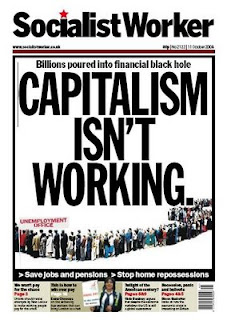
There has been nothing like this in the whole history of capitalism: the level of state intervention to shore up the financial markets is astonishing. Equally astonishing is the fact that it has had no effect whatsoever. After a steep fall on the stock markets yesterday, global equities have plunged this morning, with the FTSE 100 losing a tenth of its value in a few hours. And while it has so far been true, as Andrew Kliman points out, that the 'real' economy has contracted a lot slower than in the previous, relatively mild recession of 2001-2, the signs are that it may in fact be much worse. House prices are plummeting far more rapidly than they did in the early 1990s. For those of you who are - like me - in rented accomodation, this is actually very bad news, because it makes buy-to-let mortgages more expensive to obtain as well as driving many homeowners back into the renting market, thus driving up prices. Because the UK has, like the US, rested its economic performance to a great extent on its housing markets, the sudden decline makes the UK worse placed than other EU states to cope with the recession according to the OECD. Like the US, we are up to our eyeballs in debt and have no savings to match, and many people have relied on mortgages as collateral for credit. And like the US, in fact much more than the US, our economic growth has been driven by the financial sector while manufacturing has been allowed to implode. I mention all this because Gordon Brown is still telling anyone who will listen that this is a problem that really swept in from America, without acknowledging that his government deliberately imported the specific structural imbalances of the American economy. And I would be willing to be that the OECD's estimate, made at the beginning of last month, would be on the optimistic end of expectations today.
The coordinated interest rate cut has, reportedly, not been reflected in the Libor rates (the rate of interest on the London interbank money market). In fact, the cost of borrowing in dollars seems to have increased. So, banks are still severely restricting their lending to one another, despite unprecedented funds made available by the government. Even the weaker pound hasn't boosted exports, because global demand is falling. Falling oil prices should boost consumption, but it won't be enough to stop the slide in domestic demand - in fact, the main reason for oil prices falling is the slump in demand. Corporate profitability in the non-financial sector remains relatively high according to the most recently available statistics. But it has been inflated by strong performance in the energy sector. Even the first quarter of this year saw rates in both service and manufacturing fall in the UK. We have yet to see what impact the contracting of lending and thus investment, as well as falling demand, has had in recent months. And while it was easy to pretend for a while that the problem was just in the financial markets, notwithstanding the fact that the financial bubble originated in weaknesses in the 'real economy', one has to ask how leveraged the 'real economy' is? How dependent has consumer spending been on debt? How dependent has investment been on companies being able to get credit? We know the answer to both questions: corporate and consumer debt hit record highs in the last eight years. The 'real economy' has been, to use an irritating term, living beyond its means.
The next question that follows from all this is how bad can it get for the government? The worsening of the crisis has improved Brown's stature in the administration, and even in some of the polls (not by enough to save the government, though). Many people perhaps suspect that, however bad it is with the government, the Tory plan to cut taxes for the rich and slash public spending is no way out of the crisis. To that extent, I would expect the government to benefit in the short-term even if its bail-out plans are likely to become more unpopular as their basic inability to save jobs and prop up the economy becomes obvious. On the other hand, the growing deficit (set to be between 3 and 6% of GDP by 2010) will be used by the Tories to say that the government has overspent. Moreover, the Tories' inheritance tax and council tax plans will galvanise middle and upper income earners in the key marginals. Business will get over the mean things that George Osborne has been saying about money men (they know he's just teasing), and they appear to be moving back to the fold. And while Osborne is likely to have to raise taxes somehow, despite his 'populist' noises about the 10p tax, he will try to find a way of doing it that doesn't offend the Tories core constituencies. (An aside: one hears from some more schematically minded marxists that we shouldn't be too concerned about taxes on lower income earners and particularly services taxes like the VAT, on the grounds that workers, actually, don't pay any tax. For, in the aggregate analysis, the wage rate is set by the market, and the real wage rate is net take-home pay not gross pay - therefore, all taxes are essentially taxes on profits. Leaving aside the fact that many don't receive wages set by the market, but wages and deferred wages paid by the government, this assumes that wages in the private sector are paid at their actual market value - if this automatically took place, there would be no need for unions. Class struggle would have no bearing on wages - a preposterous idea. Tax increases on lower income earners at a time when the rhythms of class struggle are contained by an unfriendly political climate and the absence of a serious antisystemic movement are not necessarily transferred to the rich.)
The Tory lead was halved when the crisis started to get worse in mid-September, but they remain in the lead in part because as Yougov [pdf] finds, enough people think the party has changed and aren't as wary of them as they ought to be. The most recent polls [pdf] suggest that the Tory lead has risen by 4%, but the biggest squeeze is on the frankly hopeless Liberal Democrats (whose main economic spokesperson is also mooting public spending cuts). Meanwhile, even Labour Party members still think little of Brown [pdf], with half of them saying he's doing badly and 66% saying he isn't radical enough. It has come to something when they can say that Blair, arguably the most despise Prime Minister in living memory whose ratings at times dipped below those of Thatcher, is seen as having been a better bet. So much for the hopes invested in the 'secret socialist'.
The political impact of this crisis is still wide open. People expect the ideas of the radical left to gain currency, but some of the rush back to Labourism in light of the Tory resurgence has also been reinforced. Moreover, if ideological radicalisation is not matched by effective collective resistance to job cuts, then it can collapse alarmingly rapidly into despair or, worse, support for the far right. But given that the government is so bloody eager to help the bankers, it ought to be a pushover to say they should be protecting jobs - don't just part nationalise and throw money at the banks, take the whole banking system into public ownership and run it in the interests of full employment and strong wages. As it is, they seem to be allowing a sort of social Darwinism to operate in the banking system such that - rumour has it - HSBC employees are now joking that their advertising slogan "The world's local bank" should be changed to "The world's only bank". (Next to Goldman Sachs, that is). And if we can run up a debt to fund the banking system, there is no reason to accept cuts to the public services with wage cuts for public sector workers. And ultimately, if the bosses suddenly find capitalism so fucking inconvenient for them, why should we accept it?
Labels: banks, capitalism, economy, financial sector, neoliberalism, new labour, socialism, tories
8:43:00 am |
Permalink |
Comments thread |
|
Print |
Digg |
del.icio.us |
reddit |
StumbleUpon |
Tweet|
Share|
Thursday, October 09, 2008
Race riot posted by Richard Seymour
"Riots have broken out in the mixed city of Acre, reportedly triggered when an Israeli Arab man drove his car during the Yom Kippur religious holiday."Dozens of cars and shops were damaged as hundreds of people took to the streets, Haaretz newspaper reported.
"For Jews, Yom Kippur is a sombre day of fasting, during which it is considered offensive to drive in much of Israel.
"The Arab man was reportedly attacked by youths who said he was making noise intentionally, Haaretz said.
"The Arab man is reported to have said he was simply driving to a property he owned in the eastern part of the city."
The usual procedure when reporting violence of this kind is to place a special accentuation on the ethnicity and/or religion of the rioters. Think "Muslim rioters". But here they only relate the ethnicity of the offending Arab. The second step, if I recall correctly, is usually to inveigh ponderously against the blight of religious intolerance and the threat to free expression and Enlightenment ideas. Curiously absent so far. And the third step is to engage in a surreptitious essentialism in which said violent intolerance is a fact of [Muslim/Arab] culture which is strictly opposed to and excluded from [Western/Anglophone] culture. I can't see it happening this time.
Labels: clash of civilisations, enlightenment, islamophobia, Israel, racism
8:36:00 pm |
Permalink |
Comments thread |
|
Print |
Digg |
del.icio.us |
reddit |
StumbleUpon |
Tweet|
Share|
The end of freedom posted by Richard Seymour

The spectacle of right-wing commentators lamenting the end of the free market and the imposition of tyrannical state socialism is ridiculous and, in its way, pathetic. It reminds one of those apologists for Southern slavery who deride Lincoln as an agent of communism on the basis of what Marx said of the Civil War. Yet, in a way, I sympathise. The feeling of one's ideological universe imploding cannot be pleasant, and must be disorienting. For what is actually happening here? In a way, bail-outs under neoliberalism are nothing new. And even as the British government moved to partially nationalise the banking system, Brown was very clear to state that the individual entities will remain private, while Darling insisted that such entities as were wholly nationalised would repay the amount spent on them in full and would be restored to the private sector. It is pitched as a pragmatic effort to stabilise the system within the terms of neoliberalism, not as a significant parting from it. But those for whom the ideologeme of the 'free market' was a living reality don't believe them and, while their distress might provide momentary amusement, there is an important sense in which they understand very well what is taking place.
A few weeks back I was at a talk by Dan Hind at the very glamorous offices of the IPPR just off the Strand. (Actually, they were rather drab and inconspicuous offices, although I hesitate to extend the same description to its permanent inhabitants - I will have a book to promote myself, you know). It was, as you would expect, about his book on The Threat to Reason, which holds that there are more dangerous forms of irrationality than spiritualism, snake oil salesmen, cults, religion and 'postmodernism'. One of which, as he pointed out, happens to be the claim that 'free markets' are hardwired into 'human nature'. Some version of this claim has implicitly underwritten the programmes of successful political parties in much of Europe and the United States for three decades - this is not to say that majorities actually believe such zaniness, but it is to point to the hegemonic status of these ideas. It is not just the pseudo-pragmatic claim that 'markets work', are the most effective delivery system for goods and services, and are superior in most respects to the state or any other conceivable collective form in which production, distribution and exchange could take place. It is much deeper than that: it is the ideological claim that human beings are naturally inclined to truck, barter and trade, and that freedom consists precisely in allowing this deep urge to be fulfilled. In some right-wing sociology, this is indeed all that human beings ever do, whether in regard to commerce, love or friendship. Unfreedom consists in every form of public life that restricts or regulates such activities, and so there must be a balance between such cessions of authority to non-market institutions (regulators, tax collectors, policemen) as are deemed necessary for markets to work and the need to obsessively contain such authority. Further to that, obstacles to that natural propensity are posed not only by monopolists but especially by trade unions and the kinds of radical anticapitalist political parties that encourage secession from the 'free market'. These are implicitly 'totalitarian' threats, and a good liberal state is one that is capable of responding effectively to them, curbing their power, and - if the threat becomes too extreme - destroying them. This is how Milton Friedman and his students became collaborators with the Pinochet regime. And it is how Friedman himself came to defend child participation in waged labour as a necessary step on the road to freedom.
The longevity of this silly and sinister dogma is not for want of effective criticism. It was skewered long ago by Karl Polanyi, who pointed out that markets in the modern, capitalist sense - so far from being the result of a natural human propensity - were created by violent government intervention. Moreover, he argued that freedom was not best protected in it, but rather that the passing of the market economy "can become the beginning of an era of unprecedented freedom", since "regulation and control can achieve freedom not only for the few, but for all". Freedom for the few entailed the freedom to exploit, to make gains radically incommensurate with one's contribution to society, to hold back innovations and prevent their being used for the wider good (such as HIV drugs). Such freedom can only be sustained in the long run by force and violence, and ultimately fascism. Liberty for the many involved limiting those freedoms claimed by the few as the only freedom worth having. It was true that such freedom as had been claimed for the market was cognate with other freedoms championed by liberalism: freedom of expression, of conscience, of association, and - of course - free labour. However, the capitalist market would leave neither of these freedoms intact were it not humanised, disciplined and regulated, and ultimately suppressed. So Naomi Klein, though brilliant, is not original in asserting that 'free markets' have an elective affinity with coercion, violence and dictatorship. Corey Robin draws on a long tradition of left-wing and progressive thought when he points out that, contrary to the common bromides of neoliberalism and 'antitotalitarianism', states are often the repositories of freedom while civil society and the market is often its enemy. And the unwillingness of so many millions of human beings to pursue their purportedly innate disposition, their curious and sometimes powerful reservations about it, has been a permanent aporia of this kind of liberalism.
But then why should such implausible doctrines not only have survived the Keynesian/state capitalist interregnum but actually come to thrive again? How could it be that a sizeable number of people have appeared to acquiesce in its basic assumptions? This reminds us that ideology is not merely (mis)reportage: if I say that the Queen is a symbol of the glorious traditions of a Christian nation, I am making an ideological claim; but if I say that the Queen is a particularly large fifth moon orbiting Omicron Persei 8, I am not. It is difficult to understand why this is if you consider a claim just in relation to its truth value. In order to understand the ideological representation of markets, one has to understand something about how markets function. One cannot neatly seperate a pro-market discourse from what it is discoursing about. This is what is important in Marx's 'ideology criticism' - far from upholding a banal dichotomy between 'essence' and 'appearance', Marx collapsed the distance between the two. They are not identical, but nor are they autonomous. As he argued in the Grundrisse, against Proudhon and his followers, social equality is precisely not just a false claim made for markets. Rather, individuals are "stipulated for each other", in the context of an exchange of equivalents, as free and equal agents. Market transactions do not express themselves as involuntary expropriation, even where that is in fact what is happening, but as voluntary engagements.
That explains the context in which the ideas of neoliberalism could even be comprehensible; the historic collapse of the postwar social democratic compromise provided the occasion for their aggressive relaunch; and the liberalisation of the stock exchange announced their hegemony. The true believers really do see the broad historical shift that is taking place. The financialisation of the economy and aggressive deregulation that neoliberalism championed is drawing to a close. This doesn't mean that such regulatory models as are introduced are likely to be to the general benefit of the population. We are not, short of a sudden upsurge in American radicalism backed up by organisational regroupment, about to see the New Deal restored. Nor does it mean that the reconstitution of class power that is about to take place will diminish finance capital as such - rather, it is likely to concentrate its power, and integrate it more closely with the state. And in fact, unless there is resistance, it is likely to be a much more authoritarian state. But for neoliberals, state intervention into the economy in itself constitutes a net contraction of the total available freedom. And this is what they think they mean by communism, or socialism, or - as in Naomi Wolf's histrionical audit of the Bush administration's recent actions - a fascist coup. These people have spent a great percentage of their adult lives believing that the alternative to a perpetual liberalisation of the markets was the restoration of serfdom. Capital and its managers were always more pragmatic: their aim was to hegemonise the state, to make it a powerful instrument of their interests, not to diminish it.
Labels: capitalism, federal bail-out, freedom, neoliberalism, socialism, wall street
10:39:00 am |
Permalink |
Comments thread |
|
Print |
Digg |
del.icio.us |
reddit |
StumbleUpon |
Tweet|
Share|