Tuesday, March 30, 2004
Letter To The Guardian... posted by lenin
Someone has fired off a rather brilliant response to Ann Clwyd's Guardian article today. The Grauniad probably won't publish it, but as it's already on the MediaLens message board, I'll publish it myself:Sir,
Ann Clwyd’s apparent sincerity is fatally undermined by her either naïve or mendacious elision of western complicity in Saddam’s atrocities.
Her lament, that the west should have acted sooner, belies the reality that the US and UK did act: they consistently provided financial aid, military intelligence, and planning advice to Saddam, while fully aware that he was using chemical weapons against Iran. As one insider recounted, the Pentagon ‘wasn't so horrified by Iraq's use of gas. It was just another way of killing people — whether with a bullet or phosgene, it didn't make any difference.’ (NYT 18/08/2002). Reagan blocked the US Senate from punishing Iraq for violating the Geneva Protocol on Chemical Weapons and, after Halabja, the US refused to pressure its client to cooperate with UN investigators (The Nation, 26/08/2002). ‘The U.S.-Iraqi relationship,’ wrote Assistant Secretary of State Richard W. Murphy at the time, ‘is ... important to our long-term political and economic objectives’ (Washington Post, 30/12/2002). Likewise, those mass graves of Marsh Arabs were filled with US and UK help; since we disarmed rebelling generals and allowed Iraqi forces to pass through allied lines and massacre the Shi’a, rather than let them overthrow Saddam (Spectator, 10/08/1991) .
Finally, Clwyd may ‘understand’ that a war crimes tribunal for Iraq was blocked by China, Russia, and France, but she is wrong. The US officially anticipated that such moves would be blocked but this was never tested and is hardly plausible, given that Russia, for example, never vetoed such moves against Serbia – its former close ally.
Ann Clwyd may genuinely care but, if she wants to be seen as anything other than Blair’s ‘useful idiot’, she must condemn our own crimes as well as those of Saddam.
Frances Yates and The Scientific Revolution. posted by lenin
I meant to post this ages ago, but a brief debate with someone yesterday prompted me to recall it...Defining the argument:
In her classic work “Giordano Bruno and the Hermetic Tradition” , and subsequent writings, Frances Yates has elaborated a theory of modern science, placing its origins in the Neoplatonism and “Hermetic-Cabalist” traditions which experienced a revival in the fifteenth century, largely due to the translating work of Marsilio Ficino on behalf of Cosimo Medici. In this treatment, I want to argue that Yates successfully establishes a series of connections and family resemblances between magic and modern science, but that her claims for magic exceed what her evidence justifies, while the evidence that she adduces is sometimes tenuous. I think she has also misplaced the causal connection, so I will end by adumbrating a different way of considering the evidence that may avoid the problems of Yates’ interpretation.
Frances Yates
From the Magus to the Mechanic.
"[T]he Renaissance magus", Yates believes, "exemplifies that changed attitude of man to the cosmos which was the necessary preliminary to the rise of science". Indeed, there is no shortage of similarity between the practitioner of natural magic and that of natural philosophy. Sometimes, the distinction is not at all clear. The modern "emphasis upon empiricism and upon 'peering into' nature ... appears in works on natural magic". Giambattista Della Porta, the prolific author on natural magic insisted just as much as Francis Bacon that the way to discover 'such things as lay hid in the bosom of wondrous nature,' was to investigate the natural world. As John Henry points out, "Renaissance natural magicians [insisted] that their form of magic depended upon nothing more than knowledge of nature" - although he also notes that in practise, they relied “heavily upon traditional claims in the magical literature".
Yates demonstrates both the manipulative and mathematical aspects of magic. The account of man's creation given by the 'Pimander' (one of the Hermetic texts) is one in which the Father allows man to 'produce a work'. "Dominion over nature" is in man's "divine origin", and the magus exercises this dominion "through the manipulation of occult sympathies" running through nature. It is also characterised by what "Agrippa calls mathematical magic", which includes geometry, astronomy, mechanics, arithmetic etc.
Giambattista Della Porta
Pythagorean mathematics (and also the Pythagorean “symbolism and mysticism”) manifested itself in the work of Pico. Neither “Pythagorean number … nor Cabalistic conjuring with numbers in relation to the mystical powers of the Hebrew alphabet, will of themselves lead to the mathematics which will really work in applied science”. But Aggripan mathematics did have a place for mechanical application, or “real artificial magic” as Tommaso Campanella was to call it a century later. Copernicanism may also owe something to the prisci theologi unearthed by Ficino, which, Yates suggests, shook the complacent faith in the Ptolemaic position of the sun.
Yates unearths these connections through a series of archetypes. The Renaissance magus introduces Platonism, the licit manipulation of nature and number into the Christianised natural philosophy of the High Middle Ages. These influences manifest themselves in Leonardo Da Vinci, who cited "Hermes the philosopher" and defined force "as a spiritual essence". John Dee, the 16th Century scientist and mathematician, was known to have attempted communion with spirits, and drew inspiration from Pico. Dee, especially in Yates’ later writings, is the archetypal Renaissance magus.
The next layer is the "Rosicrucian type" who is defined by the need for secrecy in the hostile climate of the counter-Reformation, "an intensely religious temper" while nevertheless remaining unaffiliated to any particular doctrine, and the "Hermetic belief that the deepest truths cannot be revealed to the multitude". The Rosicrucians were influenced by the work of John Dee and Paracelsus. They practised natural magic, especially alchemy. “Rosicrucian alchemy expresses both the scientific outlook, penetrating into new worlds of discovery, and also an attitude of religious expectation”.
John Dee.
Francis Bacon and Father Marin Mersennne exemplify the final stage of the progression from Renaissance magus to modern scientist. Bacon's New Atlantis is a utopia "ruled by mysterious sages who keep the citizens in tune with the cosmos", but who "do not practise astral magic, and are not exactly magi". Bacon's emphasis on technology reflects the influence of Renaissance Hermeticism, just as much as his desire to exercise power over nature. Father Mersenne, on the other hand, rejects the animus mundi, embraces the “modern” corpuscular outlook and those elements of magic compatible with it, and thus completes the transition.
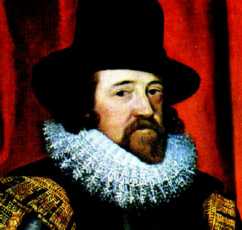
Francis Bacon
A few problems.
It is possible to accept all of Yates’ empirical examples without accepting the thetic relation they support. John Dee, for instance, may well have been “imbued with the importance of mathematics”, but it is questionable whether he discovered anything important. And the magical importance of his ‘numbers’ is not of the classical Cabalistic kind, that of attempting to interpret the scriptures, but rather the ‘book of nature’ which his ‘conversations with angels’ helped him to interpret. This innovation does not explain so much as it demands explanation.
Francis Bacon’s anti-Copernicanism may not be as easy to correlate to his opposition to magic as Yates believes. As Robert Westman points out, of all the ‘Hermetists’, only Giordano Bruno added anything original to Copernican thought, while Hermetic sun-worship is just as compatible with a geo-centric universe in which the sun is at the centre of seven planets surrounding the Earth. “Dominion over nature”, given sanction by the Hermetic tradition, could also be argued to be a feature of Christian faith.
Yates clearly believes that mathematics and magic are essential correlates in this period. But the recovery of the Archimedean texts by William of Moerbeke only led to their general appropriation in the sixteenth century when “the self-educated engineer and mathematician Nicolo Tartaglia” published them in print. The “sixteenth century revival of the classical tradition of mechanics was not in the first place the concern and work of natural philosophy at the universities, but of laymen in classics, namely engineers who were interested in theoretical questions”. It isn't straightforward to assess claims about the transmission of empiricism from magic to science - if dominion over nature was sought, how else to achieve it than to investigate nature? What better way to register its quantities than to make use of the sophisticated systems of mathematics available?
Yates invites doubt when she offers speculation , although she emphasises that as a pioneer in her field she is perhaps obliged to ask more questions than she is immediately able to answer. There are, nevertheless, some dubious interpretive gestures, such as the reference to Father Marin Mersenne as the putative final stage in the progression from magus to scientist. Mersenne was a philosopher and mathematician whose abiding concern was to combat the rising influence of animistic and magical philosophers. Repulsion against magical beliefs propelled his scientific endeavours in this case, and Yates offers no good reason to infer that this is merely the culmination of a transition.
The main aporia, however, is the heuristic. The "chief stimulus of that new turning toward the world and operating on the world" was, according to Yates, what she referred to as the Hermetic tradition. It is difficult to evaluate such claims, or to know when they are proven. Because the rise of magic was almost coterminous with, and certainly related to the rise of science, there was not necessarily a causal connection between the two.
Here's the rub. Many of the strands of magical thought and practise which Yates describes collectively as 'the Hermetic Tradition' were widely known in classical Greek civilisation, even if most of the Corpus Hermeticum should properly be dated to the second and third centuries AD, and the nascence of Christian Rome. Many of these Greek traditions owe themselves to the practises of Egyptian civilisation. Yet, while the Egyptians had much in the way of technology, they had nothing that we would call science. And while the Greeks did develop the beginnings of science, they made few technological advances. In the 800 years from the rise of Athenian civilisation to the fall of the Roman Empire, a wealth of scientific thought proliferated, but there was not the practical empirical approach that we associate with the rise of modern science. (I emphasise practical because the Greeks, notably Aristotle, were acute observers). It was as alien to the Greeks as it was commonplace to the mechanists that one should seek to interfere with nature. Evidently, there is no necessary connection between the existence of magical beliefs and the rise of exact science.
Hermes Trismegistus
While the rise of magic in the High Middle Ages and the rise of science in early modernity are clearly related, they are perhaps best understood as responses to the same opportunities and problems offered by the profound changes taking place in Europe from the year 1000. It would be possible in this view to endorse the bulk of Yates’ findings, while weighing their import differently. One could even argue that magic did provide a necessary precursor to science, but that certain catalysts were necessary to effect the change. The historical context, carefully examined, may yield a few of these catalysts, and the regulating factors which conditioned both the rise of science and the rise of magic. I’m afraid I can only offer a brief outline.
New conditions and dynamic feudalism.
Literacy: While in the early medieval period literacy was restricted to a "thin layer of literate monks and clergy", the layer of traders and artisans which emerged and began to populate towns in the eleventh and twelfth centuries needed both formal law and a written record of accounts and contracts. Literacy was no longer confined to monasteries, nor was Latin the only written language. Whereas the liberty of an urban Greek citizenry was coextensive with rural slavery and thus the almost complete separation of the intellectual elite from production, the educated men of the High Middle Ages were often rooted directly in economic activity. The sphere of thought was joined to that of action, and the philosophy of Francis Bacon exemplifies the resultant outlook.
"Dominion over nature": Such dominion, already established with the water mill and other mechanisations, became part of the perspective of the new intellectuals. Roger Bacon and Nicole Oresme "strove to increase" the domain of mathematics "in the natural world". Roger Bacon was the first European to write down the formula for gunpowder, which was the necessary preliminary for the first use of the cannon in 1320. This presaged the mathematisation of nature of Renaissance humanists, engineers and magicians.
Crisis: But economic crises, famine and plague met the profound advance of these years. Lordly consumption was expensive, as was the increasing tendency to wage war. Acording to George Duby, the "grain-centred system of husbandry began to be unsettled by the requirement of the gradual rise of aristocratic and urban living standards". The result was a series of wars between rival lords and monarchs, and peasant uprisings. As the Black Death swept in from Asia in 1348, perhaps a quarter of the population of Europe, already weakened by famine, was destroyed. Europe was plunged into "ceaseless epidemics, endemic war, and its train of destruction, spiritual disarray, social and political disturbances". It should therefore be no surprise that the "utopias of the Renaissance" cited by Yates are "governed by priests ¼ who know how to keep the population in health and happiness". Or that their inhabitants should be "practisers of astral magic ... deeply interested in ¼ scientific research".
Advancement of Northern Italy: Northern Italy was the most economically advanced region in Europe as the crisis receded, and also the least damaged. Food production had not declined as quickly as the population, and Europe recovered rapidly from its crisis. Rural labourers benefited appreciably from a general rise in income and the consequent dissolution of serfdom. Large merchant families came to dominate the region, such as the Medicis in Florence. Seeing their mercantile wealth as transient, they often sought the more secure status of land ownership, court and church positions. The Renaissance resumed unfinished business, and its primary sponsors were the new merchant families and the courts they frequented. Magic was "courtly science par excellence", largely because it involved precisely the sort of "dominion over nature" that princes and merchants sought to buttress their power.
Conclusion.
Magical practises and beliefs were important for the development of science, but paradoxically only insofar as they encouraged practises and beliefs that were commensurable with a disenchanted outlook. While the relationship of magic to science was not one of pure antagonism, neither were they coextensive. Both magic and science, while neither passive reflections of social causes, nor rigidly determined by the economic base, can be seen as related to attempts to solve pressing problems and grasp real opportunities afforded by the zenith and crisis of European feudalism.
ENDNOTES:
Frances Yates, Giordano Bruno and the Hermetic Tradition, Routledge, London and New York, 1964.
Frances Yates, “The Hermetic Tradition in Renaissance Science”, in Art, Science and History in the Renaissance, Charles Singleton (ed.), 1967 (p. 226).
William Eamon, “Court, Academy and Printing House: Patronage and Scientific Careers in Late Renaissance Italy”, in B T Moran (ed.), Patronage and Institutions, 1991, (p21).
Ibid, (p 28).
John Henry, The Scientific Revolution and the Origins of Modern Science, 1997 (ch. 3, p. 44).
Yates, 1967, op cit (p. 228).
Yates, 1965, op cit (pp. 164-5).
Ibid, (p. 170).
See, for example, Frances Yates, The Occult Philosophy in the Elizabethan Age, 1979, Routledge, London and New York, (pp 92-127).
Ibid, (p 199).
Yates, cited in H. Floris Cohen, The Scientific Revolution: An Historiographical Enquiry, 1994, University of Chicago Press, Chicago, (p 172).
Yates, 1964, op cit, (p431). This explanatory gesture rings of the Hegelian “negation of the negation”; Aristotelianism is negated by Neoplatonism and magic, the latter negated by mechanism and the Newtonian synthesis.
A. Rupert Hall, cited in Cohen, op cit , (p. 290).
Deborah Harkness, John Dee’s Conversations with Angels: Cabala, Alchemy and the End of Nature, University of California, 1999, Cambridge University Press (pp. 181-2).
Cited in Cohen, op cit, (p 292).
For example, Genesis I:25 “Be fruitful and multiply…” cited by Francis Bacon.
Wolfgang Lefevre, “Galileo Engineer: Art and Modern Science”, in Jurgen Renn (ed) Galileo in Context, Cambridge University Press, 2001. (p. 17).
Indeed, the Portuguese used mathematics and astronomy for the purpose of dominating, not nature, but other human beings as they set out to enslave parts of Africa. See Robin Blackburn, The Making of New World Slavery: From the Baroque to the Modern, 1492-1800, Verso, London, 1997, (p 97).
Some examples from Yates, 1967, op cit: "Was mathematics, for Bacon, too much associated with magic...?" Copernican heliocentricity "might have seemed to Bacon heavily engaged in ... magical and animistic philosophy". "[S]ome of Bacon's mistakes may have been influenced by his desire to rationalise...". Perhaps it was because Dee was an astrologer that “Dee, unlike Bacon, was imbued with the importance of mathematics". The "cult of ... Hermes Trismegistus, may have helped to direct enthusiastic attention" toward Archimedean texts.
Steven Shapin, The Scientific Revolution, University of California, 1996.
William von Staden, “Affinities and Elisions: Helen and Hellenocentrism”, in Michael Shank (ed) The Scientific Enterprise in Antiquity and the Middle Ages, University of Chicago, 2000, (pp 54-71).
Andrew Gregory, Eureka! How the Greeks Invented Modern Science, Icon Books, 2001, (pp 6-22); see also T. E. Rihill, “Greek Science” in New Surveys in the Classics, No. 29, Oxford University Press, 1999, (pp 1-23).
Perry Anderson, Passages from Antiquity to Feudalism, Verso, 1974, (p 28n).
The argument following from this owes itself to Benjamin Farrington, cited in Cohen, op cit, (p248). Farrington argues that by the 1st Century AD and the flourishing of Galen and Ptolemy, the Greco-Roman world had been “loitering on the threshold of the modern world for four hundred years” but could not cross it. Science, he argues, did not fulfil the same social function for the Greeks that it had for the early-moderns, and this is an important part of explaining why there was a Scientific Revolution in the Middle Ages, but not in antiquity.
Guy Bois, The Transformation of the Year 1000: The village of Lournand from antiquity to feudalism, Manchester University Press,1980.
Chris Harman, A People’s History of the World, Bookmarks, 1999.
Anderson, op cit (pp 29-44).
For example, Bacon’s advice to the “studious to sell their books and build furnaces”, so that “human knowledge and human power meet as one”. Cited in Carolyn Merchant, The Death of Nature: Women, Ecology and the Scientific Revolution, 1980, (p. 171).
Harman, op cit.
A. George Molland, “Aristotelian Science” in R C Olby, G N Cantor, J R R Christie and M J S Hodge (eds), Companion to the History of Modern Science, 1990 (p 563).
Harman, op cit.
William Chester Jordan, European Society in the High Middle Ages, 2001, (pp 303-308).
Harman, op cit.
Anderson, op cit, (p 201).
For a striking graphic illustration of this, see Fernand Braudel, The Perspective of the World: Civilisation and Capitalism, 15th-18th Century, Fontana/Collins Press, London, 1979, (p121); also see Guy Bois cited in Harman, op cit.
Yates, 1967, op cit., (pp. 236-7).
Anderson, op cit, (p204).
Eamon, op cit.
The Vicar of Cynon Valley. posted by lenin
Spot the Difference
or...
If the Vicar of Dibley is the nation’s third favourite comedy (appropriate enough, as it’s a third rate show), Ann Clwyd’s sermons ought to studied more carefully by scriptwriters and cast members alike. Comedy abounds in her latest Guardian elegy to Iraqi "freedom" , a dazzling commixture of imprecation and implication, hosannah and high praise, invocation and intimation. Clwyd, in a curious way, makes the war on Iraq seem the result of desperate appeals by Indict, the commission she headed to try and get Saddam Hussein and his band of thugs nailed in an international court of human rights, in absentia. Those attempts, she explained, were blocked by Russia, China and France – and further adds (perhaps with a Welsh cackle?) that Hussein is now to appear in court, defended by a French lawyer. French and a lawyer! Where will the perfidy end? Well, even the devil must have an advocate you know.
Clwyd leaves a lot to implication but if we leave that aside, the structure of her argument is obvious enough. She suggests that the 270 mass graves USAID claims to have discovered in Iraq provide vindication enough for the invasion of that country. USAID is not a non-governmental organisation, but a body of the US government, so perhaps we might treat those claims with some scepticism. Nevertheless, the suggestion merits consideration on its own terms - because it is, in fact, a perfect non sequitur. Presumably Clwyd would allow that there are important questions of agency, of motive, of means and method, and of the alternatives. These have all been outlined in ample detail by critics of the war, and I won’t repeat this beyond suggesting that one way to stop the suffering of Iraqis would have been to stop contributing to it. An end to the sanctions may well have given the Iraqis enough medication, food and comfort to develop and nurture their own civil society opposition to the regime. Human Rights Watch has suggested that there was a steady and marked decline in the level of internal repression in Iraq through the Nineties which disqualified, in their view, any contention that the bombing of Iraq was a humanitarian war. And, why not, the withdrawal of sanctions and the release of aid could have been tied to democratic reforms, just as human rights improvements are tied to EU entry for Turkey. No. Of course not. We can never negotiate with dictators (except when we do) and anyone who says otherwise is an appeaser. One might also note in passing the curious logic that says the discovery of crimes committed in the past with ample support from the West may retroactively legitimise an invasion by the West.
"Most Iraqis now see the moral and political imperative for the war as overwhelming", Clwyd avers. This is an interesting fabrication, since it suggests that even if Iraqis were never consulted, their concerns never actually discussed in the Pentagon and the War Room, the idea that they "now see" the justice of it validates imperialist aggression. Perhaps Clwyd will also make similarly imaginative use of those same polls to suggest that “most Iraqis now see that the Zionist Crusader alliance is a corrupt alien occuper whose main candidate for President has less credibility than Saddam Hussein”. Of course, “most Iraqis” have never communicated anything of the sort that Clwyd suggests. The much-touted poll for the BBC showed the Iraqi public evenly split on whether the invasion had been a humiliation or a liberation. And of the 48% who said that overall the invasion had been worth it, half said the invasion was "somewhat right" and the other half said it had been "completely right". Not exactly "overwhelming", then.
Clwyd is most entertaining when playing ventriloquist. "The Kurds remind us" that WMDs were a conventional tool of repression for Saddam, which he had used more than 200 times and they had "every expectation" that they would be used again. I wonder if these expectations developed before or after Jalal Talabani kissed Saddam Hussein on the cheek? Before or after Massoud Barzani invited Saddam into his turf to kill his opponents in the PUK? And where are these WMDs now that we’re on the subject? Whatever happened to that "human shredder" , Ann? (Interestingly, Ann checked that latter story with Paul Wolfowitz and was told it was a "spot-on piece". She was even invited to go talk to him about it, which she did).
The crimes of Saddam are energetically built up, constructed into a vast apparatus of demonology so that no doubt may remain as to what the absence of war has meant. "The regime cost the lives of at least two million people through its wars and its internal oppression", Clwyd tells us. Well, let her hang by her own rope, because the logical corrollary of this is that other regimes, responsible for far worse loss of life through war and repression, ought to be toppled from without. A UN force, for example, could overthrow the US government, with the territory secured by mercenary bands working with foreign armies. Resistance could be attributed to loyalty to the old regime, or "fascism" – accurately enough, since there would unquestionably be those elements powerfully at work in any resistance to the occupation. No. Don’t be silly. We don’t apply the same standards to them as we do to ourselves.
Most importantly of all, Iraq is now "free". In less than a hundred days, Iraq will be in the hands of Iraqis. By which we ought to mean, Iraq will be in the hands of a puppet government, a government of quislings and collaborators, a government of pullovers and pushovers. The Kurds, she says, are no longer to be driven from Mosul and Kirkuk – I’m happy to defer to the future on that one. For, just as much as the pro-war liberals enthuse about "liberated" Iraq, the soldiers on the ground can report a daily, non-stop wave of rocket/shell/bomb attacks. Most of these go unreported. Only when a few soldiers are killed or perhaps a massacre goes down in the city centre are we entitled to know about it. The IGC discusses the implementation of Shari’a law, of federalisation, of Clause 24, and Iraqis are left to puzzle over how much they will have left to vote on if and when elections come.
Clwyd's touching faith in US power would merit an essay of itself, but as I mentioned Wolfowitz before, allow me just to sample one conversation of hers with The Guardian on a conversation between herself and the Vulcan:
"What came out during that discussion is that Mr Wolfowitz himself had been a campaigner on Iraq since the end of the 1970s and that human rights in Iraq was a major concern of his - which I'd never realised before, obviously. I had a very interesting hour and a quarter of conversation with him, on Afghanistan, and also on Israel-Palestine."
This would certainly come as a bit of a shock to his employers in Washinton. From 1977 to 1980, he was Deputy Assistant Secretary of Defense for Regional Programs, where he helped create the force that later became the United States Central Command. He then spent years as head of the State Department's Policy Planning Staff (1981-82), before becoming Assistant Secretary of State for East Asian and Pacific Affairs (1982-86) and finally Ambassador to Indonesia (1986-89). In the latter post, he oversaw US support for human rights atrocities being carried out by the Suharto junta - a regime every bit as bloody as Saddam's. She also claims he's a bit of a wet on Israel-Palestine. (See pic below). But Clwyd is not, at any rate, very choosy about where she garners political support from. Cynical politicians, drenched in blood, flash her a smile and a cheque and she's happy. In 1997, her organisation pocketed $3m from the US Congress to pursue its cause - on account of an Iraqi Liberation Act pushed by some of the same people who had rained misery on the Iraqis for years. Clwyd also found that Donald Rumsfeld had "a great line in self-deprecation" - which I suppose you'd have to have if you happen to have shook hands with a dictator whose abuses you're now pretending to be worked up about.
Naturally, no canard is eschewed in the service of Clwyd’s war, and the Rwandan genocide makes an appearance to warn against the evils of non-intervention. (Curiously, she never mentions the Congo). Noone, surely, doubts that this cruel negligence should never be repeated? I have my doubts about the ability of a Western force to adequately handle a civil war of any kind – the record in Somalia, Haiti and Kosovo is not encouraging. But, fortunately, I don’t have to tender such a tough judgment since no such similarity exists. Genocide involves the attempted extermination of a race, ethnicity or nationality through premeditated slaughter. This accusation may have been levelled at the Ba'athist regime in 1988 when many human rights groups did refer to the massacre of Kurds as genocide, but not in 2003. No matter, for Rwanda, and cases like it, bespeak the need to end the over-riding status of national sovereignty in international law. A new UN, Clwyd says, is needed that can act in the face of atrocity, and curtail human rights abuses where they emerge.
Would that we had come so far. Would that the UN was ever likely to become a reliable agency for freedom, human rights and all of the other lovely epithets Clwyd invokes in the service of Bush Almighty. But perhaps what she means is a UN that will not attempt to thwart the benign ventures of her boss and mentor, the Prime Minister. For what Clwyd’s article boils down to is an off-key hymn ripped out of the PM’s book of praise. The devil is identified, as are his minions and his appeasers (France, Russia, the tolerance of "liberal opinion"), while God is only known through those acting on his behalf in the Whitehouse and Downing Street. And, what’s more, for all the talk of Honest Ann being manipulated by people unworthy of her good name, the way she argues displays a cynicism and a dishonesty characteristic of the Hitchens-led wing of neophytic imperialists. Clwyd has forfeited her right to claim she argues in good faith by her wilful distortion of facts, her amplification of untested claims and her omission of central facts. Pretending to speak for Iraqis, she speaks only for Bush and Blair. Making great fist out of her reputation for compassion and dissent, she makes the case for cold-hearted disregard for the victims of our crimes, and absolute conformity with it. Pack her off to Dibley, I say. Let her placate the locals with her soothing hymns and platitudes.
Monday, March 29, 2004
Drudgery. posted by lenin
A couple of days ago, I linked to a site which had been located in a search engine by someone seeking the words "richard clarke communist party". The proprietor of that site suggested that "perhaps in another few days enough bullshit will be thrown up on the internet to satisfy him/her."Matt Drudge , the insinuating skidmark on America's body politic, has come up with an "exclusive" that will blow your socks off. Turns out, this Richard Clarke guy who's been mouthing off about the President expects to make money off a book he wrote. Man, that's one evil bastard. Imagine writing a book and then expecting to get paid for it. Shit. What kind of capitalist hellhole is America becoming anyway?
And this isn't the first attempt to locate black motives behind Clarke's criticisms of the Bush administration. Now it turns out that some of the relatives of 9/11 victims are choking with fury over Clarke's "profiteering" from their tragedy. These critics rail against Clarke for having "politicised" the 9/11 commission and "further dividing the country" - "with the presidential election less than eight months away" moreover.
Is it just possible that there is, maybe an agenda behind this? Of course not! How dare I? Who the hell do I think I am?
Apathy, and Liberal Bravery in the Face of Peace. posted by lenin
It seems no insult to the public intelligence is low enough for the liberal hack. Henry McDonald in yesterday's Absurder managed to curtail a rather patronising article on Northern Ireland with a transparently self-serving outburst on Qadaffi, and a plug for his pro-war liberal chums. Northern Ireland first. The gist of the argument is this - Northern Ireland doesn't care about democracy as long as it has peace. That's why noone turned out to a demo called by Sinn Fein. As long as they can go shopping, they don't need a say in how they're governed. Henry might have missed it, but the whole reason for the absence of peace over some decades was precisely the absence of democracy. How he could have missed this obvious connection is beyond me, unless his head is stuck so far up his own intelligence that he can't see the shit for the brown stuff.He then has a wee ramble about why Qadaffi isn't a courageous man, after all:
"While the Blair visit was justifiable in a world of shifting alliances and dangerous uncertainties, the idea of Gadaffi being 'courageous' is an insult to the victims of IRA terror as well as those who died at Lockerbie and outside the Libyan People's Bureau in London.
Furthermore, the notion that Libya's opening up to the West was brave is absurdly inaccurate. The real reason Gadaffi scrapped his WMD programme and renounced the use of terrorism is because he was simply afraid that he and his sordid regime would be next. He saw what had happened to Saddam Hussein and decided he didn't want to end up in a spider hole hiding from GIs. Whoever told Blair to describe the colonel as 'courageous' ought to be sacked."
Fair enough, courageous isn't the first word that would normally come to mind to describe a vain, pompous autocrat with about as much flair for the written word as an Observer hack. Nevertheless, the pretense that Qadaffi is simply reacting to the bombing of Iraq is perfectly absurd. Qadaffi had been attempting to negotiate with the West for years, but those attempts were simply rebuffed. Why did he attempt to negotiate? Sanctions might have something to do with it. Isn't this the reason why, for instance, the compensation Qadaffi has agreed to pay to relatives of the Lockerbie dead is to be tied to the lifting of specific sanctions. The first billion is set to be released when the UN sanctions that banned arm sales, air links, and froze Libyan assets are lifted, the second billion when US sanctions are lifted and the remainder when the US removes Libya from its list of terrorist sponsoring nations.
Henry McDonald might do well to acquaint himself with such elementary facts, and his editors should insist upon it before he is paid for another column inch. And they should certainly stop this:
"One of the few voices on the British Left who was prepared to support the toppling of Saddam will be in Belfast this week. My colleague, Nick Cohen, who has bravely spoken out in favour of military intervention in Iraq in order to free those living under the Baath Party's lash is to chair a talk by Francis Wheen..."
Since when was it "brave" to take the side of the government, the military, the US government, the Pentagon, the Conservative Party, the Sun newspaper, the Daily Telegraph and ... oddly, enough, the very same paper you work for?
Now, today's Guardian has another whine from the increasingly banausic Peter Preston. What's his bitch today? The public are just too apathetic. They want a referendum on Europe, but they can't even be arsed to vote. They tell opinion pollsters they intend not to vote very much any more. A lot of them don't even claim to have discussed politics or political news for over two years. The poll finding is of interest as much for what it doesn't say as for what it claims to say - polls show the bulk of people were against the war, are against PFI, are against tax cuts for the rich, favour renationalisation of the rails, consider asylum seekers a serious economic problem, etc. And that in large majorities. And we are to believe that those people haven't talked politics in a few years? Nah. They just haven't talked about parliament. Why? Because there ain't no politics there worth chatting about. Peter Preston's liberal smugness always misses this elementary common sense.
Sunday, March 28, 2004
Terry Eagleton on Edward Said. posted by lenin
Free of charge, from me to you.The last Jewish intellectual
Book Reviews
Terry Eagleton
Monday 29th March 2004
Power, Politics and Culture: interviews with Edward W Said
Edited and with an introduction by Gauri Viswanathan Bloomsbury, 485pp, £20
ISBN 0747571074
Reading these 29 interviews with the late Edward Said, it is hard to believe that he needed an emergency button in his New York apartment which was connected to the local police station, or that his office at Columbia University was once burned down. For the judicious, eminently reasonable figure who emerges from these absorbing dialogues is the exact opposite of the bogeyman branded a "professor of terror" by some of his less level-headed Zionist opponents.
Said certainly detested Zionism, but he hated terrorism, too, and says so loud and clear in this collection. He was the finest intellectual champion that the Palestinians are ever likely to have, yet ended up feeling little but icy contempt for Yasser Arafat and his brutal, corrupt regime. (The regime returned the compliment, grotesquely claiming that this scourge of US foreign policy was a CIA agent.) He could be acerbically critical of Arab regimes, a note rarely struck by Bernard Lewis or Conor Cruise O'Brien in their apologias for Israel. At one point in the book, he dubs Hamas and Islamic Jihad "violent and primitive". Saddam Hussein (and this from a man who vigorously opposed the first Gulf war) is a "murderer and a pig and a tyrant and a fascist". Said even supported UN sanctions against Iraq, while rejecting the faux-left line that if the fight is between fascism and imperialism, you must reluctantly opt for the latter.
He admits that Israel's actions in Gaza and the West Bank drive him to "tremendous anger", yet he also describes himself, a mite tongue-in-cheek, as "the last Jewish intellectual", meaning a thinker who, in Judaic style, is wandering, homeless, dispossessed. He disagrees with the equation of Zionism with racism, which strikes him as too simple-minded. He has, he remarks, felt a lifelong affinity with Jews, and there is nothing in this lucid, passionate volume to suggest that this is a mealy-mouthed gesture. The abrupt, abrasive Said, who is quite capable of rounding suddenly on his interrogators in this book when he feels they are being pious or coy, did not do mealy-mouthed.
Neither did he do Theory. The man who helped to change the face of literary studies despised what he calls here "jaw-shattering jargonistic postmodernism", and gave up reading cultural theory years earlier. His concern is justice, not identity. He is more interested in emancipating the dispossessed than in bending genders or floating signifiers. One of the major architects of modern cultural thought comes across in this book as profoundly out of sympathy with its cerebral convolutions, which - as he shrewdly sees - are largely a symptom of political displacement and despair. Popular culture, he remarks provocatively, "means absolutely nothing to me", a comment that would not have won him many invitations to beach parties had he been an assistant professor of English in California.
In fact, Said was all along a humanist of the old school, and declares this unfashionable allegiance without the slightest sense of embarrassment. If he fought for the extension of the literary canon to peoples and nations that it shunned, it was not, in his view, a canon to be derided callowly. He did not see the need to choose between Jane Austen and Chinua Achebe. If ethnic or cultural identities can be politically energising, they can also be spiritually narrowing. "I am not just interested in Palestinians in American literature," he observes, unlike those vulgar Marxists who used to be interested only in novels with coal mines. He could tell you without effort which poets were up and coming in the Philippines, or how autobiography was faring in South Korea, but he also saw his own inquiries as extending the work of the great European humanists, drawing upon their scrupulousness, rigour and erudition. He did not save himself a lot of tedious spadework by dismissing these luminaries as dead white males. Nor did he accept the patronising line that any novel written in the post-colonial world is automatically to be praised. And he was as distinguished a classical musician as he was a literary critic.
The same maverick quality characterised his politics which, in their nervousness of orthodoxies, were in some ways more liberal than socialist. He sometimes speaks of the left as though he were not part of it, which might have come as a surprise to those who set fire to his office. Marxism he handled warily, and the word "capitalism" rarely crossed his lips. He was almost physically pained by rigid doctrinal systems, and mildly revolted by the idea of discipleship. His imagination was quickened by the diverse, unstable and unpredictable, and turned off by the homogeneous. It is hardly a surprising predilection for a Christian Arab brought up in Jerusalem and Cairo and educated in the United States.
What interested him is what he called "travelling theory"; and this sense of being errant, provisional, intellectually on the hoof, was one of several ways in which he remained true to the exiled people to whom he lent his voice. He describes himself in this volume as "a traveller, who is not interested in holding territory, who has no realm to protect". It is natural that he should use a geopolitical metaphor for the life of the mind. Yet he also sees that being caught between two or more cultures can be a cause of misery as well as a source of creativity. He is not given to the sacred postmodern ritual of romanticising the Other, and with typical even-handedness castigates the fashionable cult of exile. Not every post-colonial who steps off the plane to take up a well-paid job at Oxford or Yale is an exile or refugee. Said himself, whose mercantile family was remarkably cultivated and well-heeled, rightly refused the term as a self-description.
Intellectuals are not only different from academics, but almost the opposite of them. Academics usually plough a narrow disciplinary patch, whereas intellectuals of Said's kind roam ambitiously from one discipline to another. Academics are interested in ideas, whereas intellectuals seek to bring ideas to an entire culture. The word "intellectual" is not a euphemism for "frightfully clever", but a kind of job description, like "waiter" or "chartered accountant". Anger and academia do not usually go together, except perhaps when it comes to low pay, whereas anger and intellectuals do.
Above all, academics are conscious of the difficult, untidy, nuanced nature of things, while intellectuals take sides. One reason why Raymond Williams seems to have been easily Edward Said's favourite British intellectual is that the work of both men combines these qualities with astonishing ease. Williams and Said are both angry and analytic while aware that, in all the most pressing political conflicts which confront us, someone is going to have to win and someone to lose. It is this, not a duff ear for nuance and subtlety, which marks them out from the liberal.
Like most post-colonial thinkers, Said is suspicious of Enlightenment rationalism, having witnessed at first hand some of the shadows that this light can cast over the world. Yet the forthright honesty and steely lucidity of his voice in these interviews, his impatience with cant and pious waffle, also bear witness to the virtues of that rationality. Perhaps if those who reviled and insulted Said could have read this book, they might have desisted. Or perhaps not. For, like any authentic intellectual, Edward Said was aware that ideas, for all their impor- tance, weigh very little when it comes to material interests.
This article is the copyright material of the New Statesman. As such, all readers of this website will be swiftly prosecuted just as soon as Peter Wilby gets off his ass and stops editing those stupid fucking unenlightening interviews with government ministers he feels obliged to slot into his magazine every few weeks.
Free Speech in an Age of Racism and Violence... posted by lenin
Yer man/woman over at Socialism in an Age of Waiting has an interesting piece on David Miller's Voltairean defense of free speech in yesterday's Guardian. The author of this site is no fan of mine, because I'm a member of the SWP, but I'm sure if I say nice things about the site I can seduce him/her into reciprocating.On the other hand, I do have to take issue with this, on the current crisis in Kosovo:
"Considering how the Kosovar Albanians were routinely treated when they were a minority within Serbia, it is no surprise at all - though it is certainly regrettable, and inexcusable - that some of them are behaving intolerantly and violently now that they feel that they belong to a majority."
"Intolerantly"? Sorry, SIAW, this is certainly not about the "intolerant" behavior of "some" Kosovars, but about the nationalist inspired attempts at ethnic cleansing by a politically motivated section of the nascent Albanian state there. And, although it partially owes itself to years of Serb oppression (of varying degrees), it does have an autonomous political weight of its own. It is also the necessary and logical outcome of attempting to create a state whose premiss is the dominative majority of one ethnic group. The solution to the violent dissolution of Yugoslavia with its nationalist hatreds, bigotry and ethnic cleansing is the socialist revitalisation of pan-Yugoslav solidarity, not the creation of seperate statelets to contain each specific ethnicity. I don't know how much SIAW would agree with this, but given the link to the AWL I would guess not a great deal at all.
My own piece on the current crisis in Kosovo can be reached here .
Britain's Favourite Comedies... posted by lenin
Please. The Vicar of Fucking Dibley, the nation's third favourite comedy? Look, I can understand old Del Boy bagging number one. How could he have lost with the oleaginous charms of David Dickinson pouring on the old "working class hero" snake oil? But Dawn French pretending to be a lardy, talentless, lovelorn, choc-a-holic, matronly fucking priestess with about as much talent in one-liners as Jim Davidson when he's forced to write his own? There cannot be that many pseudo-liberal wankpads in this fucking shithouse of a country.That's all. Back to serious political stuff tomorrow.
Saturday, March 27, 2004
Chomsky, Monbiot, Hitchens and the Hippocratic Principle... posted by lenin
Regarding Monbiot's proposals for a new UN Charter to restore justice to international law, Noam Chomsky says that Monbiot has "radically misinterpreted" the nature of the Hippocratic principle as somehow meaning "avoid doing any harm, even if it may lead to greater benefits" so that "a doctor violates the Hippocratic oath by giving someone an injection, because the puncture harms the skin." The Balkans example is especially pertinent:
"Turning to the case to which he refers, Kosovo in March 1999, the US and NATO command anticipated that the effect of military intervention would be to intensify sharply the level of atrocities in Kosovo, as clearly happened. These had been stable and relatively low for some time according to the State Department, OSCE, and other Western sources, and were attributed mostly to the KLA guerrillas by the British government (implicitly) and by the most serious pro-intervention scholarship (quite explicitly). Unless there is some powerful reason to the contrary, then, the Hippocratic truism implies that intervention should not be undertaken -- and there is always a heavy burden of proof to be borne by the call for resort to violence, another truism.
"There is of course more to the story, as there always is in the real world: thus there were diplomatic alternatives -- NATO and Serbian -- on the table at the time. After 78 days of bombing, a compromise was reached between them, lending further support to the surmise that the diplomatic track might have been pursued without the bombing and the atrocities against Kosovar Albanians it instigated, as anticipated by NATO, not to speak of the effects of the bombing on those targeted directly. It follows that the burden of proof to be borne by advocates of bombing is even heavier. Can it be met? Perhaps. The Hippocratic truism does not provide an answer, of course, nor did I (or anyone) suggest otherwise. But that, clearly, is the challenge that must be faced by advocates of bombing in Kosovo, intervention in Rwanda, and other such cases. We cannot evade the serious questions that always arise by gross misinterpretation of the Hippocratic truism."
I think this is eminently defensible, and since one Christopher Hitchens has proven so contemptuous of this logic, I thought I'd share a little secret with you. I just discovered some Hitchens quotes on the Balkans war which suggests a position rather different to the one he has latterly evinced:
ON ETHNIC CLEANSING -
"[T]he cleansing interval ... was both provoked and provided by the threat of air attacks on other parts of Yugoslavia."
ON US FOREKNOWLEDGE OF ETHNIC CLEANSING -
"[T]he 'line of the day' among administration spokesmen, confronted by the masses of destitute and terrified refugees and solid reports of the mass execution of civilians, [was] to say that "we expected this to happen" ... If they want to avoid being indicted for war crimes themselves, these 'spokesmen' had better promise us they were lying when they said that."
Friday, March 26, 2004
Zizek Links... posted by lenin
Adam Kotsko has an excellent page of links to Slavoj Zizek . Among the best:
The Iraq War: where is the true danger?
"We all remember the old joke about the borrowed kettle which Freud quotes in order to render the strange logic of dreams, namely the enumeration of mutually exclusive answers to a reproach (that I returned to a friend a broken kettle): (1) I never borrowed a kettle from you; (2) I returned it to you unbroken; (3) the kettle was already broken when I got it from you. For Freud, such an enumeration of inconsistent arguments of course confirms per negationem what it endeavors to deny - that I returned you a broken kettle... Do we not encounter the same inconsistency when high US officials try to justify the attack on Iraq? (1) There is a link between Saddam's regime and al-Qaeda, so Saddam should be punished as part of the revenge for 9/11; (2) even if there was no link between Iraqi regime and al Qaeda, they are united in their hatred of the US - Saddam's regime is a really bad one, a threat not only to the US, but also to its neighbors, and we should liberate the Iraqi people; (3) the change of regime in Iraq will create the conditions for the resolution of the Israeli-Palestinian conflict. The problem is that there are TOO MANY reasons for the attack..."
Laugh Yourself To Death: an analysis of Holocaust comedies
"The falsity of Schindler's List is thus the same as the falsity of those who seek the clue to the horrors of Nazism in the "psychological profiles" of Hitler and other Nazi figures. Here, Hannah Arendt was right in her otherwise problematic thesis on the "banality of Evil": if we take Adolf Eichmann as a psychological entity, a person, we discover nothing monstrous about him - he was just an average bureaucrat, his "psychological profile" gives us no clue to the horrors he executed. Along the same lines, it is totally misleading to investigate the psychic traumas and oscillations of the camp commander in the way Spielberg does. The way out of the predicament seems to be to turn to comedy which, at least, accepts in advance its failure to render the horror of the holocaust. Paradoxical as it may sound, the rise of the holocaust comedies is thus strictly correlative to the elevation of the holocaust into the metaphysical diabolical Evil - the ultimate traumatic point at which the objectifying historical knowledge breaks down and has to acknowledge its worthlessness in front of a single witness, and, simultaneously, the point at which witnesses themselves had to concede that words fail them, that what they can share is ultimately only their silence. Holocaust in advance disqualifies all (explanatory) answers - it cannot be explained, visualized, represented, transmitted, since it marks the black hole, the implosion of the (narrative) universe. Accordingly, any attempt to locate it in its context, to politicize it, equals the anti-Semitic negation of its uniqueness."
Welcome to The Desert of The Real!
"And was the bombing of the WTC with regard to the Hollywood catastrophe movies not like the snuff pornography versus ordinary sado-maso porno movies? This is the element of truth in Karl-Heinz Stockhausen's provocative statement that the planes hitting the WTC towers was the ultimate work of art: one can effectively perceive the collapse of the WTC towers as the climactic conclusion of the XXth century art's "passion of the real" - the "terrorists" themselves did it not do it primarily to provoke real material damage, but FOR THE SPECTACULAR EFFECT OF IT ... The ultimate American paranoiac fantasy is that of an individual living in a small idyllic Californian city, a consumerist paradise, who suddenly starts to suspect that the world he lives in is a fake, a spectacle staged to convince him that he lives in a real world, while all people around him are effectively actors and extras in a gigantic show. The most recent example of this is Peter Weir's The Truman Show (1998), with Jim Carrey playing the small town clerk who gradually discovers the truth that he is the hero of a 24-hours permanent TV show: his hometown is constructed on a gigantic studio set, with cameras following him permanently. Among its predecessors, it is worth mentioning Philip Dick's Time Out of Joint (1959), in which a hero living a modest daily life in a small idyllic Californian city of the late 50s, gradually discovers that the whole town is a fake staged to keep him satisfied... The underlying experience of Time Out of Joint and of The Truman Show is that the late capitalist consumerist Californian paradise is, in its very hyper-reality, in a way IRREAL, substanceless, deprived of the material inertia. And the same "derealization" of the horror went on after the WTC bombings: while the number of 6000 victims is repeated all the time, it is surprising how little of the actual carnage we see - no dismembered bodies, no blood, no desperate faces of the dying people... in clear contrast to the reporting from the Third World catastrophies where the whole point was to produce a scoop of some gruesome detail: Somalis dying of hunger, raped Bosnian women, men with throats cut. These shots were always accompanied with the advance-warning that "some of the images you will see are extremely graphic and may hurt children" - a warning which we NEVER heard in the reports on the WTC collapse. Is this not yet another proof of how, even in this tragic moments, the distance which separates Us from Them, from their reality, is maintained: the real horror happens THERE, not HERE?"
Laughing Through Snot... posted by lenin
I'm sick. Not in the way you had all assumed, just sick enough that I ought to be in bed rather than crouching in the internet cafe. But this made me laugh so hard my head feels like a drum and the surrounding customers are drenched in icky green snot:"nice try
someone found my site early this morning searching for richard clarke communist party . I looked at the search results and i am afraid that the searcher probably will be disappointed. perhaps in another few days enough bullshit will be thrown up on the internet to satisfy him/her."
Oh yeah, a Bush admin official harbouring a secret desire the redistribute the wealth of the rich and put the proletariat in charge of production. It's almost as ludicrous as a Bush admin official having links to Al Qaeda, I mean... er... hang on...
PS: For anyone interested, scan the site meter below sometime. People find my site by searching for stuff like "lenin fucks" , "lenin's bullshit ideology" and lenin sucks trotsky" .
Who the fuck needs hobbies with as rich and fulfilled as that, eh?
Thursday, March 25, 2004
Michael Ignatieff Drops a Norm... posted by lenin
Norman Geras has fragments of a speech by Michael Ignatieff, Imperialist Lite, to the Carnegie Endowment on the subject of terrorism:
"[W]hat do I mean by terror? Can we define terrorism when one man's freedom fighter is another man's terrorist? There is no moral relativity on this at all: A terrorist targets non-combatant civilians to achieve a political goal. Those who undertake political actions that target civilians are terrorists."
Presumably this definition is selected to protect the United States from charges of terrorism, since we all know that the US of A never hurts the good guys on purpose. (Ahem! Sanctions? Vietnam? Nicaragua? Never mind). But mark the sequel:
"Human rights claims do not justify the targeting of civilians under any circumstances. Israeli occupation of Palestinian lands does not justify terrorist attacks on civilians under any circumstances. The Palestinian people have a just cause. The end of military occupation of territory acquired after the 1967 war in Gaza and the occupied territories is a just cause. But a just cause does not ever justify the targeting of civilians."
Now, Ignatieff makes a number of points against Israeli policy as well, but fails to connect the word terrorism with their actions, knowing as he does that Israel has committed many intentional acts of violence against civilians . There is, of course, no question of connecting the United States with terrorism. Only Hamas, only Al Qaeda, only the IRA.
Why? I suggest, just a possibility, that Ignatieff's silent conditional is that a violent act targetting civilians is terrorist by nature if and only if it is carried out by extra-state organisations (or perhaps even by states he happens to dislike). State crimes of this kind are often deemed war crimes, but as H.U.H.? points out:
"The problem here is that the distinction between terrorism and war crimes is inherently ideological: unless you believe that states somehow have a right to violence that individuals do not, terrorism and war crimes are not just morally equivalent, they are exactly identical."
I would suggest that this ideological operation is at work in the distinction between the IDF and Hamas, between the Parachute Regiment and the IRA. Incidentally, Ignatieff falls into a noose of his own making on the latter topic:
"You can't win a war on terror without a political strategy. But you must calibrate that strategy in such a way to avoid rewarding terrorism as an activity.
One admirable attempt to this end has been that of the British Government. They have always mixed a political initiative to both the Unionist and the Nationalist communities with a very firm military attempt to control terror. They’ve balanced a military and political strategy in a way that seems less than exemplary, but the broad strategic judgment -- never negotiate with the IRA but talk to Sinn Fein, holding your nose -- seems the right way to go."
Well, this would be more impressive if it hadn't transpired some time ago that John Major had been in secret discussions with the IRA in order to reach a peace which has, remarkably enough, lasted for some time. As why should he not? As the representative of a state which had itself sponsored terrorism through the UFF for years, he was on a perfect moral footing to do so. Similiarly, when Mark Steyn made the point in The Face of The Tiger that there could be no negotiation with Islamic fundamentalists since their message was not one of poverty or oppression but their willingness to behead Danny Pearl as a symbol of their hostility to the West, he missed the absolutely essential point that the US and its allies are on a perfect moral footing to talk turkey with Al Qaeda and the rest. Can't you just imagine Donald Rumsfeld sharing his cheap wisdom with Mullah Omar while bin Laden makes herbal tea? If not, it is only because they are on opposite sides of the coin.
Perhaps lurking beneath it is a rebuke to the Iraqi Resistance - sorry, Ba'athist remnants, fascists, malcontents and whatnot. If they undertake actions they know will kill civilians, they are terrorists. If the US undertakes actions it knows will kill civilians, it is the vanguard of demoracy in the Middle East. We, liberal democracies, cannot possibly negotiate with them. We might slip a hint or two the way of their supporters, offering modest concessions here and there. But to simply roll over and give the Iraqis what they ask for (an end of the occupation and a complete transfer of power to the Iraqis) would be to encourage and reward terrorism! For my own part, I would rather see Iraqi "terrorism" rewarded than US imperialism at this juncture. Get out, stay out and get the fire brigade out as the ads used to say.
Links... posted by lenin
Brendan O'Neill takes issue with that Iraq opinion poll, managing to impugn its methodology, its sponsors and its characterisation in the media. No bad thing.Slavoj Zizek prays for a secular, socialist wing to develop in the Middle East resistance, in this old interview I found from April last year. Not looking too hopeful...
Alex Callinicos takes a peek at the crisis in the Balkans and what it means for the great Nato mission of charity in the region.
Juan Cole , writing for Antiwar.com suggests that Israel's killing Yassin has endangered American lives. He quotes Ayatollah al-Sistani:
"'We call upon the sons of the Arab and Islamic nations to close ranks, unite and work hard for the liberation of the usurped land and restore rights. This morning, the occupying Zionist entity committed an ugly crime against the Palestinian people by killing one of their heroes, scholar martyr Ahmed Yassin.'"
And this is a guy who can draw a crowd or two when the mood takes him. Who would have thought they could be so ungrateful, eh?
And finally, Resolute Cynic wonders why Tony Blair would undertake a trip to Libya that seems destined to upset everyone. Well, almost everyone...
Moses and the Wheelchair. posted by lenin
Take that filthy smirk off your face. Yes, you know what’s about to happen. I’m going to open my big mouth about Israel again and invite more junior Zionists to brand me an anti-Semite. Big frickin deal. I wish I was Jewish, then I could just be, what, “a self-hating Jew”? Oh well…Why did Israel bomb the house in which Sheikh Ahmed Yassin was sitting on Monday? Why now? And why did Ariel Sharon make it his personal task to oversee the entire mission? There are plenty of ready-made explanations. Michael Hoffman of the Independent explains that it was an act of self-defense and wonders “If a Jew could have got close enough to Hitler, would it have been wrong to kill him?” Purple-faced non-sequiturs aside, the Israeli line is that Yassin is, or was, the “Palestinian bin Laden”, a man responsible for hundreds of Israeli deaths. He was, for them, the head of a terrorist organisation whose life was not worth the risk to Israeli soldiers in attempting an arrest. Israel does not waste its soldiers “on the likes of Ahmed Yassin”, Jonathan Freedland reports an official claiming. (Freedland, The Guardian, 24th March 2004). The pretense that this sick, dying old bastard was actually directly involved in operations against Israel is not particularly compelling. Indeed, according to Freedland, the true explanation is much more sinister.
Israel, he suggests, is going to withdraw from the Gaza strip unilaterally, as the one last shot at peace. In doing so, however, it does not want to cut a figure of retreat as it did in pulling out of Lebanon under fire from Hezbollah. It especially does not want to leave Hamas with the lingering after-thought of what more it might have accomplished with a few more bombs. So, Israel has risked its own security, strengthened extremists on both sides, and raised the ire of the international community for the sake of a withdrawal which, according to Freedland, is not really going to lead to a Palestinian state since it may include land grabs that make a real Palestinian state de facto impossible.
In offering this explanation, Freedland seems to have a realistic grasp on the priorities of the Israeli government – they must be forced by might to accept whatever crumbs we offer them. But in dissenting from this opinion, I only wish to offer another theory, which has at its core roughly the same broad understanding of Israeli policy. First of all, I think it highly likely that Israel does indeed have some to withdraw from the West Bank. Possibly even the Gaza strip, under more fortuitous circumstances. The prolonged indecisiveness over what to do with the occupied territories (or even whether they should properly be called “occupied”) reflects one of the most basic contradictions underpinning Israel’s existence – “the demographic problem”.
That, essentially, is the crux of the matter. It has been at the heart of Zionist policy-making since it first acquired Balfour’s stamp of respectability. So when, for example, the right-wing bloc around Likud won the 1977 election on a clear platform of annexing the West Bank (which they called Judea and Samaria) and the Gaza strip, they subsequently abandoned the policy, with the pretext being that they wished for Labor’s Moshe Dayan to be their Foreign Secretary, and he would not join the government if it threatened to annexe these territories. The more likely explanation is that the Arab Palestinian population was rapidly growing in these territories, and a state that managed to have as many Arabs as Israelis would become a bi-national state ex nihilo. Current demographic projections indicate that the future population will favour the Palestinians more. According to Arnon Sofer, a geographer at Haifa University, the population of historic Palestine by 2015 will reach 15.1 million, out of which only 6.1 million will be Jews. A ‘Jewish state’ which had more non-Jews than Jews in it would be a reduction to absurdity that Israeli right-wingers would wish devoutly to avoid.
On the other hand, the occupied territories are, as a matter of Zionist faith, the proper possession of the Land of Israel. A settlement which saw these rescinded to a weaker enemy would surely be regarded with considerable disdain and regret by these right-wingers. Isn’t this the reason why Moshe Dayan once ridiculously suggested that the West Bank be divided in rule between Israel and Jordan – the latter would run the civic society and provide the citizenship, while the former would patrol the streets with their army and control the water, thus preventing the existence of a Palestinian entity which both Jordan and Israel would have some reason to fear. But that was happily rejected for the non-started that it was, Jordan seeing no reason why it should cede the water supply to Israel. So, how to resolve the contradiction?
The answer may lie in some useful precedents going even as far back as the genesis of modern Israel. Specifically, the way in which Zionists solved the original “demographic problem” in response to the 1947 UN partition agreement. I think we can safely say that the intentionality behind the ethnic cleansing of 750,000 is established beyond reasonable doubt. This was not the benign intention gone awry, pace Benny Morris. It was a matter of both Zionist ideological conviction and military doctrine. The Book of Haganah History, an eight-volume publication of the Israeli military publishing house, relates the strange tale of General Yigael Yadin, and his Plan D doctrine, formulated in 1947. According to Plan D, it was necessary, if the State of Israel was to become a reality, to evacuate Arab towns and villages in the Jewish zone, especially those that could not be “controlled”. A large Arab population, particularly one inhabiting core towns with the werewithal to develop a resistance, would leave the Jewish State fatally weakened. For Israel even to get off the ground, a certain measure of ethnic cleansing would be necessary.
We don’t need to ask too many questions about whether high-level politicians expressed particular approval of this doctrine, because we already know it was put into practise. 750,000 Palestinians were expelled, many thousands murdered – most notoriously, the massacre at Deir Yassin took several hundred lives when Haganah troops descended on the town, told the residents they had fifteen minutes to leave, then began to shoot the place up. When Israeli apologists bleat that the Palestinians want to drive them into the sea, think of Palestinians being driven into the deserts and mountains.
The Six Day War and its aftermath offer another Illustration of the problem. Having successfully fought and won this war, having so humiliated the hostile Arab forces that allegedly threatened Israel with extinction, why did Israel not move immediately to annexe the territory it had claimed? Why does it remain “occupied territory”? The problem once again is demographics. The raison d’etre of Israel is the privilege, protection and cultural unity it offers to the most historically oppressed group of people in Europe (comparisons with non-European slavery, if they must be made, should be done so with considerable reservation about the moral implications). If Israel loses that relative homogeneity, it ceases to be Israel in all but name. If the people of the occupied territories become full citizens of Israel, with full social security, legal and employment rights, then a rather improbable project is at an end.
Far better, then, to extinguish Palestine as an entity. Baruch Kimmerling, the Israeli social theorist, refers to this process as “politicide”. It is a process that dissolves “the Palestinians’ existence as a legitemate social, political and economic entity” and “may also but not necessarily entail their partial or complete ethnic cleansing from the territory known as the Land of Israel”. Isn’t this the reason for the talk of “population transfer”? For Ariel Sharon’s ridiculous notion that Palestinians could be deposited in liberated Iraq to be protected by US troops? And for the fact that the government includes right-wing extremist factions dedicated to the forceful expulsion of Palestinians (the pretense that this would be entirely voluntary is a ruse to get around 1985 anti-racism legislation)?
So my theory would be something like this – this government wants finally to assert Israel’s unimpeachable hold on Eretz Yisrael, (and also on the part of some of its components to halt what is seen as the corruption to the internal fabric of Israeli society that results from exercising domination over another group of people). It cannot do so as long as there is an expanding Palestinian population in the West Bank and Gaza. It can solve the problem in two ways: one is to abandon the bulk of the territories and allow the Palestinians to form a limited kind of “state” (heavily supervised, of course, by surrounding settlements); the other is to annexe the whole territory, remove the Palestinians and build another “Iron Wall” against any possibility of a Palestinian resurgence. The latter is clearly the preferable option for Israeli ideologues, but it would have to overcome both internal and external resistance. It would have to win the approval of the United States government, and also of the Israeli people, before it crushed the resistance of the Palestinians. The only way to do this is to provoke a climactic round of bloodshed, some series of atrocities so awful that Israelis will acquiesce in almost any ghastly venture to protect themselves. What is euphemistically called “the international community” would be powerless to mount a serious opposition to Israeli measures. The US government would be inclined to give Israel carte blanche to do what it wants.
As I say, this is but a theory. The Freedland option seems plausible, but if it proves so it will be because a new Plan D has not been feasible. I might also suggest that if a “unilateral” withdrawal takes place (an odd way to describe it – imagine someone pontificating on the likelihood of Saddam Hussein “unilaterally” withdrawing from Kuwait), it will not be the end of the matter. Extremists in Israel are on the ascendancy, just as they are in Palestine. The population dynamic will prove highly problematic for Israel, and genuine Palestinian statehood on top of that would be a healthy thorn in its side. How a future Israeli administration would respond to this is an open question, but the range of answers is terrifying.
Tuesday, March 23, 2004
Monbiot's Charter. posted by lenin
I conducted an opinion poll in your street last week. 90% of respondents said I should douse it in petrol and set it alight. I hope you won't attempt to undermine this excursion in grass-roots democracy... George Monbiot is an honest radical. But I've always felt that he is too willing to bend toward the Establishment, too willing to accept their pleas of good faith on occasion. This is such an occasion .George admits to being somewhat stumped by the Iraqi opinion poll which seemed to show, among other things, that most Iraqis felt that things had got better since the occupation began, and more Iraqis were prepared to say that they considered the invasion 'right' than would say it was 'wrong'. After all, we could easily acknowledge the cynicism with which Bush, Blair and Senor Aznar undertook this adventure while still saying that it had moral outcomes which it would be foolish to foreswear simply in the name of an abstract principle. Should the world's oppressed be "left to rot" simply because we distrust the motives of those undertaking the latest 'emancipation'?
On the other hand, George does acknowledge a rather stinging criticism of allowing oneself to accept the principle of 'humanitarian intervention' - it hands ready made excuses to empire-builders the world over. And this could indeed have even worse consequences than leaving the oppressed to rot. We simply cannot tell. If the choice is between two unpalatable evils, how do we make a decision that isn't morally obscene in some way? (George evinces something of Garton Ash's "tortured liberal" at this point). I suppose my thought has always been that you can't know the consequences of any action, although you may have a guess. What you can also guess at is the intent of the agent. Making a utilitarian calculation of likely consequences is unsatisfactory because our field of perception is limited both spatially and temporally.We can't know every transaction involved in the situation at hand, and we can't know how every contradiction will resolve itself. Omitting intent is also somewhat scandalous to our moral sense - we generally think that it matters if you meant to run over that small child or not, even though it makes no odds for the victim.
George doesn't say it, but he tacitly acknowledges that both consequences and intent must form part of our judgement of the legitimacy of a war. So, he proposes the following:
"We need a charter that permits armed intervention for humanitarian purposes, but only when a series of rigorous tests have been met, and only when an overwhelming majority of all the world's states have approved it. We need a charter that forbids nations with an obvious interest in the outcome from participating."
Well, who would write such a charter, who sign up to it, who enforce it? The power to create international law resides in the hands of the powerful. Law is not a set of principles to which strict adherence is the only valid response, but a process, and one in which the powerful always have a cumulative advantage. I'm not merely knocking this idea. I can identify with the aim of defining a moral basis for declaring one's position on a war, and also with the desire to give it the legitimacy of a legal form. I simply think it is so abstract and so unlikely as to not merit the effort that we (the antiwar movement, the Left) would have to divert to it.
I also have some problems with the ramifications of Monbiot's response to the poll. Few deny that polls give us some kind of information - just what kind is a matter of debate. Politicians consider opinion polls to be snapshots of material to be worked on, not final judgments to be passively accepted. Only we, the public, are invited to or expected to simply take it as read and get on with our lives. At the same time, the interpretation of the poll is too important a task to be left to government spinners. For example, I noted that the BBC was presenting and high-lighting only those parts of the survey which appeared to bode well for the occupation. Equally interesting, I thought, were the findings that the bulk of Iraqis opposed the occupation and considered the best way of bringing security to the country an end of the occupation and a full handover of Iraq to the Iraqis. The BBC mentioned 'negatives' under the forlorn heading, "But it wasn't all positive for the coalition...".
How to assess the central contention, that life has got better for the majority of Iraqis? One would have thought that the removal of sanctions and the opening of trade had something to do with this - both attainable without war. This is another flaw with the utilitarian stance. Judging an action by its outcome precludes any discussion as to whether other courses might have led to similar outcomes with perhaps less disastrous immediate effects. Removing the cruel burden of sanctions from the Iraqis, allowing them food and medicine, facilitating the revival of Iraqi civil society (which, as the post-war record shows, was remarkably resilient) and pursuing the diplomatic paths open to reducing Saddam's capacity either to threaten the world or his own people would have been the option of any government genuinely dedicated to the well-being of Iraqis.
And finally, this. One thing the opinion poll underscored, which I have pointed out before, is that no result will settle this argument. When Iraqis said in their overwhelming numbers that they considered the US motive for invading Iraq to be connected either to a desire for oil, or to help Israel, which of the warniks considered that debate settled? When a poll showed that only 15% of Iraqis considered the occupation army a force for liberation, did the Cruise Missile Liberals recant? And now that they indicate their opposition to the occupation, how many warniks think they have got this right? I'll quote myself, since noone else is saying this:
"[W]hat is the value of these opinion polls in terms of deciding what we think about the invasion and occupation of Iraq? ...
If Iraqi wants and needs are paramount in Washington and were at the fore of considerations as to whether war should be waged on Iraq, then what opinion polls did they consult to validate their occupation? It was impossible to know what Iraqis were thinking, although I think it's fair to say they were at the very least trepidatious about yet another foreign intervention into their country. They could have asked the ex-pats, but it seems that the only ones who were prepared to support the war were those already in the employ of the CIA (Chalabi and his bande a parte). They certainly didn't consult Arab opinion.
In addition, those who adduce these polls as evidence for their claim that Iraqis were crying out for occupation all too easily dismiss the other half of the population. We knew before the war, and we now have empirical proof provided by the pollsters, that the Iraqi public is significantly divided over the invasion and occupation of their country. That it is so divided is perhaps remarkable. But since we know that both the antiwar coalition and the warniks can cite a group of Iraqis who validate their arguments, isn't it a piece of intellectual subterfuge to duck behind the nearest Iraqi who supports you?"
To isolate this war, and to pretend it can only be judged on the narrow parameters set by those who waged it is to do serious violence to the truth:
"The War on Terror, in both its proximate effects and theoretical explication, is a war for global domination - not by a benign hegemon (a "behemoth with a conscience" as Kagan calls it), but by a self-interested, hypocritical and violent state with a history of support for Third World Fascism. It must be opposed for what it is, not for what opinion polls say about it."
A Few Links... posted by lenin
Philip Challinor at Media Lies has expertly taken down a rather daft hosannah to the Prime Minister from Andrew Rawnsley:"Andrew Rawnsley’s article "Blair is doomed to be ignored" (Observer, 14 March) compares Tony Blair to Cassandra. I fear Rawnsley’s erudition is a little shaky: Cassandra was a prisoner of war who always told the truth. Then again, Rawnsley's own dedication to the truth is nearly as impressive as his grasp of Greek myth..."
Go get him, tiger!
Terry Eagleton in The Guardian has a few words for those pampered jades posing as "realists":
"...On the other hand, nobody is more abstractly utopian than hard-nosed, street-wise pragmatists. Some of them cultivate a little philosophising on the side, or perpetrated a spot of it in their youth, but these academic speculations are not to be confused with the Real World. Their current bosses can forgive such adolescent indiscretions, secure in the knowledge that ideas don't matter anyway. As with bad breath, ideology is always what the other person has. Socialism and anti-racism are ideas; greed and inequality are just plain, honest-to-goodness facts of life."
Chris Young at See Why has a spat with Norman Geras. Frankly, I think he goes too easy on the guy, but he does at least identify a "Norm" or two. ("Norm" coming to mean, on this blog, a risible point dressed up in mildewy sarcasm and condescension). Visitors to Norm's blog will be delighted to note that he is offering the full text of a vacuous article by Andrew Anthony for The Guardian. Every single stale shibboleth of the pro-war Left is revisited and every single claim made by it before the war started is revised. And the usual snide stupidity attends it. So, right up Norm's street then...
And, Slugger O'Toole slams a meaty fist into the mouths of optimists on the Northern Ireland impasse. Slugger apparently brings you opinion from "across the political spectrum", which could mean literally what it says or simply that it has both Orange Bastards and Fenian Cunts writing for it. As for me, I'm agin it all. I don't go in for sectarian bigotry, shure it's only them other ones that's causin all the problems, killing one side or the other. I myself have always insisted on killing people from both sides of the divide. Just to keep it fair. Anyway, that's your link feed for today.
Monday, March 22, 2004
Israeli Terrorism posted by lenin
Some random thoughts on Straw's denunciation of Israel's terror strike in Palestine today...Blair is well-connected to the Israeli government. He will always prevaricate on this issue to avoid pissing off either the Israelis or his own backbenchers.
Straw is presumably expressing the serious concerns of most European states, and also of the Foreign Office. Specifically, this is sure to increase instability in the Middle East and puts a rather large nail in the coffin of Bush's "road map" which was supposed to be the big reward for aquiescing in the 'war on terror'.
On the other hand, I find it rather offensive that the death of a Palestinian only merits comment and denunciation if it happens to be considered dangerous to Israel or West Asia.
Last week I counted seven news reports in which Palestinians had died, all relegated to minor news stories. When a suicide bombing occurs, by contrast, we can always expect a loud gasp from the media, lots of meaty pictures and expectations of Israeli retaliation.
My suggestion is that deaths are only important if you're killing people who can do something to hurt you, (pace Chomsky's observation that the bombing of South Vietnam was less important for the liberal media than that of North Vietnam, despite the fact that the South was being bombed at triple intensity).
Burchill grovels to Galloway... posted by lenin
After some sniggering comments from Harry's Place and Crooked Timber about Galloway's legal threats over Julie Burchill's smear, it is gratifying to see Burchill prostrate herself thus:"George Galloway, MP
I owe George Galloway an apology. In my column last week, by confusing him with someone else, I wrongly accused him of breaking into an ex-girlfriend's flat, smashing it up and spitefully stealing some knickers. These accusations were entirely untrue and the ungracious comments I made about R.E.S.P.E.C.T., the new political party for which George Galloway will be a candidate in the European elections in June, were therefore totally inappropriate. I regret these errors and am really sorry for any embarrassment or offence caused."
I wonder if Julie would care to take back her comments regarding to fabulousness of Serb "socialism" during the Balkans war?
"[T]he Nazis did not put Jews on the train to Israel, as the Serbs are now putting ethnic Albanian Kosovars on the train to Albania" (Julie Burchill, Guardian, April 10, 1999).
I'm taking bets on this now...
Saturday, March 20, 2004
Demo Reports... posted by lenin
As per usual, there is a great deal of variance on how today's international series of demos is being reported. BBC says, in its top story, that "some 25,000" marched today in London. The Guardian tells us, in a story tucked away in 'UK news' that "fewer than expected" marched, although they offer no estimate. ITN reports that 30,000 were expected by the police and STWC.The number one story on Sky News is the international protests today, and they estimate a turn-out of 25,000 for today's march in London. The Telegraph reports the same turnout. CNN reports the same turnout for London, but 300,000 for Rome. It also reports Iraqis taking to the streets to protest the occupation. Fox News, remarkably, reports that London protest organisers put the turnout at 100,000 .
The Sydney Morning Herald reports a turnout of 2000 for the Sydney protest. The Mirror reports that 100,000 were due at the march, but police put the figure at 30,000.
Reports and columns will be linked and slated as soon as they arrive at my desk. Which will probably be tomorrow.
Friday, March 19, 2004
The First Casualties. posted by lenin
As I predicted , the media are busily larging up the entry of 750 troops into Kosovo, while resorting to the same empty banalities that have always helped to avoid explanation and blame when it suits them.For Channel Five news today, "the troops cannot come soon enough".
For The Guardian , the most vigorously pro-war newspaper during the last Balkans war (so much so that even The Sun had to tell them to calm down), it is all because of "the deep and intense hatred between 2 million ethnic Albanians and fewer than 100,000 Serbs." They bemoan the absence of dialogue, intermarriage, and near-apartheid, South African-style. They do not mention that this is a direct legacy of the Nato intervention, which as a matter of historical record escalated a low-level civil war into ethnic cleansing and has now institutionalised nationalist sectarianism in Kosovo.
For The Independent , "Kosovo has been a model of nation-building", which we cannot allow to disintegrate. Astonishingly enough, it also outlines all of the ways in which that "model" has been an absolute catastrophic failure - there's a genius at work there.
Meanwhile, the truth emerges about the genesis of the riots. We were told that it was an inflamed response to the drowning of two Albanian boys. It now seems it was planned :
"What might have started off as an isolated burst of anger in Mitrovica over the still unexplained drowning of two Albanian children now appears to be something more planned. "We have had similar attacks to these in Kosovo before," said a UN spokesman, Derek Chappell. "But the fact that these attacks took place at the same time all over Kosovo does make me think they were orchestrated by the same extreme groups."
Lt-Colonel James Moran, a K-For spokesman, was more explicit. "There was a lot more organisation today than we saw yesterday," he said. "People had organised buses to take protesters to different areas. We turned several around." Whoever was behind that agenda has certainly succeeded in nullifying the UN's attempts to build bridges between Serbs and Albanians over the past four years."
Who would want to do a thing like that? Be upstanding, Kosovo Provisional Authority...
Side Note: I'd like to thank Marc Mulholland at the Daily Moider , for this extremely flattering plug:
"Lenin's Tomb is run by a member of the SWP, not normally much of a recommendation. But Lenin's is a vigorous, polemical and funny writer who churns out a great deal to provoke and entertain. He's one of those few who can make swearing funny."
So flattering that I felt obliged to repeat the whole thing here. Cheers!
Thursday, March 18, 2004
A couple of interesting links. posted by lenin
Anti-Semitism is decreasing in Europe ."Despite concerns about rising anti-Semitism in Europe, there are no indications that anti-Jewish sentiment has increased over the past decade. Favorable ratings of Jews are actually higher now in France, Germany and Russia than they were in 1991. Nonetheless, Jews are better liked in the U.S. than in Germany and Russia. As is the case with Americans, Europeans hold much more negative views of Muslims than of Jews."
Stole this from Crooked Timber
That Iraq Opinion Poll Was Sexed-Up :
In reply to one question 48.2 percent of people say the invasion of Iraq last year was probably right. But 51.8 percent say it was wrong or refuse to give an answer.
Around two thirds of those asked, 66.3 percent, say they have no confidence in the occupation forces. A majority, 52.6 percent, also have no confidence in the US-appointed Iraqi Governing Council.
Even more worrying for the occupying forces is that Saddam Hussein is still 16 times more popular among Iraqis than Ahmed Chalabi, the man that the US handpicked to be the key figure in the Governing Council. Chalabi is only supported by 0.2 percent of those polled!
The BBC says the poll shows that Iraqis want to "regain security". It quotes "security expert" Dr Alan of Britain's Royal United Services Institute saying the poll shows, "Iraqis are now looking for a strong leader who can save the day."
In fact only a minority (27.5 percent) want a "strong leader" while the overwhelming majority of Iraqis (85.9 percent) want an Iraqi-run democracy. The poll does suggest people believe that "regaining security" is a key issue. The BBC report implied this means the occupying forces should stay to establish such security.
In fact only 5.3 percent of those polled think the "coalition forces" should "take care of regaining public security". Just 4.3 percent think that the Iraqi Governing Council should be in charge of this task.
The BBC didn't mention that 86.9 percent of Iraqis think "transferring all political authority to an Iraqi government" would be an effective way to improve security. Half of those who responded also said that the "immediate departure of coalition forces" would be effective in improving security.
One question the BBC didn't highlight the answers to at all was the very obvious one on whether people supported "the presence of the coalition forces" in Iraq. Of those who answered 56.3 percent opposed the occupying forces. If all this makes cheery reading for Bush and Blair you can only agree with the old proverb that says, "Those who the gods would destroy, they first make mad."
Just one last point of interest. This week's Socialist Worker has some interesting revelations about the Spanish Popular Party (revelations for me, at any rate). It claims that Jose Maria Aznar "started his political career in the youth wing of Franco's fascist movement" and that the PP was formed by "Fraga, former minister in charge of censorship for the fascist dictator Franco."
Boy, the world is that small, isn't it?
"Ethnic Tensions" in Kosovo. posted by lenin
The Latest Crisis
Following the announcement that the UN will allow further elections to take place in Kosovo, which will be overseen by OSCE monitors, renewed “ethnic tensions” explode onto the streets of Kosovo . The partitioned town of Kovoska Mitrovica has witnessed pitched battles between Serb and Albanian “communities” resulting in 14 deaths. This followed the drowning of two Albanian children who allegedly leaped into a river after being chased by Serbians with a dog. It now seems that, whatever the rumours, no Serbs were involved. The violence has since spread across the country, with Albanians burning Orthodox Churches (90% of which are already ablaze according to Radio Five), and Serbs destroying Mosques . Britain is now to send 750 troops to Kosovo to put the natives back in their place.
Who Did What, Where and Why...
As per usual, it would repay significantly to step back from the immediate horror and ask what happens when nothing happens? In other words, what is in this place that is leading to a renewal of the old “divisions” which Nato thought they had pounded to dust when they wrecked the Serb civilian infrastructure, killed a few thousand and dented some tanks.
First of all, the terms that I have enclosed in “scare quotes” are precisely useless for talking about this. The only reason I use them is because they are automatically recognised by everyone when discussing a topic like this. “Bitter hatreds”, “barbaric enmity”, “divided communities” … the lexicon of the liberal humanist (for such it is) is thus disfigured with politically vacant terms. I remember them well from growing up in Northern Ireland when the alleged apolitical liberals of the press pack would constantly bemoan the “sectarian rivalries” which were tearing Northern Ireland apart. The only problem was “hard-liners” and “the tiny majority that spoils it for the everyone else”. Please! It wasn’t no “tiny minority”. And, at any rate, this whole gesture reduces an intensely political conflict with a transparent inequity of power and blame to a simple ethnic conflict, a failure of two cultures to understand one another properly.
Imperialists, naturally enough, seem to use the same tactics to divide people wherever they find it useful. So why should it surprise us that Nato and the UN thought the best thing for Kosovo would be first to partition Serbia and Kosovo, second to partition the towns within Kosovo? From Belfast to Kashmir, the same dynamics replicate themselves in alarming fashion. (Or perhaps these are best understood as yer Wittgensteinian “family resemblances”) It isn’t that they create the division in each case – rather, they take it as read, perhaps as something natural in the species they’re dealing with, and institutionalise it. Predictably, it also contributes enormously to diverting the resources of the subjugated into internal conflict.
So, what has been germinating, breeding, in this cleaved community?
Neither Belgrade, nor Washington...
The starting point has to be international interference in the former Yugoslavia, specifically the bombing of Serbia and Kosovo which began on March 24th, 1999. The bombing's alleged motivation was the oppression of Kosovo Albanians by the Serb authorities. Either the scale of Serb repression in Kosovo had escalated (one version) or it was going to escalate (complementary version) under the aegis of Operation Horseshoe. I bow to noone in my cynicism toward corrupt old Stalinoid regimes like that in Milosevic-era Serbia. But my equal cynicism toward America necessitates that I cast a somewhat wider net of critique than the narrow concerns of the mainstream (especially liberal) media.
It would be nice to believe that Nato had transmuted itself, in the post-Cold War world, from a defensive-aggressive military pact into the armed wing of Amnesty International (as Nick Cohen might have had it in one of his many comforting soujourns off the planet). But the record of that war suggest a different story to the one relayed to us by Nato and the ideologues who supported the war. Specifically, the UK government cannot have been overwhelmingly concerned about the oppression of Kosovo Albanians because George Robertson claimed, speaking before the House of Commons on the day the bombing started, that until mid-January 1999, "the Kosovo Liberation Army (KLA) was responsible for more deaths in Kosovo than the Serbian authorities had been".
He later claimed:
"We were faced with a situation where there was this killing going on, this cleansing going on - the kind of ethnic cleansing we thought had disappeared after the Second World War. You were seeing people there coming in trains, the cattle trains, with refugees once again." (Jonathan Dimbleby, ITV, June 11, 2000)
William Cohen, the US Defense Secretary claimed:
"We've now seen about 100,000 military-aged men missing... They may have been murdered." (Quoted, Degraded Capability, The Media and the Kosovo Crisis, edited by Philip Hammond and Edward S. Herman, Pluto Press, 2000, p.139)
This sort of claim was typical during the war, and was often used to legitemise the war itself. The salient fact that the bulk of the repression being described (and considerably exaggerated) began after the war started was rarely reported. Prior to the bombing, and for the following two days, the United Nations Commissioner for Refugees (UNHCR) reported no data on refugees. On March 27, three days into the bombing, UNHCR reported that 4,000 had fled Kosovo to the neighbouring countries of Albania and Macedonia. By April 5, the New York Times reported "more than 350,000 have left Kosovo since March 24". It is also worth noting, regarding Robertson's March 24th testimony before the Commons, that the mid-January point he refers to is January 15th, when the Racak massacre took place, killing forty-five people. Subsequent to that atrocity, there was no discernable shift in the distribution of violence - therefore, if the observations of both Robertson and Robin Cook were correct until Racak, they were correct afterward. (I don't know if they were, but since they are the ones who nominally led us to war on that occasion, they are entitled to be judged on their own words). According to those who waged the war, it cannot have been fought on the basis of an escalation of violence, approaching "genocide" (a term frequently bandied about during that war).
Nevertheless, The Guardian beamed :
"It's hard to resist pride that a Brit has been deemed worthy of presiding at a top table... Even if George Robertson were a shining star of the administration rather than a competent performer whom events have tested and found to have the right stuff, his loss would be a small price to pay for remaking Nato." ('A Brit for Nato? Robertson has a lot of the right stuff', Leader, the Guardian, August 2, 1999)
It is true that violence dramatically escalated after the war. The OSCE reports:
"Once the OSCE-KVM [monitors] left on 20 March 1999 and in particular after the start of the NATO bombing of the FRY on 24 March, Serbian police and/or VJ [army], often accompanied by paramilitaries, went from village to village and, in the towns, from area to area threatening and expelling the Kosovo Albanian population."
But that was "entirely predictable" according to Gen. Wesley Clark. In fact, "the military authorities fully anticipated the vicious approach that Milosevic would adopt, as well as the terrible efficiency with which he would carry it out." But that missed the point. The Nato war "was not designed as a means of blocking Serb ethnic cleansing. It was not designed as a means of waging war against the Serb and MUP [internal police] forces in Kosovo. Not in any way. There was never any intent to do that. That was not the idea."
After the Catastrophe
Nevertheless, it is not surprising that the crimes that took place as a result of the bombing were invoked to justify that bombing. Nor is it surprising that the bulk of the news media which had been so excited by Milosevic's crimes against the Albanians proferred little or no reportage of, or reaction to, the ethnic cleansing of Serbs from Kosovo which followed the end of the war. Jiri Dienstbier, the UN representative on human rights, declared in late 1999:
"The spring ethnic cleansing of ethnic Albanians, accompanied by murders, torture, looting, and burning of houses, has been replaced by the autumn ethnic cleansing of Serbs, Romas [gypsies], Bosniaks, and other non-Albanians accompanied by the same atrocities."
A November 1999 report by the International Crisis Group concluded that "there are as many killings right now in Kosovo as there were before NATO intervened."
Now, this is entirely predictable - not because the Kosovars were harbouring some secret agenda of destroying Serbia (as some Serbian nationalists pretend), but because it is precisely in the logic of trying to create a seperate state on the basis of ethnicity. (If anyone, by the way, will have the chutzpah to argue that this was a reaction to Serb crimes, will they at least be consistent and claim that the crimes of the Serb military were a reaction to Kosovan terrorism? That way I can disagree with them twice.) Indeed, these crimes did not merely let up after a while - which you might think if you allowed yourself to be guided by the quality and quantity of the news coverage. In 2001, 24 Albanians were shot, 13 of them children. They were members of the Krasniqi clan, of whom four men were considered "loyalists to the Serbian regime" because they worked in Serbian companies. For this, their whole family was exterminated:
"'Everyone in Kosovo knows but none dares to speak about it,' says the former prime minister of the exiled Kosovars and current chairman of the New Party for Kosovo, Bujar Bukoshi. 'After the war the cruelest cleansings took place among the Albanians. Under the pretext that they were 'Serbian collaborators', the leaders of the KLA liquidated their political opponents; old blood feuds were settled, and Albanian civilians were executed by the Albanians themselves.' ... The number of the victims is estimated to be more than a thousand. The perpetrators or instigators were usually former senior KLA leaders; after the war they were integrated nearly without exception into the KLA successor organization, the civilian Kosovo Protection Corps." (Der Spiegel, "The Cruelest Cleansings" September 21st, 2001).
Nor have the occupation forces acquitted themselves with any particular grace. Their corruption, the lack of democracy, the involvement of their security company, Dyncorp, in prostitution and sex with underage kids , perpetual unemployment and poverty have all led to rising anti-UN sentiment and protest in Kosovo. Radical Islamists have been able to capitalise on the poverty of Kosovans under the occupation, effectively monopolising the distribution of food, clothing and shelter in some areas, creating a "Taliban phenomenon" in which occupation policies in Kosovo may lead to "the production of Europe's own Taliban". (Isa Blumi, Current History, March 2003).
The Serbs have also attempted to reclaim some lost ground. And this is where Mitrovica comes in. In 2002, the International Crisis Group noted that the Serbian government was funding a security force in the northern half of the town, known as the "bridgewatchers" (which is about the height of creativity in the new Serbian regime), who see themselves a defending their part of the town against Albanians south of the river Ibar. Indeed, as far back as 2000, when Milosevic was overthrown, Kostunica suggested that Serb troops should be allowed to return to Kosovo. Naturally, the UN occupiers have done their very best to make the Serbs living in the north of Mitrovica even more resentful of the occupation than they had already been, by attempting to sieze control of a Serb factory in the town.
The Kosovo Provisional Authority has also been stirring the pot . In 2002, it passed a declaration challenging the Border Delineation Agreement of February 2001 which had established an internationally recognised border between Serbia and Macedonia. Prime Minister Bajram Rexhepi, a member of the Democratic Party of Kosovo (PDK), presented the motion. The PDK is the main political successor to the KLA, headed by former commander Hashim Thaci. Albanian seperatists had never been particularly hot about an independent Macedonia, and two off-shoots of the KLA (the National Liberation Army and the ANA) began to mount attacks on the Macedonian army and police. One assumes the KPA declaration was intended to heighten that feeling and further the Greater Kosovo ends of certain a certain kind of Albanian nationalist. Dutch military intelligence analysts, at The Clingendael Institute , claim that the US has been supporting the NLA in its campaign against Macedonia .
Imperialism, Nationalism and Resistance
Those are some of the ingredients which are contributing to the present crisis. Serbian nationalists want to retake Kosovo, and would presumably like to enact some kind of retribution on Kosovo Albanians. Kosovan nationalists want to expand Kosovo, and expel or subdue remaining Serbs. The UN occupation is proving corrupt and held in considerable contempt on "both sides of the sectarian divide" (as ITN newscasters used to say about Northern Ireland). And in the midst of it all, the political supporters of Osama bin Laden are winning "hearts and minds" as fast as the "coalition" is losing them. There are forces within Serbia and other parts of the former Yugoslavia capable of challenging those setting about the destruction of the Balkans from within and without. Whether they are capable of mounting a decisive challenge is difficult to say. But the pretense that imperial occupation was ever a solution to the Balkans post-Tito crisis has been abraded somewhat by the dire presence and performance of UN supervised troops in Kosovo. Pan-Yugoslav solidarity is the answer to the bigots, nationalists and geopolitical schemers:
"The only way out of the national and state chaos and bloody confusion of Balkan life is a union of all the peoples of the peninsula in a single economic and political entity, on the basis of national autonomy of the constituent parts. Only within the framework of a single Balkan state can the Serbs of Macedonia, the Sandjak, Serbia and Montenegro be united in a single national-cultural community, enjoying at the same time the advantages of a Balkan common market. Only the united Balkan peoples can give a real rebuff to the shameless pretensions of tsarism and European imperialism."
(Leon Trotsky, The Balkan Question and Social Democracy)
# Mullaaaah, Just Killed a Man; Put a Gun Against His Head, Pulled the Trigger, Now He’s Dead; Mullaaaaah, oooooohh # posted by lenin
What I Learned From This Week's New Statesman
Afghanistan will soon be a holidaymaker’s dream. Women’s’ rights have “categorically improved” according to Charlotte Ponticelli, the senior co-ordinator for international women’s’ issues at the State Department (yes, the State Department is big on women’s’ rights). According to the Bush government, elections will soon be held to validate the Presidency of Hamid Karzai and Afghanistan will have been delivered from medieval-style tyranny to modern, enlightened democracy. Kabul already has its own Internet café – the very hallmark of modernity and free speech. It has restaurants, and new homes being built all the time. Girls may now attend school. Refugees have returned to Afghanistan in their droves (2 million is the figure usually cited).
Few have noticed this stunning renaissance outside of Afghanistan, with all eyes fixed on the interminable crisis unfolding in Iraq (yeah, sure, they’re rebuilding schools and reconstructing the infrastructure and everything will be fine in a few months. Scouts honour.) What is even more remarkable is that few have noticed this stunning renaissance inside Afghanistan either. Yes, new homes are being built in Kabul – but they are for the aid agencies to live in. Afghans are obliged to make use of the bombed out houses without roofs or windows. True, girls may now attend school (and, if they are lucky enough to live in Kabul, they can also attend a beauty school sponsored by Western cosmetics companies). But they may not sing on television, and pretty soon they will be prevented from driving if the country’s chief justice, Fazl Hadi Shinwari gets his way. They can still be stoned to death, too, and find themselves forced into marriages, subjected to torture, sexual violence or traffick. Elections may be imminent, but with less than 10% of the electorate registered to vote, and a third of the country is locked in perpetual war, these will only happen over the objections of the UN, international aid agencies and half the Afghan leadership. The Taliban’s resurgence in the south and east of the country may also make some impact on how people vote, as will Karzai’s complete lack of any political base in the country. (He is so popular among his fellow countrymen that no Afghan can be found to defend him, so he is protected night and day by a crew of mercenaries from Dyncorp).
It is also true that refugees have been returning to Afghanistan – but not always willingly. Uzbekhistan and Britain have both insisted on returning refugees compulsorily, while Amnesty International describes the situation they are being compelled to return to as extremely dangerous. The point about refugee returns would also be more compelling if there had not been enormous waves of refugee returns to Afghanistan while the Taliban were still in power. Or indeed, if a very large component of the refugee problem were not the result of US bombing.
I might also be inclined to make almighty fist out of the steep rise in opium production (to 76% of the total world output) since the fall of the Taliban if heroin addicts did not make up the bulk of my readership, and I did not consider the ‘war on drugs’ a hypocritical façade for clamp-downs on individual freedom (specifically that of the poor and the marginal). US troops don’t seem particularly adored in some parts of the country – and the reasons were made clear by Human Rights Watch, who accused the soldiers of being “cowboy-like”, targeting people who “generally turn out to be law-abiding citizens”. It is alleged that there are torture centres in Kandahar and Kabul, but it would be irresponsible of me to mention a thing like that without hard evidence, so I won’t mention it. Suffice to mention that at least one man, who was recognised by the Karzai government as an opponent of the Taliban, has disappeared into one of these whatever-centres and subsequently been shipped of to Guantanamo Bay where torture is alleged by recently returned inmates. That could in some small way contribute to resentment in areas on the border of Wiranistan where locals put up notices offering rewards in the thousands of dollars for the heads of US soldiers and their collaborators. Bombing children probably doesn’t help either. Book with Thomas Cook today.
Wednesday, March 17, 2004
Public Stupidity And the Liberal Hack... posted by lenin
Let me steal a brilliant satirical piece from my colleague at Media Lies :Public stupidity and the liberal hack
Every now and then a writer in the liberal press will become fed up with pandering to the public whim and give their readers a stern re-introduction to the harsh home truths. In connection with the Madrid bombings, Peter Preston (“Admit it, we’re all in the dark”, Guardian 15 March) notes tactfully that
“Joe Public UK (or US) likes to "move on" even before being so instructed by his friendly spin doctors. Give him a quick rat-a-tat fix - Oh yes, it's ETA!; Oh no it's not! - and he can just about cope. Give him uncertainty and inquiry and debate, and the attention span shortens dramatically. Real Madrid, not real Madrid.”
I hope you recognise yourself. The thrust of the article seems to be that, since everyone is as ignorant as Peter Preston about the origin of the massacre, we’d all be better off not talking about it. If there’s one thing the forces of democracy need to win the battle against terrorism, it’s an end to all this chatter about who the terrorists actually are.
Preston’s irritation at our shallow and superficial ways was also in evidence a few weeks ago. On 26 January, he told us why so many people thought Blair had to go. Oh, “Baghdad” was a factor, certainly; but the real reason, the underlying cause, was simply this:
“We're bored ... Eleven years of Frasier, nine years of Friends, five years of the Sopranos, seven years of Blair ... We don't care what a twinkling bloke he is any longer. We've had it up to here with mission visions and rictoid grins. Now please, can we switch channels?” (“When it’s time to call time”, Guardian 26 January)
Sadly, the Guardian is by no means the only victim of its readers’ stupidity. Answering a query about his total silence concerning America’s horrendous relationship with Haiti in a purportedly historical analysis of the latter country, Paul Reynolds of BBC Online was in no doubt as to where the responsibility lay:
“One has to select, edit and choose in the process of trying to keep it tight enough so that people in general will actually read it. Believe me, it is a hard enough ask to get them to do that!” (Email to Philip Challinor, 6 March)
Polly Toynbee, like Peter Preston, is occasionally subject to righteous schoolmissy-fits. On 30 January (“Now Labour must show magnanimity in victory”), she defended the Hutton report against the rowdy barbarity of the sceptics:
“Hutton was right to exonerate a prime minister who had been monstrously traduced, in a casual, flippant way.”
The idea that anyone might have factual evidence to back up their traducings was naturally so contemptible as to be unworthy of mention.
But worse was to come. Those casual, flippant traducers just wouldn’t go away. A week later, Toynbee was forced to point out that the happy cameraderie of Guardian news meetings was being tainted by uncertainty as to
“whether the intricate daily arguments about the war – who knew what, when – have become so arcane that they are leaving even our readers behind” (“Revenge or victory”, Guardian 6 February)
Today Toynbee has returned to this theme of revenge or victory – that “the left” must beware of seeking vengeance on Blair at the expense of the next general election. As in her earlier piece, she waves Michael Howard at us in order to make clear what is at stake:
“Michael Howard and Maurice Saatchi are formidable foes - and formidably nasty.” (“Don’t collaborate with our enemies to tear Blair down”, Guardian 17 March)
The idea that Blair and his cronies are a significant improvement is of course so obvious as to be unworthy of discussion. The goodness of the incumbents is not open to doubt. If Labour is to blame for anything at all, it is the under-publicising of its own good works. Labour has failed to realise that the voters are too myopic and dim-witted to understand the golden blessings that have showered down upon them, so now there is a risk that – for the sake of a few thousand bodies littering the Middle East – we’ll piss it all away.
Horror! Give up our Labour government, which imprisons without trial and charges rent for unearned prison sentences; which has accelerated the privatisation of the NHS and which is headed by a war criminal and a pander to war criminals – give all this up for Michael Howard, who would do it all slightly differently? Perish the thought. Before you go charging out to protest on Saturday, reflect upon the wise words of Toynbee:
“There's much the government could do better. Its messages this second term have been a disaster, even if rolling out the delivery has continued apace. But those who want a Labour government - even if they want a different/better one - need to start appreciating the one they've got instead of collaborating with the enemy to tear it down.” (“Don’t collaborate with our enemies to tear Blair down”, Guardian 17 March)
Is that clear enough? You want a change because you’re bored. You’re bored because you don’t understand. You don’t understand because you’re thick. If you want a change, you’ve got to learn to appreciate the same old thing. If you want an improvement, you’d better be satisfied with what you’ve got. And if you want democracy, do as you’re told.
Fantastic stuff...
Israel and Anti-Semitism. posted by lenin
"Life isn't fair. You can quote me." Says Steve at Spike Magazine , so I have. It isn't fair in this case because once more a perfectly admissible opinion on Israel, by the proprietor of H.U.H.? has been rubbished as "anti-Semitism". "Boneheaded and semi-literate vulgarian antisemitism" at that, replicating the views of the British National Party, according to no less a figure than Oliver Kamm, (I don't know who he is, but he's apparently a hot fucking item in the blogging world).H.U.H.? says :
" One of its many tragedies is that the Israelis have bought into, and are acting out, anti-semitic stereotypes. There really are Israeli settlers enriching themselves on land stolen from the Palestinians. There really are Israeli soldiers who may not be eating Christian babies, but they are shooting Muslim children...
...I’m agnostic about one-state or two-state solutions (obviously, I favour the no-state solution); but as someone who has always been proud of what Jewish heritage I have, if there is a Jewish state, I want it to live up to the best in Judaism, not embrace the worst that has been thought about Jews. So fuck you David Ben Gurion, and fuck you Ariel Sharon (both terrorists together). Fuck you Israel. Be better."
I'm not sure you'll ever hear the BNP advocate a "no-state solution" for any particular problem the world throws up. Nor would they discuss their pride in their Jewish heritage. And they probably wouldn't be calling for Israel to "Be better". I have, of course, challenged Oliver Kamm to excise some illustrative juicy titbits from the relevant BNP literature, but he has, sadly, thus far refused to answer.
Spanish Election posted by lenin
From Matthew Turner's place :"What you should be reading on right-wing blogs
Dear Spaniards,
We apologies for maligning you over your recent election. It appears that actually the Socialist Party was 2% in the lead before the attacks, so at most about 1% of right-wing voters changed sides after the attacks, and in any case we have no evidence why they changed sides. It could have been for a plethora of reasons, only one of which involves 'giving into Al Qaeda' like we suggested. Furthermore the turnout was up, and that almost certainly brought many new voters into the equation. Most of this we knew when we wrote our foul nonsense (see below) but the fact is that we don't really believe that any country should have a foreign policy which isn't 100% support for George Bush, nor do we believe much in democracy.
Yours
Right-Wing Bloggers
What you might read...
Dear Portuguese,
Go ahead, appease the Islamofascistibabykillermotherfuckers. Bow your heads to god their way, cover your women in black sacking, kill your gays. Forbid Jews to hold good jobs, make them wear yellow stars – you know the drill. As the Great Cthulhu says, “You will be devoured last! Yum!” But at least you’ll have shown up those Yankee imperialists! And that’s what counts, isn’t it?"
Yours
Right-Wing Bloggers"
It seems the Whitehouse are taking a similar (though more sober) line, indicating that:
"Terrorists must not be allowed to think that they influence elections or that they influence policy. That would be a terrible message to send."
I do hope they'll go and inform the Nicaraguans of that salient American principle.
Absolutely Libellous. posted by lenin
The pro-war Left have been all of a flutter lately over the court action being taken by George Galloway against The Times for publishing an obscene series of lies in an article written by Julie Burchill, ye fatuous windbag of yore. She, apparently, made a number of false (and rather ridiculous) claims against Galloway. Since the article was published, it appears to have been removed from The Times website. Crooked Timber and Harry's Place have been pissing themselves over the irony of it because - some other socialists once lost a libel case themselves! Imagine! The hypocrisy of it!Yes, yes, I know. Lindsey German edits a magazine which once housed an article by Alex Callinicos which contained the inaccurate assertion that Quintin Hoare and Branka Magas were "apologists" for the Tudjman regime. Naturally, Hoare and Magas were outraged. They sent for their lawyers at Carter-Ruck, the notorious libel lawyers who will probably drag me through the courts for having said that. Neither Bookmarks, nor Lindsey German, nor Alex Callinicos ever attempted to defend this article. It was admitted that a serious error had been made. The legal costs of the action mounted (Carter-Ruck are very expensive), and Paul Foot made an appeal to socialists and all in the labour movement to donate to a fund to help cover the costs and rescue Bookmarks from imminent harm. He said, among other things:
"It has been a long tradition in the labour movement that arguments between socialists should be conducted openly and should not, except in extreme circumstances, be tested in the courts by the libel laws.
The reason for this tradition is simple. As soon as lawyers get involved in these arguments, the expense of the action in almost every case far exceeds both any damage done by the libel and anything a socialist publisher or author can possibly afford."
So, you see the irony there. There they are knocking the use of law courts, "except in extreme circumstances", and yet Galloway is busy slapping The Times with law suits! To add to the deliciousness of it, Lindsey German fires off a furious letter to The Times questioning Burchill's account of events at Respect meetings she claims to have attended. Imagine it, she loses a court case over inaccurate claims published in the magazine she edits, and she dares to criticise someone else for making inaccurate claims?
As Chris over at Crooked Timber notes :
"Remember the begging letter from Paul Foot appealing for funds to pay for the legal costs and damages incurred by his Socialist Worker Party chums Alex Callinicos and Lindsey German after they libelled Quintin Hoare and Branka Magas? ... The very same Lindsey German is now threatening legal action on behalf of George Galloway MP."
Okay. If you've got over your outrage, we can proceed. First of all, a little factual knock on the head for Chris Bertram. Lindsey German is not threatening legal action on behalf of Galloway. Galloway is threatening legal action on his own behalf. The fact that German alluded to Galloway’s clearly stated intent in no way makes her responsible for the action. In fact, this information is all available on the source he notes, Harry's Place. If that wasn't enough, it is also available in the links provided by Harry's Place. Second, another factual correction for Marcus, the estimable author of the article at Hatchet's burrow. He says:
"Can this be the same Ms German who lost a libel case last year after falsely claiming two fellow-socialists were supporters of holocaust-reviser Franco Tudjman?"
Lindsey German did not make the claim. True, she did allow the article to go to publication and has consequently accepted her share of responsibility for that. But she herself did not make the claim. Sloppy reporting of the facts is unfortunately characteristic of Harry's Place.
Thirdly, Paul Foot's letter was fairly clear on what it meant. Let's rinse and repeat:
"It has been a long tradition in the labour movement that arguments between socialists should be conducted openly and should not, except in extreme circumstances, be tested in the courts by the libel laws.
The reason for this tradition is simple. As soon as lawyers get involved in these arguments, the expense of the action in almost every case far exceeds both any damage done by the libel and anything a socialist publisher or author can possibly afford."
Notice the caveats? "Arguments between socialists" should not be tested in the courts. Unless Julie Burchill has transmuted herself from being a tiresome, hyperbolic figure of ridicule into a principled militant socialist, then we clearly aren't talking about the same thing. Second, The Times is being sued for this article - not because it made the specific claims, but because it made the editorial decision to allow the article to be published. It is not "a socialist publisher or author" and it can well afford whatever sum a court might award Galloway.
Okay? Need I clarify it any further? Does anyone else have any stupid sniggering comments they want to enter before this issue makes way for some more important stuff?
Tuesday, March 16, 2004
Miscellaneous... posted by lenin
Harry's Place has finally produced an article which I'd like to firmly recommend. No doubt I'll be regretting that in a couple of days' time, but Harry has rattled out a furious response to Mark Steyn, that pig-eyed sack of shit who works for the Telegraph, on his claims that "The Spanish Dishonoured Their Dead" .Both he and Chris Brooke have linked an excellent response by Chris Bertram over at Crooked Timber . Naturally, I wish he wouldn't say he'd vote Labour so many times (why, why, why are people so attached to this Ghost Ship of a party?). But his response is pertinent, on the money and very funny.
If you scroll down the comments field in Harry's piece, there is a ubiquitous retort by that unctuous toad, Peter Cuthbertson. His idiocy is overwhelming...
"What a surprise: the leftist version of democracy is like the leftist version of free speech - you're allowed to say what you want and vote the way you want, but no one else is allowed to criticise you for it.
The People's Party was 5% ahead in the opinion polls this time last week. They ended up on Sunday that same percentage behind. That swing occurred because those swing voters blamed their government for doing things that made Al-Qaeda angry."
Naturally, I've tried to educate him but we shall just have to wait. Like acne, it'll pass away in its own good time.
Spurious has a few thoughts on the Spanish election for your edification...
And Juan Cole has a long, but incisive analysis of the Madrid Massacre...
Brendan O'Neill has some strong words for those gloating over the massacre because it will finally get the Europeans out of their lazy Kantian beds and into the Hobbesian thick of things...
On other matters, this geezer is back with some philosophical magic, this time dissecting the life and word of Leni Reifenstahl....
You can read a witty review of Alain de Botton's latest adventure in middle-brow philosophy here .
Iraq Opinion Poll posted by lenin
Like shit to a blanket, the BBC are clinging to government propaganda for dear life - presumably to save it from the chop. Their coverage of the latest opinion poll from Iraq produced the most unbalanced, sanitised, Orwellian piece of reporting it has been my displeasure to wake up to on a Tuesday morning. Granted, I'm always pissed off on a Tuesday morning - but the BBC have a duty to soothe early-week hangovers, not aggravate them.The latest opinion poll from Iraq has been given such a glib, puerile, that's-alright-then spin over at Auntie's Place that I feel duty-bound to point out where their analysis might have been a bit slack:
1) The lead story noted that most people in Iraq felt that life had got better. This was its opener:
"An opinion poll suggests most Iraqis feel their lives have improved since the war in Iraq began about a year ago.
The survey, carried out for the BBC and other broadcasters, also suggests many are optimistic about the next 12 months and opposed to violence."
Quite impressive. But what start with these findings? Other findings are equally interesting, surely? Such as the fact that 50.9% of Iraqis said they were opposed to the occupation of Iraq, while only 39% suported it . Or that "Opinion was evenly split on whether the invasion of Iraq had humiliated (41 per cent) or liberated (42 per cent) the country."
2) That's it, really. Er...
I've written all I want to say about allowing opinion polls of the public in a defeated nation determine our stance toward imperial aggression here . The main point, for those too flipping lazy to click on the link is, quite simply that "[US power] must be opposed for what it is, not for what opinion polls say about it."
A couple of folks from the MediaLens website have been working out their views on this, especially the spectacular ways in which the Beeb chose to spin the evidence.
Monday, March 15, 2004
A Few Friendly Pats on the Head. posted by lenin
Juan Cole directs his insightful gaze at the story of British Muslims and their attitude to New Labour, terrorism, and the war on Iraq. Chris Brooke , who will eventually get embarrassed by my incessant plugging, has written an excellent coda on the Spanish election result and also lists some of the barkers who have bemoaned the outcome as "a victory for Al Qaeda and so on. Resolute Cynic has a nice quote from Trotsky on the way terrorist attacks always benefit the political Right:"The smoke from the explosion clears away, the panic disappears, the successor of the murdered minister makes his appearance, life again settles into the old rut, the wheel of capitalist exploitation turns as before – only police repression grows more savage and brazen."
Hmmm. I'd like to see the fuckers try that in Spain now.
Finally, I also would love to link you to some of the excellent television reviews from The Guardian's weekend mag, The Guide by Charlie Brookner, but they don't have it online. Take it from me, if you haven't had a good read of his Screen Burn column, you don't know what gut laughter is. Rik Waller is a "waddling water-bed", Davine McCall's eyes are "onyx pools", dead and depthless "like a shark's", I'm A Celebrity... viewers are amoeba-like creatures with enormous thumbs hammering out text messages, "barking like seals" every time their message doesn't show ... every week he gets himself worked up into a joyous frenzy of rage that makes the whole supplement rip-off worth the money. However, if he's reading this, he can persuade his useless fucking editors to link me on their site.
The Sun Says... posted by lenin
You know how it is. You're on the train, a few crinkled newspapers lie scattered across the opposite seats. Noone's looking. The Sun. There it is in all its glory, winking at you like some VD-ridden rent-boy, inviting you to probe its mucky depths. Well, as yer man Wilde once said, "I can resist anything except temptation". So, I had a look at their pencil n crayons editorial, "The Sun Says" . Their view on the Spanish ouster of their contemptible government:"THERE seems little doubt that al-Qaeda carried out the Madrid massacre.
But did the terrorists strike because Spain backed America and Britain in the war on terror?
No. They murdered 200 innocent people because they are bent on destroying everything Western.
If, in their hours of grief, Spanish voters have exacted revenge on their Government then that would be a sad mistake.
Muslim fanatics were at war with the West long before September 11 forced countries like America, Britain and Spain to stand up and be counted.
The latest bloodshed has nothing to do with with our ousting of Saddam. Because France and Germany sat on their hands, does that mean they are not a target?
No country can afford to do nothing. This is a war on the world — and we have to fight back.
You can’t appease terrorists. That just makes you a soft target."
I get the sneaking suspicion that The Sun has hired Christopher Hitchens to be their leader-writer. But I have to question their logic there. I mean, maybe if we want to find out why Al Qaeda affiliated groups concocted this atrocity on the European mainland, they could have a look at Al Qaeda's own "mission statement" for this particular attack:
"We declare our responsibility for what happened in Madrid exactly two-and-a half years after the attacks on New York and Washington. It is a response to your collaboration with the criminals Bush and his allies.
This is a response to the crimes that you have caused in the world, and specifically in Iraq and Afghanistan..."
Fairly cut and dried I would have thought. But no. There's no connection - and you'd be a fool and a communist to make one. And if you disagree with bombing Iraq, you're appeasing terrorists. Makes perfect sense to me.
I should just note, in passing, that the headline to the Sun's editorial on this was "Sad Mistake" in this early morning edition. It now says "Brave Spain". The Lawd woiks in mysterious ways, bruthas and sistaaaaas!
Sunday, March 14, 2004
Madrid Massacre posted by lenin
Amid the usual clamour of commentators for the moral high ground, the truly virtuous position on the latest tragedy (which I now heatily join), a few insights have emerged from the din of false notes. Both Sir Tim Garden and Joan Smith have noted the dramatic success of the Spanish reaction to the massacre in Madrid. Mass demonstrations in defiance of such attacks demonstrate an unwillingness to be broken, or terrified. The automatic socialisation of grief and anger, even confusion, is a hugely healthy response. Another response which is, in my view, of enormous merit has been the canniness of Spaniards, the way in which government attempts to exploit the tragedy for their own political ends have been seen for what they are:"MADRID, March 13 (Reuters) - The Spanish government told its ambassadors to spread the word that armed Basque separatist group ETA was to blame for the Madrid bombings within hours of the attacks, a leading newspaper reported on
Saturday.
"You should use any opportunity to confirm ETA's responsibility for these brutal attacks, thus helping to dissipate any type of doubt that certain interested parties may want to promote," El Pais quoted Foreign Minister Ana Palacio as writing in a memo.
Officials could not be immediately reached for comment on the report in a paper linked to the opposition Socialists...
If ETA is to blame, that could benefit the ruling party because of its tough stance against the Basque separatists. But if there was al Qaeda or other radical Islamic involvement, it may be viewed as the price of Aznar's support for war in Iraq."
And :
Outgoing Prime Minister Jose Maria Aznar and his wife were booed and jostled as they arrived to cast their votes.
"I wanted to feel a little bit better, because at home I can't do anything"
Madrid protester
As he tried to address supporters, he was drowned out by cries of "manipulators", "liars" and "peace".
Mariano Rajoy - who is to succeed Mr Aznar if their Popular Party (PP) is returned to office - was also forced to find cover after youths hurled abuse as he voted.
It now looks as if the Popular Party will pay the political price for such opportunism - and I am very glad about that, if very surprised. Still, amid the false notes are Joan Smith's contrast between the dignified reaction of the Spanish PM and the inept catchphrases churned out by Bush jr. after the World Trade Centre was destroyed. Not because such observations shouldn't be made for the sake of some spurious "decency", (as if disaster removed the obligation to speak the truth), but rather because we now know that the Aznar government was busily working to exploit this tragedy for its own purposes. Other such dissonances include the apparent tendency to denounce the war on Iraq for having increased the terrorist threat - again, it may well have done that, but the reason to oppose the war was because of the risk it put Iraqis at just for the sake of US imperial prerogatives. That, surely, was the most fundamental concern. Then there were the awful, awful speeches by Blair and Prescott. I am not known for being receptive to the lachrymose bullshit of these two poetasters of hypocrisy, but this weekend's disgraceful performances take the biscuit:
"We will match their determination with our own; we will be as resolute as they are fanatical; as strong in defence of good as they are hellbent on doing evil." Tony Blair .
Good versus evil, eh, Tone? How utterly profound. (Click that link and read the rest - it's fantastic when Blair starts speaking for us.)
Prescott's obsequies were slightly worse in a way. No city is safe, he declared. Why? Because terrorists don't respect international borders. That's the nature of fanaticism. They couldn't give two windy fucks about your border controls.
Well :
"Barbaric terrorism recognises no national boundary. Extremism, by its nature, knows no limit".
Well, no. It is in the nature of a universalist religion to evince a lack of regard for borders and nationalities. Isn't that what he means? Islamic terrorists can make an incursion into any territory they feel like it because they see their "struggle" as global. It obviously isn't true of ETA, Farc, or the PFLP for example. The problem with Prescott's lack of logic is that it precludes any attempt at explanation. If no city is safe, and no target is privileged, what could explain these evil actions? Evil? Envy? Hatred of our democracy, our ways, our freedom? Any of the puerile explanations offered by our political class for Islamic terrorism? Prescott is, suffice to say, completely wrong on this. I'll put a substantial sum of money on Sao Paulo being pretty safe. And I wouldn't expect any attacks on Capetown this year. Alberta would also make a pretty good holiday destination. No, I think perhaps these people are a little more selective about which group of innocent civilians they kill than Prescott would seem to imply. Ahmed Rashid, in Taliban (2001), describes Al Qaeda as a loose affiliation of different groups with specific grievances, some of them valid, some of them not. (He doesn't, of course, say that their means are valid, but some of the grievances are). He has also not been alone in noting that Al Qaeda draws support by high-lighting the atrocities committed against Muslims in places like Iraq, Bosnia, Chechnya etc.
So, what do you think, can we discuss cause and effect at all? Is there perhaps a way to do what any serious attempt to prevent terrorist attacks must do and deal with the underlying causes while hunting down the guilty? Perhaps deal with the malaise as well as the symptom? Maybe we can call for our own leaders to stop contributing to terrorism? No. Of course not. David Aaronovitch says so. There aren't any causes (or at least none that he cares to talk about). He correctly points out that this particular kind of terrorism has nothing directly to do with global poverty, but then he fails to make the obvious and necessary corrolary judgment - that Al Qaeda have benefitted from Western support for corrupt regimes in Africa, the Middle East and South East Asia. That they have been able to recruit because there has been a hotbed of anger in all of these areas for so long. But we can't be seen to be giving on, capitulating, giving comfort to the enemy, appeasing anyone. So, let us instead select another country to "liberate", (Syria? Iran?), turn it into our own little fiefdom - sorry, budding democracy - and build up the apparatus of secret trials, distant torture centres , arbitrary arrests and ever "tougher" asylum laws. Then we'll all be safe.
No, Joan Smith is right. The Spanish have indeed shown us the way by kicking out their disgraceful administration and demanding a serious response to terrorism. Basta Bastardos! La Paz!
Norms and Values. posted by lenin
Chris at See Why has a few words to say about my recent spat with Norman Geras:"But what I do feel fairly strongly about is that Norm Geras is not an "Apostate, Mad Dog who must be shot". No, to put it mildly, I do not think that Norm deserves to be shot."
Fair enough, and I'm sure Chris understands that I was taking the piss.
Still, he invites us to consider the Brad deLong rules on blogger civility:
"If you don't want to be called a liar, then don't lie. Similarly, if you don't want to be called an idiot, then don't be one."
I agree, and I might just point out that Brad deLong is both a liar and an idiot. Having wasted aeons of time smearing Noam Chomsky , he responds to Edward S. Herman's demolition job by engaging in yet another misrepresentation .
The quality of deLong's response can almost instantly be evaluated by his flippant opener:
"I got bored reading Ed Herman, and I'm sure everybody else did too.
So let me confine my reply to one single point, rather than further
boring everyone with responses to ten of Herman's errors and
misrepresentations."
Naturally, one is bored/disgusted/appalled/horrified by one's opponent. And naturally, there are at least ten "errors and misrepresentations" which Herman is guilty of, and which deLong just doesn't feel like illustrating for us at the moment:
"Ed Herman claims that Chomsky's defense of Nazi sympathizer Robert
Faurisson "soley [as] a defense of the right of free speech and that
from beginning to end that was all the struggle was about for
Chomsky."
PUH-LEEAAZE! Chomsky did not write that Faurisson was a Nazi
sympathizer--and for that reason it was the more important to protect
his free speech. Chomsky wrote that Faurisson seemed to be "a
relatively apolitical liberal" who was being smeared by zionists.
Herman then repeats the lie by claiming that Faurisson's critics were
"unable to provide any credible evidence of anti-Semitism or
neo-Naziism.""
Well, Brad deLong obviously doesn't know what "Faurisson's leading critics in France" told Chomsky when he spoke to them. If he wishes to invoke the "liar" charge at this point, he'd better exceed the allusive "guilt-by-association" tactic which he has so far deployed with moronic consistency. And note that Herman did not write that Chomsky wrote "that Faurisson was a Nazi sympathiser - and for that reason it was the more important to protect his free speech". Herman accurately reports Chomsky's position which was that "even if Faurisson were to be a rabid anti-Semite and fanatic pro-Nazi -- such charges have been presented to me in private correspondence that it would be improper to cite in detail here -- this would have no bearing whatsoever on the legitimacy of the defense of his civil rights. On the contrary, it would make it all the more imperative to defend them since, once again, it has been a truism for years, indeed centuries, that it is precisely in the case of horrendous ideas that the right of free expression must be most vigorously defended; it is easy enough to defend free expression for those who require no such defense."
Also note that while Chomsky did indicate that his judgment, on the basis of little familiarity with, and even less interest in Faurisson's work, the latter was a "relatively apolitical liberal", it is nowhere the case that he said (or even implied) that Faurisson was simply being "smeared by Zionists". In fact, the only reference to Zionists that one can find in Chomsky's published works on this matter, is Abraham Foxman of the ADL: "A number of critics (for example Abraham Forman of the Anti-Defamation League in Le Matin) contend that the only issue is Faurisson's right to publish and that this has not been denied..." (His Right To Say It, The Nation, 28th February 1981). In neither of the two Chomsky articles on this matter can one even find the word "Zionism".
Since deLong doesn't bother attempting to refute anything else Herman has had to say, nor even retract his own proven misrepresentations, he deserves to have his own fatuous little aphorism thrown back in his face.
What does this have to do with Norman Geras and See Why? Nothing. I just felt like talking about it.
Saturday, March 13, 2004
Will the Madrid Massacre Become Europe's 9/11? posted by lenin
No, of COURSE it won't!
Timothy Garton Ash, our beloved "tortured liberal" at The Guardian, is expert at plucking the latest liberal abortiveness from the zeitgeist and turning it into another reason why We Must Unite Europe! It seems this guy won't stop with his EU-fetishism. Blair goes to war, we need more European integration. US President a moron, we need a European Defence Force. Terrorist attack in Madrid, we need Franco-Spanish unity. But check this out from his latest :
"If it was al-Qaida, then few will doubt that this is Europe's 9/11. Those commuters will have been murdered as punishment for the sins of the west. (No matter that the innocent victims included Muslims from north Africa now living in the suburbs of Madrid. Don't bother Islamist terrorists with such details.) To prevent future attacks will require even closer cooperation between European police and intelligence services, and Europe-wide immigration and asylum procedures. We will finally wake up to the fact that Islamist terrorism is a threat geographically closer to us than to America. It will be clear what Europe has to do, although no easier to do it.
There will also be a deeper case for European solidarity. If Aznar's government is being singled out for joining what al-Qaida calls the "Crusader-Zionist alliance" in the Iraq war, the lesson to be learned in this moment is not that no European government should ever participate in any action in the Muslim world for fear of reprisals. It's that Europeans should stick closer together, one way or the other."
A distinctly global problem (Indonesia, Turkey, Kenya, Saudi Arabia etc) thus becomes a specifically European problem. If Ash wants "European-wide immigration and asylum procedures", of course, he need only await the completion of Fortress Europe. The measures being undertaken by EU governments include the effective militarisation of the EU's external frontiers, both on land and at sea; policies of destitution, detention and deportation; punitive sanctions for airlines, shipping companies and road hauliers who fail to police their passengers by applying rigid documentation standards that ignore the often desperate need of refugees for clandestine travel; and the setting of ever higher refugee recognition hurdles on an asylum track of shrinking legal protections. None of this augurs particularly well for human rights, but after all, since we know that your average asylum seeker is probably a terrorist incognito it would be churlish not to acknowledge "what Europe has to do" even if it will be "no easier to do it". (Notice that this truly is tortured liberalism - a humane conscience tormented, torn out of figure, by the knowledge of the brutal measures it must undertake).
Aside from anything else, it is transparently the case that the Madrid Massacre will not become Europe's 9/11. It will not do so for two simple reasons: 1) It wasn't on television, and 2) Spain doesn't have the werewithal to launch a series of aggressive wars, even supposing a specific country could be saddled with the blame for this atrocity. What took place on 9/11 was shown on television screens as it happened around the world. I watched it, (awaiting, in vain, Tony Blair's drubbing at the TUC), and watched it, and watched it. No amount of repetitions of that same, bleak image could tear my eyes from that screen. It was shocking both because Americans were the victims (a matter of some schadenfreude among certain European cynics), and also because it actualised the horror moment from every US disaster film of the 1990s. And finally, it carried with it a horrendous sense of doom since noone could predict how the United States government would react to that horror. I knew people who seriously anticipated a nuclear strike on Iraq, or Sudan, or North Korea.
The Spanish tragedy will remain that, most likely, just as the tragedy of Afghanistan, Iraq, Sudan, the Congo, and every other country which has suffered horrendous barbarity will remain its own. If some Al Qaeda affiliated group turns out to be responsible for this it may resonate more broadly, but it will not have the phantasmatic impact that planes destroying two vast towers in one of the world's richest, most populous and most vibrant cities did.
Is it Al Qaeda? Well, Al Qaeda cells have been discovered in Spain. In November 2001, Spanish authorities arrested eight men suspected of being Al Qaeda operatives involved in the September 11 attacks. In September 2003, Spanish judge Baltasar Garzon said the September 11 attacks were partially planned in Spain. There were some spurious attempts at connecting Al Qaeda with ETA - because one of the alleged Al Qaeda members was also said to have had some past links with Bantusana, the 'political wing of ETA' - but experts note that ETA's secular-nationalist agenda (expressed in the idiom of mutilated Marxism) is a world away from Islamic fundamentalism. (By the way, don't you just love the abuse of language involved here? Sinn Fein are similarly "the political wing of the IRA". And what, may we ask, is not political about what the IRA and ETA say and do? What is meant, of course, is that Bantusana and Sinn Fein pursue parliamentary success, which is the only genuine application of the term 'politics' in the bourgeois lexicon.) So, it shouldn't be altogether surprising to find Al Qaeda trying to launch an attack on Spain, and we shouldn't need to refer to the Crusades to figure it out. The attack would be their first on the European main-land (the GIA attacks in France belong to a different category), and is directed at a significant European partner in the 'war on terror'.
But let's all amen the PM: "This terrorism is terrorism waged without limit, without any care for the grief of the innocent... but like previous battles vital to the progress of humankind, this one too will be won." Yeah, Tony, someone's going to win it. But since you implicitly acknowledge now that there are different levels of terrorism - that with limits and that without - where do we rank your terror attacks on Iraq? We all acknowledge how appalling ETA's attacks on government buildings in Spain are, just as we cursed the IRA for its explosions in Belfast, London and Manchester. But at least they gave warnings, PM, at least they gave police the opportunity to clear the area and protect innocents. Who warned the Iraqis in that market place when you decided to take them out? And are your 'limits' reached at the minimum of 8437 civilians killed in Iraq? Or do we aim for the stars?
Friday, March 12, 2004
WTF? posted by lenin
Diane Abbot explaining why Al Qaeda might have attacked Spain:"Plus, you know, terrorists are big on history and, you know, Spain was important in the Crusades..."
(Diane Abbot, The Politics Show, 11th March 2004).
PS: Just a quick thought now. If this is ETA - and it still may be - then this is their Omagh moment. This is the moment where any and all support they had dries up, and their organisation is finally broken. Even if it isn't ETA, it will have enough of an ideological impact to really destroy any potential ETA has of winning its struggle in the old ways. Guerilla struggle is in most cases an elitist affair, excluding the mass of the population while the 'professionals' go out and do the dirty work. It even, of course, kills many people who would otherwise agree with the cause, just as the IRA campaign did for so many decades. Just a thought...
Thursday, March 11, 2004
So, It's Al Qaeda After All. posted by lenin
We can't be sure yet, of course, but Al Qaeda look like they are accepting - nay, clamouring for - responsibility for the grotesque multiple bomb attack on Madrid train stations today:DUBAI (Reuters) - A letter purporting to come from Osama bin Laden's al Qaeda network has claimed responsibility for the train bombings in Spain, calling them strikes against "crusaders", according to a London-based Arabic newspaper.
"We have succeeded in infiltrating the heart of crusader Europe and struck one of the bases of the crusader alliance," said the letter which called the attacks "Operation Death Trains". There was no way of authenticating the letter, a copy of which was faxed to Reuters' office in Dubai by the London-based al-Quds al-Arabi newspaper.
The letter bore the signature "Abu Hafs al-Masri Brigades". The newspaper received similar letters from the same brigade claiming responsibility on behalf of al Qaeda for a November bombing of two synagogues in Turkey and the August bombing of the U.N. headquarters in Baghdad.
Now, I'm just cogitating here, this is in no way a capitulation to the so-called "war on terror", but if its possible for these twits to carry out such an atrocity in Spain, why not here? Why not, indeed, an attack in the Tube? Trouble is, if it is true, then we self-evidently are failing to curtail the Al Qaeda threat. And bombing anywhere won't help us. Imagine that, a problem that can't be solved by killing some people... who woulda thunk it?
Tony Blair on Why We Went to War posted by lenin
Something very interesting pops up on the Daily Moider . Here is the Prime Minister:"I accept … that however abhorrent and foul the [Saddam] regime ... regime change alone could not be and was not our justification for war."
Well, that flushes David Aaronovitch, Christopher Hitchens, Johann Hari and other humanitarian interventionists down the pan with some rather unpleasant detritus.
But, the Moiderer has an interesting observation on the rest of the PM's speech:
"However, he claims to be formulating a new philosophy "in international relations from [the]traditional one that has held sway since the treaty of Westphalia in 1648; namely that a country's internal affairs are for it and you don't interfere unless it threatens you, or breaches a treaty, or triggers an obligation of alliance."
Blair suggests that this new philosophy should be a "doctrine of international community, where in certain clear circumstances, we do intervene, even though we are not directly threatened ... not just to correct injustice, but also because in an increasingly inter-dependent world, our self-interest was allied to the interests of others; and seldom did conflict in one region of the world not contaminate another."
It's not very certain how clear these circumstances really are, particularly when unreliable and politically partial intelligence is set as the basis for 'judgement' on whether a state's condition potentially threatens general globalised order.
One would prefer the elucidation of some ground-rules. For example, a democratic polity cannot be militarily attacked unless it directly threatens other states. In other words, the principles of Westphalia apply in these cases. In all other cases, it would be nice to see specific reference to Just War categories, though perhaps, given the Roman Catholic provenance of these rules, it's too hot a potato for Blair to handle."
I think Blair is barking up a dead tree here. He is unlikely to locate any rule-based system which would, say, legitemise a US-UK attack on Iraq, but not also allow a Nicaraguan attack on the Whitehouse. Rulers often have to drink of their own poison in this way. But, as I've banged on about time and time again, it is even impossible to construct the kind of system of unambiguous "ground rules" which I think the Moiderer is demanding. Why? Let me advance my reasoning again. Law is indeterminate - there is a multiplicity of interpretations of law available, and it is often a lawyer's job to locate the inconsistencies, loopholes etc in case histories to construct a reasonable way in which a particular law may be over-ridden by other concerns. So, for example, the Official Secrets Act can in one interpretation be outweighed by the claim of "necessity". The spurious determinacy given the law at the level of the nation-state (because the state has all the guns and can enforce any decisions reached) is entirely absent at the level of geopolitics. Law is a process, not a set of abstractions. For that reason, the process will work itself out in different ways depending on who has the greater power to determine the outcome.
Pashukanis , the Marxist theoretician of Law, insists that law is not merely an ideology (as some Marxists have had it), but a material force - it is the specific form of the way in which social relationships are regulated - moreoever, he says, it is a form specific to market societies:
"The exchange of commodities assumes an atomized economy. A connection is maintained between private and isolated economies from transaction to transaction. The legal relationship between subjects is only the other side of the relation between the products of labour which have become commodities. The legal relationship is the primary cell of the legal tissue through which law accomplishes its only real movement. In contrast, law as a totality of norms is no more than a lifeless abstraction."
The social regulation of feudal societies is different in this respect to capitalist societies - in feudal society, the law is what what the landlord tells you to do; in capitalist society, the law is how two individuals with nominal equality formally regulate their exchange on the market place. Thus, the serf might plough the land until his back is broken because the landlord tells him he must, but when he takes his produce to the nearest town to sell it, he is on abstractly equal relations with everyone else there.
In such circumstances, the specific interpretation of law that prevails will tend to be the one favoured by real social power. Economic power in the case of yer GATS and yer WTO. Military power in the case of yer UN. Blair's uneasy adumbrations will never confront such a manifest reality head-on. It is one of those things that just goes without saying - because we are virtuous, because we are just, because we are threatened by invisible enemies every day...
Wilde Stuff posted by lenin
Chris Brooke is serialising Oscar Wilde's excellent essay, The Soul of Man Under Socialism. Those of you who have not yet been romanced by Wilde's libertarian, egalitarian flattery would do well to have a read. Or if you feel like dipping the nacho of your curiosity into some modest but spicy dips, the Official Oscar Wilde website has an excellent page of quotations .Norman Geras Gives Me A Roughing Up. posted by lenin
Norm has slipped his willing mouth over my carefully laid bait and decided to slag me off for slagging him off. You can read what he has to say here , and my rebuttal follows here:Norm's first objection is that:
"Nik helpfully points out to me that 'The Democrats are not a working class party, and have no organic connections to the labour movement', and he chides me for possibly 'think[ing] there is a sincere difference between John Kerry and George W. Bush'.
Strange to relate, however, my post did not characterize the Democratic Party as a working class party and nor did it say anything one way or another about the the degree or kind of difference between Kerry and Bush - even though the occasion of it was a piece by John Pilger in which he was discussing this difference, or alleged lack of it."
Perhaps Norm isn't being deliberately obtuse, but I suspect he isn't stupid enough to miss the reference to his comparison of Pilger's comments on Kerry and Bush and the policy of the Comintern under Stalin in which loyal footsoldiers were obliged to refer to everyone else on the left as "social fascists". But he does get the reference, for he later says so:
"My point, my only point, in making this comparison was that like the Comintern parties in the 1930s Pilger was (loosely) associating with fascism politicians who are not fascist, while being rather more indulgent towards political forces to which some of us think this epithet is more appropriate : like the Saddam Hussein regime and those presently blowing up Iraqis (to say nothing of UN and Red Cross personnel) in Iraq."
I agreed with him about Pilger's hyperbole. That unfortunate verbal tic doesn't invite confidence, but I would willingly defend the bulk of what Pilger has had to say in recent years. Now, I can't be sure, but I'll just guess that Norman Geras has no evidence that John Pilger is a devotee of the late Hussein regime. Because he wished for it to fall under rather different circumstances than it did is no indication that he is a closet Ba'athist. I'll also suggest that Norman is being somewhat dilute in pretending that anyone in Iraq who fights the occupying forces merits the epithet of 'fascist'. There are countless reports of Iraqi resistance groups being composed of opponents of the Ba'athist regime.
I gather that, at any rate, Geras is comparing Pilger's denunciation of Bush as a "crypto-fascist" with his similar denunciation of Gore's advisor Al Fuerth for calling for the destruction of the Iraqi regime. Presumably, we are supposed to infer that Pilger is indulging the late Ba'ath regime, wishing he could have protected it from the wrath of fascists in the Whitehouse. But, of course, Geras omits the context - which is that anyone wanting to know what a Democrat president would have done had only to examine what senior Democrats, especially those close to the elected President had to say about the war:
"A question that New Democrats like to ask is: "What would Al Gore have done if he had not been cheated of the presidency by Bush?" Gore's top adviser was the arch-hawk Leon Fuerth, who said the US should "destroy the Iraqi regime, root and branch". Joseph Lieberman, Gore's running mate in 2000, helped to get Bush's war resolution on Iraq through Congress. In 2002, Gore himself declared that an invasion of Iraq "was not essential in the short term" but "nevertheless, all Americans should acknowledge that Iraq does, indeed, pose a serious threat". Like Blair, what Gore wanted was an "international coalition" to cover long-laid plans for the takeover of the Middle East. His complaint against Bush was that, by going it alone, Washington could "weaken our ability to lead the world in this new century"."
Geras, having therefore decided that my argument was 'empty', failing to answer his point ( which was fairly slender in any case ), notes the fatness of my attitude:
"Gosh, it's jolly unfriendly. It says 'ex-Marxist Norman Geras'. Ouch. That is so wounding - particulary since on Nik's blogroll I'm only 'Marxist gone awry'..."
I suppose I should apologise. Initially I had thought he had just wobbled to the right. I seemed to recall his essay on Marx and morality (in Marxist Theory, Alex Callinicos (ed)), and was surprised that such a perceptive critic would find himself cheering on the forces of the radical right in a blatant power-grab. I was then acquainted with the truth. I will never again call him a "Marxist gone awry". He can check my blogroll. Nevertheless, if the remainder of his post is the height to which his crushing intellect and elevating invective will take him, I must say I feel decidedly unthreatened by whatever response he might muster to anything I happen to write about him in the future. Here's him:
"Your post was stupid. True, it contains no obscenities, and you've not risen to calling for me to be shot like a mad dog. But you (a) engage with what I don't say and (b) call me names. I'm not saying that you're stupid, since I don't know you. Just that your post was. Let me buy you a drink some time."
I'm the last person to turn down a drink under any circumstances, but I'm afraid he wouldn't enjoy my company very much. You see, I am stupid. I expect he could take up hours of my time and his explaining why the United States military is suddenly a weapon of liberation, and I still wouldn't get it. I'm just thick. Imagine him trying to explain why Israel's actions in no way contribute to anti-semitism. We'd be there for fuckin' days! There, see I did it. I used an obscenity. On top of that, I'm probably indulging fascism, antisemitism and snottiness. I rule!
Left Wing Imperialism: An Infantile Disorder... posted by lenin
Nick Cohen in the New Statesman
Another post unscrupulously pinched from MEDIA LIES .
The antiwar movement just won’t stop it with the Bush-bashing. According to Nick Cohen, in a comedy piece for this week’s New Statesman, Iraqis are struggling for democracy, and freedom, and human rights – and the antiwar movement is still banging on about the war, and how dangerous that man in the Whitehouse is! Why, he wonders, can’t they get over it already and just support Iraqi democrats? Why is the far left supporting “fascist uprisings”? How were 150,000 people persuaded to march against Bush carrying banners demanding the withdrawal of occupation forces, when even the Iraqi Communist Party has learned by “chastening experience” that “capitalism is preferable to fascism”?
Leaving aside the problematic opposition between fascism and capitalism (surely by capitalism he means ‘liberal democracy’, unless somehow Iraq had not been awash with money and profiteers for some forty years), the ICP has learned many lessons through “chastening experience”. They once learned, for instance, that Ba’athism was preferable to resistance. So did Jalal Talabani, the leader of Cohen’s beloved PUK, when he kissed Saddam’s cheek during the first Gulf War, then went on to collaborate with Iranian theocracy. Massoud Barzani, of the KDP, was not averse to inviting Saddam in to wipe out his PUK opponents either. Unsurprisingly, those forces most willing to collaborate with the occupation have been the most opportunistic backers of Saddam in the past.
So when Cohen complains that the antiwar movement is still banging on about Bush and the war when Iraq is in such a terrible mess, he could consider that the two might just be connected. Not just in terms of the war itself, but in terms of the total prior engagement of the West with Iraq. Suppose the present imbroglio has something to do with that. Most people would notice a correlation like that, just in terms of cause, effect, the apparent proximity of events, etc., but not our eagle-eyed extirpator of heresy.
“There were half a dozen good reasons for being against the war,” Nick Cohen admits a year too late, only to add, “there wasn’t one for the left turning its back on its comrades in the war’s aftermath.” The reasoning is approximately as follows: the resistance to the occupation is composed of the political supporters of Osama bin Laden, and the Ba’athists. They are ultra-rightists, homophobes and bigots seeking to crush the left. The reaction of the international left was that “they shrugged” rather than rally in defense of their comrades. This gesture is “so shocking” that “a year later they cannot admit to themselves what they have done”. Imagine – just say – that the United States government does not really intend democracy for Iraq. Suppose that Shi’ites demanding elections are right to be hostile to the occupation and cynical about its goals. And suppose that among the anti-occupation forces were democrats, civil society forces, opponents of Saddam? Would it then be enough to convince the war-liberals that not everyone who called for the occupation to end was somehow covering up for Saddam Hussein, Al Qaeda or other past allies of US capitalism?
Examples? How about the man whose premature death is recorded in the same issue of the New Statesman, Professor Abdullatif Ali Al-Mayah, a “prominent human rights campaigner” and also a dedicated opponent of the British-American occupation of Iraq? How about the Mahdi Army, a Shi’ite force with no particular reverence for the Ba’ath ‘fascist’ machine? How about the Iraqi Democrats Against the Occupation, an exile group whose opposition to US imperialism is in no way mitigated by their opposition to the Hussein regime that they had to flee.
At any rate, Nick Cohen is wrong to suggest that the left has simply ‘shrugged’ when faced with the atrocious actions of bigots in Iraq. Since he mentions Tariq Ali, I’ll just mention that I attended a packed public meeting in which Tariq Ali denounced the mysognistic violence of Muqtadr’s boys and supported Iraqi comrades in the audience who called for them to be defeated. He has repeated the same things in speeches in Lahore and Los Angeles. That is also the position of Iraqi Democrats Against the Occupation, whom Cohen has never to my knowledge even mentioned in any of his articles. It is not that the left has neglected this terrain – it has just stubbornly insisted on appending to this opposition the demand to resist what the US is doing in Iraq. Far from abandoning Iraq, the Left has simply persisted in casting the net of critique somewhat wider than the myopic neo-imperialists of the liberal press.
Cohen’s prose is impressionistic, a layering of details rather than a structured argument. Crucial facts are elided, fictitious positions are imputed to his opponents, and once again Barham Salih is evoked as the symbolic figure of resistance. Not having met Salih, I find it difficult to evaluate his own political integrity, although he is quite willing to impugn that of leftists who disagreed with the US invasion. But I do know that he is a member of the PUK, and that this organisation has been opportunistic, mercenary, utterly unprincipled in its attitude to dealing with Saddam and with Iranian theocrats. They would rather have allowed the Iranian government to enter their territory, murdering Kurdish dissidents who were hiding out from the Mullahs, than lose their pathetic feud with the KDP. Cohen is happy to accuse the left of covering up crimes, but oddly omits to mention this salient bit of history. He rarely has a bad word to say about the occupation, although it has so far generated more corpses than the so-called “fascist uprisings”. He has spent more time discussing the alleged crimes of the Stop the War Coalition than the actual crimes of troops in Iraq, and would rather be having his debate with Saddam Hussein than the left (hence the constant need to imply guilt by association).
But since Cohen stupidly claims that Tariq Ali’s support for the Iraqi resistance to the occupation represents a nuanced version of the standard shift from 1968 radicalism to the right, (because anyone who resists the foreign occupation of their country is, let us never forget, a fascist) let me play his game. If he is willing to condemn antiwar activists for working with the Muslim Association of Britain because they are a branch of the Muslim Brothers, he is obliged to condemn in even more vigorous terms the US occupiers for appointing a member of the Muslim Brothers to the Iraq, who has been responsible for trying to equip the new Iraqi regime with the accoutrements of theocratic power. He might also have a word or two to say about whether the Iraqi Governing Council is murdering its opponents. Particularly the aforementioned Al-Mayah of the Baghdad Centre for Human Rights, who was gaining in popularity as he excoriated the corruption of the IGC, and “making some of the politicians here quite jealous”. Al-Mayah is just one of seven university professors to be assassinated recently, as liberal forces opposing both the occupation and the “Ba’athist remnants”. Where is all this liberal crap about solidarity when the US or its quislings may be the villains? And it is hard to believe Nick Cohen is ignorant of the intentions of the US government. Anyone with their ears and eyes open will have caught a glimpse of what Rumsfeld and company have in store for the world – US domination through both military and market forces. So, shall we rejoice while they slaughter thousands in pursuit of this goal?
Cohen complains that the Left only opposes murderous regimes that are backed by the West – but that argument, aside from being untrue, cuts both ways. Liberal imperialists rarely have anything to say about the crimes of their own states, and never judge these by the same standards they would apply to any other government. He complains that the Left elevates Israel into a matchless demon, which blots out all the abhorrent Muslim forces in the Middle East. Aside from the obvious disparity in privilege and power, this again is untrue. The left has consistently argued that the corrupt regimes in the Arab world are Israel’s greatest asset. They have crushed their own left, and crippled pan-Arab solidarity. Egypt has taken America’s money, used the radical Islamists to crush its Nasserists and Leftists, and provided Israel with a crucial comfort zone while it decimates the Palestinians.
There is, finally, the standard dig at political-correctness. Cohen cites Paul Berman of Dissent magazine (a witless misnomer if ever one was coined), who pretends that the antiwar Left was convinced, out of its own liberal multiculturalism, that Arabs somehow choose to live under grotesque dictatorships, and should be free to enjoy their squalour. This smokescreen is doubly ironic, since it is precisely our warmongering Prime Minister Tony Blair who loves to invoke cultural relativism where it suits him. (In an otherwise inert interview for Newsnight, Jeremy Paxman asked the PM why Britain continued to sell arms to the disgusting Saudi oligarchy if it was so enamoured of democracy and human rights all of a sudden. Blair’s response, reflexively, was “well… they have their culture…”!) Of course Arabs do not choose to live under tyranny – they have been forced to do so, courtesy of the West. That being the case, who but the most naïve liberals would trust the US government with dispensation of the vital task of liberating the oppressed of that region?
Cohen even complains when BBC journalists like John Humphreys do their job by pointing out to lachrymose, insinuating politicians that ‘liberation’ is not the reason we went to war (it isn’t, is it?). Fortunately, the international Left has been proven right in almost every essential. It has allies in Iraq, (and not the ones Cohen thinks it has), who should be encouraged to continue their resistance against both the corrupt occupation and the vile merchants of bigotry exploiting discontent with the occupation. Cohen’s infantile lashing out reflects his failure to win the argument on the Left and his desire to cover up and compensate for his immense loyalty and service to power.
Spanish Bombs... posted by lenin
I hardly know what to say. 173 dead . And it looks like it wasn't ETA.Who then? Al Qaeda? It's being suggested by the media, but I think it's too easy. It's a catch-all answer. I thought perhaps that Spain's recent knuckle-rapping from the UN about torturing ETA suspects had prompted a timed response. But it makes no sense, whichever way you look at it. If anyone has any clues out there, fill in the comments box. No conspiracy nuts blaming Jewish reptiles with twelve-foot tails please.
Tuesday, March 09, 2004
Why Bother? posted by lenin
I couldn't resist pinching this from my new hang-out, Media Lies .Harry's Compulsive anti-Stopperism Loses Readers' Interest
Harry the Hatchet has apparently been under attack from readers over the particularly strident attacks on the antiwar Left. On the one hand, some who do not share the political outlook of John Pilger and George Galloway feel resentful about being tarred with any brush applied to them. On the other, many are just bored by the spacky hands whacking out the same old tunes on the old salmon-background sic 'em site. I feel the former are probably missing the point - it isn't that they are being tarred with some rather grubby brushes, but precisely that the warniks want desperately to split the enormous coalition against the war, to turn it in on itself and force a split. The latter are closer to where I'm at.
But wait! Harry has some answers for those who think strident tones should be the preserve of our increasingly whacky Prime Minister and his spooked family. He cites Norman Geras, (whom I took to task just the other day at Lenin's Tomb ) in his answer:
"This is why bother. John Pilger, just to start with him, is not in fact some lonely nut-case, even if there are signs that his judgement is now rather disturbed. He is a journalist of world renown, who has a reputation for good work in the past, and also access to prominent media outlets. In these respects he is far from alone."
On what grounds Pilger is supposed to be disturbed we are not allowed to know. John Sweeney has attempted a sad little smear against his foe which rebounded in terrible fashion on him. But the point is that we don't need to be told. It's obvious enough, isn't it? Someone who condemns US power and lauds the anti-occupation forces working inside Iraq must be disturbed. Isn't this the reason why they say what they say, and argue how they argue? Isn't it irrationalism, fundamentalism, Stalinism, Trotskyism, fascism?
Norm continues:
"It needs to be answered. It needs to be characterized for what it is: at worst pro-tyrant, at best deluded, leftism. For the rest, it doesn't implicate anyone on the anti-war left who doesn't want to be implicated. They are capable of stating their own viewpoints, and - within that - their better positions on these issues."
Noone on the Left is pro-tyrant. Any fool who runs around telling you that the antiwar movement was teeming with people desperate to be placed under the tutelage of a mass murderer and merchant of torture is a pure sap, or worse. Similarly, not every single person in Iraq who has a negative word to say about the occupation is necessarily a crypto-fascist, or nostalgic for the hey-day of Ba'athism. I have yet to see a single word from Nick Cohen, Christopher Hitchens, Norman Geras, David Aaronovitch, or indeed Harry Hatchet to demonstrate their vacant thesis - the perfectly excellent reason for this is that they cannot begin to justify it.
Harry ponders the Stop the War Coalition's success:
"Although led by a sectarian grouping, the Socialist Workers Party, it has successfully attracted support from all shades of opinion from Liberal Democrats, Labour Party members, Greens, pacifists and communists and leftists of varying outlooks. And of course it has won the backing of a number of religious groupings."
Harry has no business suggesting that the STWC is led by the SWP, but if it was it would be a perfectly excellent example of just how non-sectarian a "grouping" they are that they alone are capable of uniting such a splendid array of forces:
"Yet what is also unprecedented is the easy ride that Stop the War has had from the media ... apart from a few exceptions, Stop the War has not been put under scrutiny by the media. There has been very little focus in the press on the real politics of STWC or of the groups and individuals that make up its leadership. They have simply been described as 'peace activists' - a phrase that, as we have discussed, is itself open to some discussion.
On the few occassions when a journalist did point out that, for example, STWC Chairman Andrew Murray was a member of the Communist Party of Britain, there were howls of 'witchunt' from the STWC and from those strange relics of British communism who objected viruently to one of their members being described as a communist."
Noone has criticised the STWC?:
STWC marchers are either the "blithering ex-flower child or ranting neo-Stalinist" who ""do not think that Saddam Hussein is a bad guy at all". (Christopher Hitchens)
The "the shameless Stop the War coalition". (Nick Cohen)
Well, let's not dwell on the details. The point about Andrew Murray having been a Communist is presumably irrelevant unless one wants to imply guilt by association - a remarkably McCarthyite, nay, Stalinist debating strategy. Ditto the following:
"Whenever the highly relevant links between the Muslim Association of Britain and the SWP came under discussion, again the reaction was close to hysterical..."
So, presumably, when Nick Cohen complains that the Muslim Association of Britain "thinks Israel should be abolished" (fair enough, I do too), this has something do with condemning the position of the antiwar movement? Evidently not. If the MAB were nowhere in the antiwar movement, Nick Cohen would still be denouncing it as a collective sigh of support for tyranny.
Harry and Norman claim they have nothing against what Geras patronisingly refers to as the "sane" antiwar Left, that which is "antiwar and anti-Saddam", the sort Harry claims is represented by The Guardian and The Independent. If only the Pilgerites, Trots and Chomskyists could be this sane! Well, he could do a bit more reading up:
"Saddam Hussein is obviously an evil man." (Socialist Worker)
Saddam is "a vicious dictator who brutalised, tortured and murdered tens of thousands of Iraqis." (Socialist Party website).
"Marxists have no sympathy with the man who ruled Iraq with a mailed fist, who murdered Communists and trade unionists, who gassed Iranians and Kurds, who massacred Shias and killed political prisoners with excruciating torture." (Socialist Appeal)
Saddam Hussein is a "ruthless megalomaniac" (Tariq Ali on Counterpunch)
"I felt no pity for Saddam. He had killed some dear comrades of mine and imprisoned too many others" (Tariq Ali again)
Saddam Hussein is "murderous", a "fiendish tyrant" (John Pilger)
"All people who have any concern for human rights, justice and integrity should be overjoyed by the capture of Saddam Hussein ... An indictment of Saddam's atrocities would include not only his slaughter and gassing of Kurds in 1988 but also, rather crucially, his massacre of the Shiite rebels who might have overthrown him in 1991." (Noam Chomsky)
Naturally, Harry and Norman are perfectly well aware that the antiwar Left is not the mythical Saddamite beast they make it out to be. The truth is, they would rather have a debate with Saddam Hussein than with the antiwar movement. They would rather talk as if being pro-war was objectively anti-fascist, and no concerns about geopolitics, about the dismissal of viable alternatives, about the suitability of the agent of 'liberation', about the parlous state Iraq is in because of the occupation - in fact, no discussion of the issues central to the antiwar case need ever come under discussion, so long as the antiwar movement is "at worst pro-tyrant, at best deluded leftist".
Enemies of the State posted by lenin
Review of Michael Haynes and Rumy Hasan, A Century of State Murder? Death and Policy in Twentieth Century Russia, Pluto Press, 2003; and Penny Green and Tony Ward, State Crimes: Governments, Violence, and Corruption, Pluto Press, 2003.Why Won’t You Die, Already?
Death is the great leveller, we agree. A rich man may escape the stress and ordeals of a peasant’s life, but he may not escape his eventual termination. Haynes and Hasan would hasten to argue, however, that the timing and circumstances of a person’s death is closely framed by social structures – authoritarian or libertarian, egalitarian or exploitative. It is premature death that is unfair. They cite Richard Lewontin’s claim that if we want to eradicate TB, we ought to worry less about the tubercle bacillus and more about poverty and hygiene. The tubercle bacillus was a cause, but not the cause of widespread TB infections. Indeed, the contrast between pre-war, depressed Britain and post-war booming Britain is precisely one between widespread poverty and disease (rickets, TB etc) and radical improvements in both health and wealth for the masses. Policy, and economic structure, shapes the distribution of death in all societies – poor societies have high birth rates and high death rates, while richer societies tend to have declining birth rates and death rates, with an initial population explosion as death rates decline faster than birth rates.
Aside from social and economic causes of death, there can be ideologically induced famines, as in China and Russia this century, in which policies of forced collectivisation and diversion of vast resources to technological and military expansion caused millions of premature deaths. These can also include famines produced by deliberate neglect and blockade, such as the Bengal famine of 1943, in which a harvest failure was rendered deadly by the British decision to reduce sailing in the Indian Ocean to sustain the war campaign in North Africa. Three million Indians died for the maintenance of Empire. But premature deaths resulting from policy can often be less extreme in its immediate impact, yet more deadly and insidious over time. Amartya Sen compares the death rates in India and China after 1948, noting that because India was a capitalist society, it lacked certain crucial social provisions which the Chinese government was ideologically inclined to provide – notably healthcare for the peasantry. The Chinese catastrophe of the ‘Great Leap Forward’ was in the long run outmatched by the premature deaths caused by India’s failure to use its resources to serve its citizens, so that India racks up more skeletons each year than China did in its entire years of shame.
Haynes and Hasan are dealing with Russia, and the peculiar nature of deaths in a country cursed with so punishing a destiny as constant war, oppression, and rupture. Specifically, what was the connection between the autocratic regime established in 1928 after prolonged inner struggle since 1917, and the tragic deaths of millions through famine, war and disease? And what is the connection between the nominally more liberal regime established since 1992, and the sudden explosion in state executions and mortality rates in the mid-1990s? They note a general connection between authoritarianism and high premature mortality rates. The more power is devolved and decentralised, the more likely it is that welfare institutions will thrive to oversee the health and nutrition of the poor, and the less likely it is that working people will accede to working in unsafe environments. Penny Green and Tony Ward, in their study of state crime, go one further and point out that the more unequal a society is, the greater tendency toward authoritarianism. Discussing Latin American states, they note that those countries which had the means with which to meet some of the demands of the rising peasant insurgency, and less exploitative class relations between the peasantry and the capitalists/landowners, felt less inclined to resort to the use of death squads, or did so less often and with less brutality (Honduras). Those states that were ideologically committed to keeping the poor in their place, and also had no real means of meeting peasant demands that did not upset the social order tended to greater brutality (Guatemala). The terrorist symbols of such countries were the hacked, tortured bodies left in the streets after a visit from death squads.
From Russia, With Blood.
In Russia in the 20th Century, a radical attempt to create a society that was both egalitarian and libertarian resulted in an autocratic state, which exploited both peasants and workers more brutally than most capitalist democracies. Haynes and Hasan map the outlines of the vast changes in Russia with the use of forensic examination of demographic data in Russia over the 20th Century. It isn’t an easy task, especially since Stalin was given to increasing the population by six million or so at the bat of an eye. But the detailed picture of mortality, both ‘normal’ and ‘abnormal’ under the Tsar, the Bolsheviks, Stalinism, then the transitional post-Cold War period reflect a thesaurus of state crimes, not just the obvious ones of brutality and oppression, but also of policies selected and enforced in the knowledge of their certain dire outcomes.
Mortality under the Tsar had been viewed as intimately connected with the country’s backwardness, and the limited nature of capitalist development. The demographer S A Novoselskii noted that “the Russian death rate is generally typical for countries that are agricultural and backward in sanitary, cultural and economic relations”. The Tsar responded by encouraging the development of capital and urban centres. But, although the average income per had did in fact increase, death rates remained high as a result of poverty and the fact that towns had become “reservoirs of disease”. National and local epidemics were frequent, often stimulated by harvest failure. At the same time, there was a distinct class character to these deaths – the poor were more prone, not only to sickness, injury and malnutrition, but also to infanticide, murder and suicide. Accidents at work befell employees, and not the employers. Access to sanitation, clean water, and the absence of punitive labour lengthened the lives of the wealthy, while workers in the emerging capitalist centres were subjected to “truly penal labour” of up to 18 to 20 hours work per day. There is also the matter of infant mortality, which is typically higher in poorer societies with more children perishing in their most vulnerable years.
The other aspect of Tsarist society that contributed to high mortality rates was the priority given to military expenditure over all other forms of spending. In 1913, central government military spending accounted for 57% of the national budget, health and education only 7%. The lost war with Japan at the turn of the century had cost the Tsar economically and politically. The 1905 revolution was the fruit of that, and other factors – it was also a reaction to prolonged state brutality; to the violence of the Black Hundred gangs who, with the Tsar’s approval, murdered and terrorised his political foes, especially Jews; and to the way in which new capitalist inequalities were merging with old feudal ones, each sharpening and intensifying the other. That revolution, of course, met with immense violence as the Tsar’s troops sacked, burned and killed thousands. The order was “Don’t skimp on bullets, and make no arrests”.
World War One heightened all of the above factors as well as contributing its own battlefield mortality. Those most affected when supplies ran low were the poor. Those pushed to the front line to die were workers and peasants.
But then the controversy begins, for the revolution of October 1917 led to a qualitatively new kind of society, with aspirations toward abolishing exploitative and oppressive relations for good. Are the Bolsheviks to be regarded as murderous criminals or as honest revolutionaries working in extremely difficult conditions? Haynes and Hasan have no difficult in affirming the latter. The ‘crimes’ typically attributed to Lenin (specifically the famine of 1921-2, the brutality of the Red Army, and state institutions like the Cheka which would later be used as tools for Stalin’s terror) are more often than not the product of circumstances beyond Bolshevik control. The famine of 1921-2, for example, was the result of a cyclical harvest failure made worse by the blockade imposed by the allied countries – the authors note that mainstream historians are content to note the brutal nature of such a blockade applied to Germany during World War One, specifically the evil way in which it targeted civilians, but never mention the effects of the blockade on Russia. Food and medicine were desperately needed. There is a well-known correlation between harvest failures and the spread of disease, and the impact of the blockade was to prevent both the cause and the effect from being treated. Even such aid as they did manage to get (from the Save the Children Fund, the Quakers and so on) did not come close to meeting the desperate situation. Typhus cases shot through the roof, as did diphtheria, relapsing fever, dysentery, cholera and so on. Now, add to this the impact of the civil war. The civil war was the result both of the violence of the White Armies and the invasion of the Entente powers. There were also the Green peasant forces who perceived the Whites as a greater threat than the Bolsheviks, but nevertheless waged pitch battles with the Red Army where it felt it could. And finally, there was the Polish invasion of 1920. The authors acknowledge that the Red Army inflicted its own brutalities, but insist that these were checked and attempts were made to reign in excessive use of force. They also note that the opposing armies were often even more brutal. Most importantly, there is an implicit bias in blaming the violence of the civil war on those forces which disrupted the old order, rather than on those seeking to restore the old order – that is, there is a bias toward the capitalist status quo. There is also, they argue, a qualitative distinction between the use and practises of institutions like the Cheka under Lenin, and the amplification of draconian state police institutions under Stalin.
In this judgment, the authors don’t shun controversy. Less controversial is their description of the Stalinist terror state. They note that over the 1930s as a whole, birth rates and death rates appeared to fall slightly – but this had nothing to do with what had been promised or achieved by Stalin. Most crucially, one only reaches such averages by having ones feet in the fire and one’s head in the freezer. In 1933, the death rate (per thousand) soared from 29.5 in the previous year (comparatively high) to 71.6. By 1939, it was back down to 20.1. Infant mortality in 1933 had shot up from 182 (per thousand) to 317, and was back down to 168 by 1939. Life expectancy in 1933 dropped to 11.6 years – compared to 36.5 years in 1930 and 43.6 years in 1939. These sudden steep changes are largely accounted for by the enforced collectivisation policies of Stalin, which created and exacerbated the conditions for mass famine. But the background of this, the authors argue, is the attempt by the bureaucracy to accumulate capital more rapidly than Western powers (which they succeeded in for a while), and also the shift in priorities away from meeting the needs of ordinary workers toward military competition. Military expenditure rose from 2% of output in 1928 to 6% in 1937 and then 15% in 1940. Similarly, the share of output dedicated to consumption fell from 73% in 1928 to 64% in 1950, and even as low as 55% in the 1970s and 1980s.
The enforced collectivisation had effectively fast-forwarded the processes of primitive accumulation of capital, scattering peasants from the land and forcing them into the urban working centres while also allowing the state – standing in for capital – to seize control of grain production and break the power of the kulaks. Haynes and Hasan note that the famine was not a matter of intention, but rather of the complex interaction of socio-economic structures, agricultural factors, external pressures and ideologically inflected policy. There were in fact vast numbers of excess deaths attributable to intentional policy, perhaps up to 1 million murdered, but the effects of famine and policy produced 9 million excess deaths in the 1930s. The authors nevertheless note that such a description cannot absolve Stalin from blame, since the socialist argument against capitalism had always been that its priorities, and not the absence of available resources, prevented it from addressing the fundamental problems of poverty, malnutrition and disease. People starved, though they did not need to. Thus, the famines in Ireland of 1845-48 and in Bengal of 1943. The authors suggest that, far from redeeming Stalinism, these facts enjoin one to cast the net of critique much wider.
This critique of the underlying, chronic causes of acute crises is deployed alongside a forensic analysis of mortality, disease and welfare figures to investigate the era of glasnost, and then perestroika. Health spending, increased slightly in the 1960s, combined with a host of reforms in the countryside and elsewhere to increase life expectancy and reduce infant mortality. But health spending declined during the Seventies and Eighties as a percentage of output, and so did life expectancy. The wages of medical staff were significantly depressed. Pensions were miserly, even though Soviet workers could retire much earlier than most Western workers. Working conditions improved after Stalinism, but only barely. The facts about the stagnant society of Brehznev and Gorbachev are uncontroversial. It is when the matter of ‘transitional’ Russia, post-‘communist’ and post-Cold War, is discussed that the authors become disputatious in the best style.
They systematically debunk the myths attending the demise of Stalinism, while accepting this event as essentially a good thing. In particular, the detailed analysis of the mortality rates, disease and starvation patterns, and the use of state violence which they have employed in discussing the previous 90 years is now turned to a withering critique of neoliberal Russia. On 2nd January 1992, Boris Yeltsin’s ‘shock therapy’ began in earnest. The shock came in two ways – first, the price explosion (food suddenly cost four times what it used to), and second, the massive public expenditure cut-backs. Inflation did drop – from almost 250% in January 1992 to approximately 30% in December 1992. Progress indeed. By 1995, it was estimated that 80% of Russians had suffered a serious decline in their income. Income from work for families has dropped from being about half of all income at the start of the 1990s to just 39% in 2000.
Unsurprisingly, the mortality statistics reflect this harsh new reality. From a mortality rate of 11 per thousand in 1990, the death rate soared to 15 per thousand in 2000, peaking in 1994 at almost 16 per thousand. In fact, in this “unprecedented peace time mortality”, we find an alarming underlying truth about Russian society. Between 1990 and 1999, there were 3,353,000 excess deaths in the whole Russian territory. Male life expectancy fell from 63.5 years in 1991 to 57.6 years in 1994. Female life expectancy fell from 74.3 years in 1991 to 71.2 years in 1994.
The factors Haynes and Hasan attribute these alarming statistics to include not just the general decline in living standards. In fact, they argue that this in itself would not be sufficient to cause such a catastrophic rise in premature deaths. Specifically, they relate it to a surfeit of sickness and disease in a country that is infrastructurally weakened and spending less and less on healthcare programmes. Alcoholism also plays its part, owing itself both to the draconian Soviet legislation on booze and also to social depression as a result of the 1990s decline.
But aside from this, there is a wave of ‘abnormal’ deaths, as the Yeltsin/Putin years have coincided with a drastic increase in the use of state violence, whether through war on Chechnya, or through the death penalty. The conviction rate in Russian courts has doubled and, since Russia’s prison-industrial complex has not expanded in capacity like its rival in the US, the prisons are increasingly overcrowded, dirty and diseased.
While the use of the death penalty decreased substantially during 1992-4, it rose again in 1995-6, only to collapse again shortly after. Why? Because when Yeltsin was playing soft cop, he was appealing to the European liberals. When he was playing hard cop, he was appealing to a Russian people terrified by violent crime. The war in Chechnya meanwhile has taken 13,000 Russian soldiers, 17,000 Chechen fighters, and 160,000 civilians. That’s a total of 190,000 excess deaths for the sake of Russia’s continued possession of the province of Chechnya.
The authors of this shocking book conclude, rather less than shockingly, that “Russia is not in a good state”. But they argue that this is not merely the result of aggregate social factors or individual psychological defects. It owes itself, at least in part, to the social psychology of a people increasingly disenfranchised, isolated and atomised. Having toppled Stalinism, they have been left with the most forlorn, icy, windswept capitalism. From the stony edifices of Moscow to the Siberian Plains, one might say. But their reasons for writing this book are, the authors insist, optimistic. Like the Russian artist, they paint death in order to create life.
"Don’t Steal – The Government Does Not Like Competition!"
Penny Green and Tony Ward have composed a unique, elegant and perspicacious volume on the crimes of states, drawing rich and suggestive insights into the nature of corruption, political violence, police brutality and state terrorism. They suggest that, contrary to what theorists like Anthony Giddens claim, coercion and violence is central to the functioning of liberal democracies. Their analysis comes from a criminological perspective, examining the motives for states and statesmen to engage in ‘deviant’ behaviour that is detrimental to human rights and often to human lives.
Anyone wanting to know where the cops get off with their aloof condescension, pettiness, bigotry and violence will find a helpful summary of the main framing conditions of police conduct – among them, the fact that encounters with the public often involve one side "winning" and for the copper, it has to be the police; that there is an institutionally enabled cynicism toward those likely to come on the end of state coercion; that they tend toward authoritarian conservatism; that they reinforce an Us vs Them attitude to the public; that they are deeply cynical about both law and lawmakers; that decision-time often involves working with assumptions about the efficacy of threats, so that a normal person will take threats seriously and more willingly comply, whereas an emotionally distressed or mentally ill person is considered likely to be impervious to threats.
The case studies of Harry Stanley, Ibrahima Sey and Glen Howard reveal how deadly such assumptions can be. Sey, for example, was a mentally ill Gambian asylum seeker whose errant behaviour had alarmed his wife. The police had dealt with him calmly until they reached the police station, allowing his friend to come along for comfort. However, once they reached the station, control of a body within police territory became more important than avoiding violence. The friend was told he may not continue, and Ibrihima had to be dragged into the station resisting. Six or more officers set about Sey and subdued him. As he was brought to the ground and handcuffed, he appeared to cease resisting. An officer sprayed CS gas in his face, and he was trailed into the custody suite where four to six officers held him face down on the floor, pinning his head, legs and arms down. In short time, he appeared to go limp. After fifteen minutes, they realised he had stopped breathing. It is, of course, well known to the police that being restrained in a certain position for a prolonged time will cause asphyxiation. It seems pedantic to note that their behaviour also violated ACPO guidelines.
The authors also explore the extent and nature of state terrorism – not just in terms of warfare, but also through proxy armies and death squads. The use of these is much more widespread than we might imagine. For instance, it is well known that Latin American states under the supervision of the US often used death squads to terrorise the population and decimate the opposition. This is also true of many African and Carribean states. But what about Western democracies? Aside from US sponsorship of Contra terrorists in Nicaragua, the authors note that both Spanish and British governments have resorted to their use, respectively in the Basque region and in Northern Ireland. The British government appear to have had direct involvement in the activities of the UDA (also known as the UFF) and their targetting of Republicans, both paramilitary and civilian. The UDA was a legal organisation in Northern Ireland until 1992, when they were banned – a UDA spokesman claimed that this was because the British government could no longer control the organisation. It seemed that through the Force Research Unit (FRU), British intelligence had employed Brian Nelson to penetrate the UDA, ascend within it, and help direct some of its killings. The British government claims that this was on account of a desire to prevent the indiscriminate killing of Catholics and ensure that only really bad people got shot. Unfortunately, a prominent lawyer who defended both Protestants and Catholics named Pat Finucane was deemed at one point their most feared enemy, and was duly murdered. And there was a strategy behind attacks on ‘ordinary decent Catholics’ consistent with the aims of the UK government – namely to demonstrate to nationalists that the IRA could not protect them.
The Spanish government involvement in terror is rather more outlandish. Between 1983 and 1987, a group called the GAL killed twenty-seven people. The supposed targets were ETA militants, but nine of those killed were not members of ETA. A clan of mercenaries and former police officers, the GAL was funded and organised by government ministers and leading Socialist Party politicians. In one notorious episode, in 1983, they abducted a French citizen called Segundo Marey whom they mistakenly believed was an ETA militant. Government ministers directing the GAL ordered that Marey be kept in capitivity in order to put pressure on the French government to release four Spanish officers they had in prison. It was also suggested that Marey be killed. The scandal erupted in the centre of state power when two of the police officers involved in the abduction made a public confession. What as noteworthy, according to the authors, was the irrationality of the behaviour as much as its cynical strategic calculations. They quote anthropological studies as revealing "a state suffused with affect", carried away on its own fantasies of omnipotence - like the terrorist, they are unbound by petty laws etc.
Other state crimes include deliberate neglect (in which a natural disaster such as an earthquake in Turkey is aggravated by poor building work and inadequate foundational strucutre, particularly in poor areas), state-corporate crimes (in which the state collaborates in or facilitates the destructive actions of a particular company or conglomerate), corruption (for example, the vast octopus of kickbacks and bribes which sustains the political class in Colombia), and torture.
Torture is a paradoxical tool of state terror, since the effect is quite often to bring the victim close to death and yet the purpose is undermined if actual mortality results. Quite often, the significance of torture is not the information/confession it induces. Such information is usually rubbish, or useless. What the state wants, frequently, is simply to force the victim to acknowledge his or her complete submission and humiliation, to affirm that intense pain is world-destroying. The authors document a wealth of Western involvement in terror regimes, either in supporting such regimes politically or through supplying them with the tools of torture.
State-corporate crimes may involve the state employing private companies to do its dirty work for it. Outsourcing terror, one might say. An example would be the British government hiring Sandline International mercenaries to guard diamond mines in Sierra Leone while a civil war raged between the RUF and the government. Another would be the way in which the government of Nigeria allows companies to provide it with crucial information about the legality of land use, building on environmentally vulnerable areas etc, while also allowing oil companies like Shell to hire "supernumerary police" who then in fact become directly answerable to the police commissioners. One could also investigate the disappearing mangroves of Ecuador, the alliance between the UK government and its arms industry which causes it to sponsor murder in East Timor etc etc. The criminogenic factors contributing to each mode of state crime are carefully analysed at the level of the social, institutional and personal. The synthesis is a muscular one.
A fine combination of superb muckraking and acute criminological insight, State Crimes should be a manual for everyone interested in the dirty secrets of governance, and Lord Butler would do well to outshine Hutton and have himself a read of this excellent work - if only so that he may know what awaits him if he delivers the wrong verdict.
Monday, March 08, 2004
Political Islam and Its Discontents... Part One. posted by lenin
Jesus Christ, Superstar, Takes on Mohammed
In an interview with Johann Hari of the Independent, Bernard-Henri Levy accomplishes something very interesting indeed – he manages to make a rather limp-wristed secular liberalism (avec bombes) look vaguely macho and interesting. He considers himself “a human rights activist in fidelity to 1968”, (his wife considers him the modern Jesus Christ). He compares “moderate” Muslims with dissidents in the USSR during the Cold War. He condemns the war on Iraq as the wrong war, yet was Chirac’s personal ambassador to Afghanistan following what he regarded as the ‘right’ war. He repeats the standard non-choice of democracy vs. fundamentalism (as Slavoj Zizek points out, the gesture is intended to produce only one reaction since no one is likely to opt for fundamentalism – the vote is rigged). Specifically, he contrasts Hamid Karzai, “a moderate, open-minded, modern, democratic Muslim” with the “Islam of the warlords and the Taliban”. That’s all the choice we get, is it? Karzai, the political appointee of US homicide bombers, or Osama bin Laden, the political spokesman for suicide bombers?
Levy, like a good many Orientalists before him, drastically underestimates the Islamic world and the many possibilities within it. Political Islam itself is a variegated species, ranging from far left to ultra-right. And, if it is true that Islam never underwent a Reformation, it is also true that Islam never had the experience of Christian Europe, in which the Church was a component of the state. The secularism whose absence in the Muslim world is so bewept by a certain kind of intellectual is inherent in Islamic history – its negation, whether in Iran or in the formations of the Muslim Brothers across west Asia and north Africa, is a specifically modern phenomenon. It is related to attempts at shoring up state power in times of crisis, to attempts to crush the Arab and Muslim left, and to the exercise of colonial and imperial power. It is no good simply looking to “moderate Muslims” to repel the Islamists. Far better, surely, to understand that Islam itself stands in complex relations to the exercise of political power, and encourage the kind of radical dissent in the Muslim world that has been in absentia, and whose empty terrain has been temporarily colonised by the fanatics. In other words, if the so-called “Islamo-fascists” are perversely articulating an anti-capitalist, anti-imperialist dynamic (that’s what fascism does, no?) then the answer is obviously to give such dynamics their proper articulation in radical politics.
Islam and Secularism
Islam does not have a church or a clergy, in the elaborate hierarchical style of Christianity, nor have the rulers of Islamic states been traditionally men of religion (as opposed to religious men). Khomeini was the first ruler of an Islamic state to achieve the rule of the jurists – although Islamic scholars in other countries have rejected the idea. Christianity is a faith, whereas Islam is mainly a shari’a, so that while the former has little to say about the precise running of the state, the latter appears to contain many rules governing relations between man and man (mu’amalat), as much as between man and God (‘ibadat). Given the apparent impossibility of separating religion from politics in this view, why do I insist that Islam is always-already secular in some respect? Because the “truly Islamic society” has never materialised in practise. The Umayyad-Abbasid state, according to Mohammed Arkoun, “is secularist: the ideological theorising by the jurists is a circumstantial product using conventional and credulous arguments to hide historical and political reality … Military power played a pre-eminent role in the caliphate, the sultanate and all later forms of Islamic government … Orthodox expressions of Islam (sunni, shi’i. Khariji, all of which claim the monopoly of orthodoxy) arbitrarily select and ideologically use beliefs and practises conceived to be authentically religious”. I think there is considerable merit in this position, since a properly Islamist state, in the sense of government by the clerics, would involve the subjugation of all economic and political questions to spiritual ones, at least formally. This has never been the case in traditional Islamic countries.
Islam and Modernism
Islamic societies are considered stagnant, backward, lacking political ferment and technological innovation until they imported these quantities from the West. It is true that ‘the Muslim world’ did not develop modern capitalism, and that it existed in relative stagnation or decline after the Middle Ages. However, it bears mentioning that the rest of Asia and Africa were also in a similar state, contiguous with the rise of the European colonial powers. Maxime Rodinson suggests that, as there was no special quality in the Muslim world which would have prevented it from developing into modern capitalism (pace Weber’s ‘patrimonialism thesis’), it was the external factor of colonialism, with its attendant train of exploitation, oppression and cultural humiliation, which prevented these societies from flourishing.
In times of weakness, societies often cling to tradition and conservatism. In Islamic jurisprudence, there has been a conflict between taqlid and itjihad, (between imitation of the past, and independent judgment and interpretation). During the latter Abbasid and Ottoman periods, the itjihad was suppressed, only to be revived by Jamal al-Din al-Afghani, a scholar of Persian origin who was active in Egypt and Turkey. He encouraged the direct study of Islamic texts themselves, rather than obsessive reading of superfluous commentaries. His Egyptian disciple, Muhammad Abdu, was a rationalist who went on to influence many reformers and particularly graduates of the Al-Azhar mosque-university in Cairo (the world’s oldest university). This is the tradition of reformism in political Islam.
On the other hand, the Wahhabi movement in Arabia in the eighteenth century represents both a strict, puritanical reading of the works, and a rejection of the itjihad tradition, considered to be responsible for internal decay. In similar vein, the salafiyya tradition has been revived. Salafiyya is the veneration of the tradition of early Muslim leaders and jurists, represented intellectually by the likes of Muhammad Rashid Rida in the 1920s and 1930s, and socially by the Muslim Brothers launched in Egypt in 1928. They have not, so far, produced a systematic applied theory for economic and social organisation in spite of their many charitable and social services.
The renaissance in Islam was necessarily somewhat fragile, responding as it did less to internal stimuli than to the confrontation with a politically, economically and technologically dominated West. Nazih Ayubi suggests that the “distorted and incomplete nature of the capitalist transformation of Muslim societies stood in the way of a full adoption of the values and thinking patterns of bourgeois liberalism”. Indeed, many Islamic modernists overcompensated for this by conflating modernism with Westernism – Kemal Attaturk being a case in point. Yet the resurgence of a more reactionary brand of Islam during the 1970s and 1980s was also related to the failure of Attaturkism, Nasserism, and Arab socialism (whether Ba’athist or Marxist). Nasser, a political giant in the fifties and sixties, was broken by the Six Day War with Israel which saw his air force pounded to dust before they even took off. This event was given a particular religious inflection by Islamist groups (which is not co-substantial with an anti-Semitic world view). The other factor influencing the rise of ‘radical’ Islamic groups was their sponsorship either by political leaders (like Sadat) eager to crush the Left and also appease popular religiosity, or by states (like America) who saw such groups as an invaluable geopolitical weapon against the USSR and also pan-Arab nationalism and socialism.
In Part Two, I'll have a look at the traditional political roles of Islam, the state of political Islam today, and its possible futures. Should be fun. I'd definitely come back tomorrow if I were you.
While You Were Out... posted by lenin
... We Tortured Some of Your Relatives
This from The Independent .
US forces accused of looting torture and death in Afghanistan
By Kim Sengupta
08 March 2004
American forces in Afghanistan have been accused of flouting international law with arbitrary arrests, torture and killing of prisoners in a report by a civil rights watchdog.
Soldiers are accused of using unprovoked deadly force in capturing civilians, some of whom were then allegedly subjected to cruel and inhumane treatment leading to deaths in custody. It is also alleged that looting has taken place during searches of homes.
The report, by Human Rights Watch, says the situation at Guantanamo Bay is being replicated many times in Afghanistan, with detainees being held in even worse conditions at the military bases of Bagram, Kandahar, Jalalabad and Asadabad.
At least three prisoners are known to have died during interrogation, with two of the deaths being ruled homicide by American military pathologists after post-mortem examinations. US officials have refused to explain what happened in any of the cases.
"This stonewalling must stop," said Brad Adams, the executive director for Asia at HRW. "The US is obligated to investigate allegations and prosecute those who violated the law. There is no sign that serious investigations are taking place.".
The US is setting a terrible example in Afghanistan on detention practices. Civilians are being held incommunicado - with no tribunals, no legal counsel, no family visits and no basic legal protections. There is compelling evidence suggesting US personnel have committed acts against detainees amounting to torture or cruel, inhumane, or degrading treatment."
HRW's report, Enduring Freedom: Abuses by US Forces in Afghanistan, is based on research in Afghanistan and Pakistan over the past 15 months. The report states that while President George Bush insists that the US does not mistreat detainees, independent observers are prevented from seeing them.
Many of the violations recorded by HRW were in non-combat situations and, the organisation stresses, some of the abuses were "inexcusable even within the context of war". Remnants of the Taliban and its Islamist allies have also been responsible for atrocities, including killing civilians and foreign aid workers, the report says, but "abuses by one party to a conflict do not justify violations by the other side."
In one case, Niaz Mohammed, a farm labourer, was killed during a raid by US forces in the Zurmat district of Paktia province in July 2002.
Local people described how Mr Mohammed, who was outdoors to keep a watch on his newly harvested grain, was found dead. A villager said: "He had a bullet in his foot, and a bullet in his back"
# Hail, hail, Freedonia... #
Sunday, March 07, 2004
Liberalsm, Terrorism and State Power. posted by lenin
Yesterday, I noticed a piece by the ex-Marxist Norman Geras on Blair's apparent conversion to the Marxist philosophy of Law. It more closely resembled, I noted, the Hobbesian view of an anarchic war of all against all in which the powerful must provide order, and it is the powerful who get to determine what the law ought to be.He is at it again, with a cheapshot at John Pilger . He compares Pilger's attitude to US power , and specifically to the wafer-thin difference between the Democrat and Republican Presidential candidates, to the attitude of the "third period" Comintern under Stalin toward working with other forces of the working class against fascism:
"I'm reminded of so-called Third Period Comintern policy in the early 1930s, when the German Social Democrats were dubbed 'Social Fascists' by the Communist Party and regarded as a greater menace than a certain other political outfit which was just then on the verge of inaugurating a German - and European, and global - catastrophe."
Two obvious points. 1) The Democrats are not a working class party, and have no organic connections to the labour movement. They take campaign money, and that's it. They are a party of big business and the rich, just like the dynastic Liberals of Victorian England. 2) The comparison of Bush and his neoconservative chums to Adolf Hitler is of course very radical sounding, and it certainly resonates with Pilger's hyperbolic claim that Bush is a "crypto-fascist", but it's so patently absurd as to not merit prolonged consideration.
Less obvious points to make may be that Norman Geras, as a born-again Cruise Missile Liberal, is of course an ally of both Blair and Bush. If Norman Geras thinks there is a sincere difference between John Kerry and George W. Bush, (and presumably Kerry represents the anti-fascist resistance in this equation), then Geras would have to be the first Marxist to both support the 'fascist' and denounce others who failed to rally behind the 'anti-fascist'. He also cites the intellectually neutered considerations of Henry McDonald , a blow-em-up liberal at the Observer:
"To understand the cynicism behind the brutality of last week's slaughter of Shia pilgrims in Karbala and Baghdad, try making a comparison with Northern Ireland.
Imagine that bombs had been planted in and around Clonard Monastery in West Belfast at the time of the Solemn Novena every June. Or, alternatively, that explosive devices had been strategically placed along the route march of the Orangemen all the way from Clifton Street to the Field. At either event, both sacred days for Catholics and Protestants, the likelihood would be carnage on a grand scale. And the likely result of such large loss of life would undoubtedly be outright civil war. . .
The cheerleaders from the Irish and British ultra-left who for so long lent republican violence some spurious radical edge would have left the field instantly once their 'heroes' started fomenting total sectarian conflict."
This, a reference to the calls by many on the anti-imperialist Left to support to resistance to the occupation of Iraq, makes one mistake characteristic of liberals, with their gaping blind-spot - he doesn't realise that the argument cuts both ways. That if, in fact, the United Kingdom had dropped bombs on the citizens of Northern Ireland after thirty years of having imposed some tyrannical monster on the country and economically crippling sanctions to boot, there might in fact have been something worse than "total sectarian conflict". London would have been blitzed every week, I venture, and perhaps we would be describing Republican anti-occupation violence as "fascist".
The argument also manages to conflate the actions of the resistance to the occupation, and of those who are deliberately trying to create civil war (supposing Zarqawi is actually behind these latest attacks) - between those who want to unite Iraq against their tormentors and those who want to destroy Iraq by setting ethnic and religious wells of resentment alight: "the far left have awarded the alliance of the ex-Baathists and the Islamists the morally loaded nomenclature 'resistance'."
The absolutely corrupted and servile attitude to Western power could not be more obvious:
"Why does the left in Ireland have no problem siding objectively with those determined to strangle democracy at birth in Iraq?"
The fact that a Western intellectual would take at face value the moral prescriptions and pretensions of US power is not even a source of discomfort for the pro-war Left. The imperial projections of neoconservatives, from the Project for the New American Century, to Rumsfeld's 9/11 memos, to the National Security Strategy and beyond, apparently have no interest for these ersatz anti-fascists. Indeed, the standard ideological gesture of extricating from a dense mesh of geopolitical interests a simplistic humanitarian scenario is always the cheapest shot of all. The Iraqis themselves, of course, have responded to this by suggesting that if the Americans aren't willing or able to provide security for them, perhaps they'd best be left to do it for themselves. Not that demands for self-determination cut any ice with the occupying forces. McDonald hails "the courageous Welsh Labour MP Ann Clywd who, unlike most of her counterparts in Britain and Ireland, had seen at first hand what the Baath dictatorship inflicted on the Kurds." I'd like to know exactly what is courageous about supporting power, specifically the most powerful country on earth as it delivers airborne death to one of the weakest countries on earth. I'd like to know why McDonald assumes that Saddam's torture of the Kurds had anything to do with the reasons for going to war when elementary logic suggests that this cannot be the case. I'd like to know why on earth he imagines that democracy is nascent in Iraq, given the strictures already imposed by the US on what sort of governments Iraqis may choose. I'd like to know if there is any intellectual contortion and self-ridiculing posture to which the infantile warniks of the Left will not submit themselves in the service of the power they have come to love.
And a quick update. The US is detaining 10,000 Iraqis without charge , and the families don't know what's become of them. All hail freedom, all hail democracy. Rejoice, rejoice for the New Iraq...
Saturday, March 06, 2004
Intellectuals, Power and the Law... posted by lenin
Intellectuals and the Law
George Lukacs insisted, in History and Class Consciousness, that Marxists should avoid both the tendency to deify the law and treat it as a moral force in itself, and to vilify it and try to violate it at every available opportunity - both are merely different sides of the same coin. The Marxist should reckon with law as a force, without internalising its strictures. This quite elementary point about Marxism and international law has, according to Norman Geras , been lost on many contemporary Marxists and leftists, specifically vis-a-vis the United Nations and war. He goes so far as to commend Blair's speech as being more faithful to such subtleties than those who claim to be radical critics of the PM. My view is that his criticism is misplaced. I'd like to find a Marxist who was committed to the UN, or to international law per se. True, there has been a lot of talk among liberal-left critics of the war about the illegality of such ventures. Truer still, most on the left have criticised the war vehemently, and there has been a desire to rip aside the holy fig leaf of 'internationalism' and 'humanitarianism' ascribed to this war.
But, Blair's speech is closer in essentials to the 'Hobbesian' platitudes of Robert Cooper and Robert Kagan than a nuanced Marxist text. And of course, Blair's argument ("this may be the law, but should it be?") cuts both ways. One of my answers to UN-fetishists in the antiwar movement has always been to ask - if the UN considered this war legal, that would make it alright by you?
Law is itself the congealing of violence and power, and not an opponent of it. It is also indeterminate, so the suggestion that something is absolutely legal or illegal is itself an ideological/moral commitment. See the responses to the Kosovo intervention for some insight into this. One would think that Norman would be eager, as a lapsed Marxist, to apply that insight and deconstruct the whole idiotic opposition. Instead, he prostrates himself before the Court of St Blair, cheers on the vapid cruise missile leftists of Harry's Place, replicates the worst and most hackneyed cliche in the book - the young radical adapting in age to "the real world"... A truly pathetic display, and reminiscent of Norman Finkelstein's observation that political apostates formerly of the Left are drawn to hysterical attacks on those who remain true to their principles like Noam Chomsky:
"Behind this venom there's also a transparent psychological factor at play. Chomsky mirrors their idealistic past as well as sordid present, an obstinate reminder that they once had principles but no longer do, that they sold out but he didn't. Hating to be reminded, they keep trying to shatter the glass".
Intellectuals and Power
Geras' abasement before power aside, I've just been to see Power and Terror: Noam Chomsky in Our Times, a documentary made by some Japanese film-makers centred on speeches and interviews with Noam Chomsky. It's on at the ICA cinema, which is snugly hidden away on the Mall near Trafalgar Square. You'll find it most uplifting for the sheer qualities of the man on display when he speaks to ordinary people after the talk. Go see it , or buy the DVD .
By the way, if you feel like a trip to the ICA, they have some films featuring Lacan, Derrida and Slavoj Zizek on this month, so have a look.
Tuesday, March 02, 2004
Haiti Is Being Murdered. posted by lenin
It Started With A Chad
The coup in Haiti is a joint accomplishment of President Bush and President Chirac - together at last. Having kidnapped Aristide and shuffled him off to Africa where he resides in apparent captivity, the US forces are now allowing the death squads they helped to murder thousands of Haitians retake the country. You wouldn't know this if you were not, like me, a fanatic. The BBC tells us that Kofi Annan is rather chipper about the whole exercise, while Hugo Chavez is wondering if he'll be next in line for the coup machine. There is, says the Beeb, "unease" over the "fall" of Aristide. Replace those words with "terror" and "coup", and you have the picture. It also mentions that the rebels are being employed to "fill in the political gap" and quotes "rebel leader" Guy Phillipe as saying "I am not interested in politics... the president is the legal president, so we follow his orders". That's about as close to serious analysis as we're going to get, I'm afraid. The racist imagery on the television news of yet another country where black people are marauding with machetes and weaponry (not a wisp of context, not a scrap of informative comment) is oddly reminiscent of the images of Mogadishu circa 1992, replicated in the awful Black Hawk Down. It is hardly surprising, in the middle of all this disorder and rage, that we now see the white Superman step in to save the day and smack the locals across the mouth for getting uppity. Imperialism and racism have always been brothers under the sheets.
Over a series of months, the opponents of Jean-Bertrand Aristide have been organising street battles and calling for strikes to oust the elected leader. They accuse him of rigging the 2000 vote in which he won massively, and of corruption. On the elections, the International Coalition of Independent Observers noted:
"[T]he Haitian people have mobilized in large numbers to express their political will through participation in the local and legislative elections of May 21, 2000. We were pleased to observe employees at voter bureaus working with each other to promote a secure environment and privacy for voting. Although late distribution of voting materials in several locations may have discouraged people from voting, we did witness lines of patient voters. It is not yet possible to gauge the number of voters who were unable to find their appropriate bureau, and we will await reports from the countryside. We were greatly encouraged by encountering a diverse group of national observers representing all segments of Haitian society, and we eagerly await reports from their observations."
In fact, the claims that the elections were rigged emerged from the Organisation of American States (2000), which claimed the methodology of some of the voting procedures was "flawed". But they had also noted with respect to the first round of elections in June :
"Based on preliminary reports from the 21 observers who were deployed throughout the department of the Grand’Anse for the June 11 partial elections, the OAS Electoral Observation Mission (EOM) considers that, despite certain irregularities observed, overall the polling was carried out in an adequate and professional manner."
The irony of this talk of Aristide's corruption and alleged vote-rigging was not missed on Kofi Annan, who cruelly compared the elections to those of the US:
"The UN secretary general, Kofi Annan, accused Mr Aristide's dominant political party, Fanmi Lavalas, of violating democracy by refusing to recount the results from the disputed May 2000 parliamentary elections." At least, I assume the absurdity is intentional.
Whatever irregularities the OAS claimed to have identified in the electoral procedures subsequently in the November elections, they were jumped on by the Clinton administration :
"Bill Clinton invoked the OAS accusation to justify the crippling economic embargo against Haiti that persists to this day, and which effectively blocks the payment of about $500m in international aid."
Naturally, this has brought near ruin to a country already in the grip of woeful poverty. As Gary Younge notes in The Guardian, "Haitians have a life expecancy of 53, with the highest rate of HIV/Aids infection outside Africa and an estimated 80% of its population living below the poverty line." And in an excellent series of articles on Haiti, Medialens editors David Edwards and David Cromwell point out:
"The United States is Haiti's main commercial 'partner' accounting for about
60% of the flows of exports and imports. Along with the manufacture of
baseballs, textiles, cheap electronics, and toys, Haiti's sugar, bauxite and
sisal are all controlled by American corporations. Disney, for example, has
used Haitian sweatshops to produce Pocahontas pyjamas, among other items, at
the rate of 11 cents per hour. Most Haitians are willing to work for almost
nothing."
So, any discontent that ordinary Haitians had with Aristide imposing the agenda of his opponent in the 1990 elections (who won only 14% of the vote), under pressure from Washington, would have been instantly intensified by that single murderous gesture. And that is the key to this coup.
The IMF-CIA Dictatorship
The United States has backed every Haitian dictator, every grubby little thug to have emerged from the woodwork to do the bidding of international capitalism. More crucially, domestic landlords and capitalists have always required an iron fist to keep the poor from demanding tacky luxuries like clean water and blankets. The one thing they didn't need was Aristide, with his mass support, deriding capitalism as a mortal sin. So, when he won the elections in 1990, the CIA got in touch with some boys, and in very short order they were working with the FRAPH (according to a 1996 UN Human Rights report). Emmanuel Constant of the FRAPH worked as a paid CIA agent while that notorious group were carrying out some of their worst crimes .
Unsurprisingly, even when Aristide had been returned to power, the United States insist that the main organisers of the outlandish bloodletting that ripped through Haiti in the early 1990s remained untouched. They freed Emmanuel "Toto" Constant , and when there were attempts to prosecute the worst war criminals, the US orchestrated a stunt in which they stole crucial documentary evidence from the offices of the FRAPH and subsequently refused to allow human rights lawyers to have access to them .
Aristide was unable to implement the programme upon which he had been elected, and consequently lost the support of the working poor of Haiti. As one of the opposition groups, the National Coordination for the Advance of Women's Rights, says, "After coming to power in 1994, the regime did everything to take things out of the hands of the popular masses and decapitate the social movements. From this resulted the terrible war which the regime wages without pity against the population from 2001 onwards." (Quoted, Chris Harman, Socialist Worker ).
As Gary Younge pointed out in The Guardian :
"Before Aristide had even considered fixing the elections, the west had already rigged the markets. Take rice. Forced by the agreement to lower its import tariffs, Haiti suddenly found itself flooded with subsidised rice from the US, which drove Haitian rice growers out of business and the country to import a product that it once produced. When the country fined American rice merchants $1.4m for allegedly evading customs duties, the US responded by withholding $30m in aid." This had been entirely predictable from the legacy of the 'free market reforms' under the World Bank-Marc Bazin junta, namely that Gross Domestic Product (GDP) declined by 30 percent (1992-1994).
Even when Aristide tried to recover his popularity and offered some concessions, he found his hands tied. While he had promised to increase the minimum wage, embark on school construction and literacy programs, the hands of the new government were tied. All major decisions regarding the State budget, the management of the public sector, public investment, privatization, trade and monetary policy had already been taken. They were part of the agreement reached with the IMF on November 6, 2000. "In 2003, the IMF imposed the application of a so-called "flexible price system in fuel", which immediately triggered an inflationary spiral. The currency was devalued. Petroleum prices increased by about 130 percent in January-February 2003, which served to fuel popular resentment against the Aristide government, which had supported the implementation of the economic reforms."
All Guns, No Butter
The forces emerging to fight Aristide are of an interesting pedigree. There are, indeed, the voices of the poor, of women, of small farmers who rightly feel they have been squeezed dry. But the other forces involved are precisely those who would crush the popular movements even more ruthlessly than Aristide's party. Andy Apaid , for example, of the Democracy Platform, is the owner of most of the sweatshops in Haiti, and has been oddly eager to decry Aristide's "economic mismanagement". The Group of 184, like the Democracy Platform, is an organ of Haiti's privileged classes who would like nothing better than to show the labouring masses once and for all who is in charge.
The so-called "rebel leader" Louis-Jodel Chamblain is a former death-squad leader as is his comrade, Jean-Pierre Baptiste. One of the adventures that Baptiste (also known as Jean Tatoune) got himself involved in was a spree of ultra-violence between 18th and 22nd April 1994, in which the death squads charged into Raboteau, an area known for its resistance against the dictatorship, and began to terrorise the residents. First, they organised a "rehearsal" in which they stormed the town, fired on those known to have formed the backbone of resistance, watched as crowds fled to the harbour (where they could hide under water when the army attacked, then sacked the house of a prominent local resistance leader and brutally beat an elderly blind man. The man was so badly wounded that he died in hospital the next day. After some days of planning, the attack was mounted. Approaching Raboteau from various directions, the paramilitaries opened fire on the town. They charged into houses, trailed the residents out by their hair if they weren't already dead, forced them to lie down in open sewers, tortured and beat them. They ensured this time that there were gunmen waiting in boats to shoot as people fled to the harbour, and many were chopped down in terror and rage. This became known as the Raboteau Massacre .
Any more signs that the future isn't sunny? Well, the former dictator of Haiti has indicated he's anxious to return to his homeland and has applied for a diplomatic passport. And funny enough, I think he might just get one.